Households stocking up on UHT milk
A pack of 6 × 1 L is a good fit if you use milk regularly at home and have a dry place to store unopened bottles. Once opened, choose a pack size that suits how quickly you’ll get through each bottle.


If you regularly drink skimmed milk at home and want to stock up, a pack of 6 × 1 L UHT milk gives you a supply you can store unopened, provided you can use each bottle soon enough once opened. If organic certification or stated origin matters more to you, compare the details for the specific product rather than relying on the brand alone. For a lunchbox, a 50 cL bottle takes up less space than a 1 L bottle. However, the multipack of this size listed by Carrefour is lactose-free milk — a feature to choose for a separate need, not simply because it’s portable.
A pack of 6 × 1 L is a good fit if you use milk regularly at home and have a dry place to store unopened bottles. Once opened, choose a pack size that suits how quickly you’ll get through each bottle.
If these details guide your shopping, compare products individually: the 6 × 1 L organic multipacks listed by Carrefour Bio and Bio Village have product-specific information. Check that the size also suits the way you’ll use it.
A 50 cL bottle takes up less room in a bag than a 1 L bottle. Carrefour lists a pack of 6 × 50 cL Lactel Matin Léger skimmed lactose-free milk. Its size and “lactose-free” feature meet two different needs, so consider them separately.
Start with how much milk you’ll use after opening, then check the features you’re looking for on the label and the sizes available in your shop. If you’re considering a multipack, different needs may take priority:
| What to consider | What to check | Who is it for? |
|---|---|---|
| Size and consumption | The volume of each bottle, storage space and instructions for storing it after opening. | I want to keep milk in reserve without leaving an opened bottle for too long. Around 33% of consumers would make managing their supply a priority. |
| Organic certification and origin | Whether the specific product you’ve chosen is labelled organic and states its origin. | When I shop, the product’s stated features come first, particularly organic certification or origin. This would be a priority for around 25% of consumers. |
| Portability and lactose | The volume of each bottle and, if needed, the “lactose-free” label — these are not interchangeable features. | I’m mainly looking for a smaller bottle to take with me or lactose-free milk to meet my needs. Around 25% of consumers would prioritise one of these uses. |
| Availability of the size | The exact product and whether it’s available at your chosen shop or collection point. | I want to be able to find the multipack I’ve planned to buy at my collection point. Availability would be the top priority for around 17% of consumers. |
A pack of 6 × 1 L gives you several bottles to keep at home, but each one is still bulky to carry. Once opened, a 1 L bottle needs to be kept chilled and used within the timeframe stated on the packaging.
If you want an individual portion to take with you, check the volume of each bottle — not just the number of bottles in the pack.
If each bottle is bigger than the amount you’ll use after opening, you may end up wasting milk.
Organic certification, stated origin, bottle size and being lactose-free are separate features. None of them, on its own, tells you about the others or means the milk has greater nutritional value.
Decide which feature matters to you, then check the details on the packaging of the specific product.
Lactose-free milk is intended for needs relating to lactose; it may not help with other issues caused by milk. France’s National Health Insurance Fund (Assurance Maladie) states that people’s tolerance to lactose varies.
Don’t assume that a “lactose-free” label means a product is right for you. If you have symptoms or are unsure, ask a healthcare professional for advice.
The range shown online doesn’t guarantee that a particular size will be available at the shop where you do your shopping.
Check that the product and size are available at your chosen shop or collection service before completing your basket.
Organic and lactose-free skimmed milk options, with different sizes to suit different needs.
A 6-bottle pack of 1 L UHT skimmed milk for keeping a supply at home.
Organic UHT skimmed milk, listed in a pack of 6 × 1 L bottles.
Two E.Leclerc skimmed milk options in 6 × 1 L packs: one standard and one organic.
Lactose-free skimmed milk listed by Carrefour in 1 L bottles and packs of 6 × 1 L.
This pack of 1 L bottles is suited to drinking at home rather than looking for a small portion to take with you. If organic certification or lactose-free milk is important to you, check that the specific product carries the relevant label before buying.
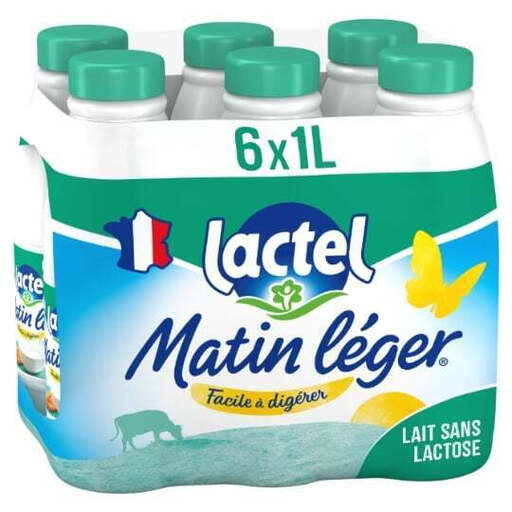 Image unavailable
This pack is a good choice for keeping skimmed milk at home. Treat each 1 L bottle separately when considering how much you’ll use after opening.
A 1 L bottle is better suited to drinking at home than as a small portion to take with you. Carrefour lists Lactel Matin Léger skimmed lactose-free milk in a pack of 6 × 50 cL. Check whether this bottle size suits your needs, and don’t confuse a smaller size with the need for lactose-free milk.
Keep opened UHT milk in the fridge and follow the storage timeframe on the packaging. The IPLC gives a guideline of 2 to 5 days in the fridge, depending on the milk. For its organic skimmed milk, Lactel specifies a maximum temperature of 6 °C and says to use it within three days.
No. The “lactose-free” label relates to lactose and doesn’t, by itself, identify the cause of discomfort. France’s National Health Insurance Fund (Assurance Maladie) states that people’s tolerance to lactose varies. If symptoms persist or you’re unsure what’s causing them, ask a healthcare professional for advice.
Check the product name, net quantity, ingredients, nutritional information, date and storage instructions for the product you’ve chosen. For prepacked food sold in France, the DGCCRF notes, among other things, that allergenic ingredients must be highlighted in the ingredients list.