
Livraison le jour même ou le lendemain

Qualité garantie

Débloquez vos offres de bienvenue: Livraison GRATUITE | Jusqu'à -80 % | 30 jours d'essai gratuits à JoyPlus
Téléchargez l'application
Fixing canvas to a frame, re-covering a chair seat, or securing upholstery to softwood doesn't always require a power tool. A 3-in-1 multifunctional wall stapler is perfectly adequate for many decorating jobs, furniture repairs and light woodworking – provided you check its compatibility with the staples and materials you plan to use.
However, choosing the right one does require a bit of care. Some listings boast great versatility without specifying the accepted formats, staple lengths or the tool's limitations. Here are the criteria to examine before placing your order.
A manual stapler doesn't accept all consumables. The names Type 140, T50, Type 28, T18, Type 8 or BN18 refer to staples with different shapes and dimensions. When a model is presented as versatile, the compatible references must be clearly stated.
If they aren't, you risk buying refills that won't work or facing repeated jams during use.
A manual staple gun is generally designed for relatively soft materials: fabric, fine canvas, cardboard, light insulation or softwood. Pine and spruce can be suitable depending on their thickness and density. Oak, beech and other hardwoods, on the other hand, often require a more powerful solution.
The adjustment wheel lets you set the driving depth, but it doesn't transform the tool into a stapler suitable for hard materials.
A kit containing 3,000 staples is practical for getting started, but ergonomics matter just as much. A handle that's too stiff to operate can quickly tire your hand during a long upholstery session. Also check for an anti-jam mechanism and how easy it is to reload.
For a fabric stapler or an upholstery stapler, the staple length must match the thickness of the material and the base. Staples that are too short may not hold properly; staples that are too long can go right through the base or spoil the finish.
The ValueMax model featured here accepts three families of consumables:
The shape of the staple also plays a role. U-shaped, D-shaped and T-shaped staples don't give the same result and aren't intended for the same applications.
A wheel on the top lets you adapt the driving force to the density of the material. Start by testing on a scrap piece of fabric and wood, then gradually increase the power if needed.
When repairing furniture, keep the fabric taut without distorting it. For a decorative project, watch the alignment of the fixing points. A steady pressure and the tool head held perfectly flat against the surface will give you a cleaner stapling result.
A metal or alloy steel body provides a rigid structure, which is appreciated during regular use. However, the weight must remain compatible with how you work. A heavy tool may feel more stable, but it can become tiresome to handle when working above shoulder height or over a large area.
After each project, remove any staple residue, check the loading channel and store the tool in a dry place. For safety, keep your fingers away from the staple outlet, stabilise the workpiece and never point the gun at anyone.
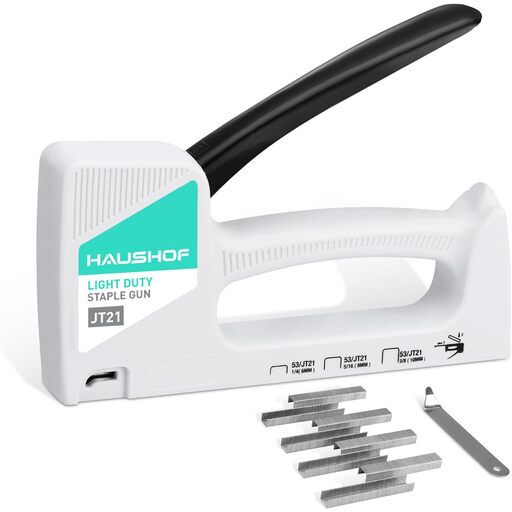
Why this choice suits this profile: This kit is ideal for small household jobs, decorating projects and your first fabric or furniture repairs. It includes 800 staples of 8 mm and a staple remover.
The Type 53 reference and compatible lengths of 6, 8 and 10 mm are clearly stated, reducing the risk of choosing the wrong refills.
Low-effort handle, anti-jam mechanism, quick-opening magazine and staple remover included.
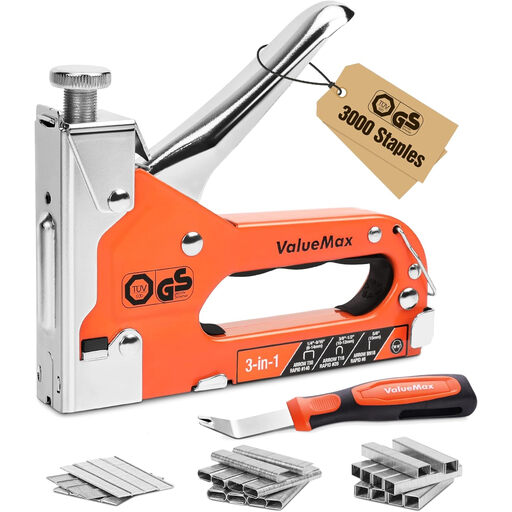
Why this choice suits this profile: Its compatibility with three formats makes it suitable for varied projects in upholstery, decorating, furniture repair and light woodworking.
The references and length ranges are detailed, while the adjustment wheel helps avoid excessive driving depth depending on the base material.
Alloy steel body, power adjustment, hinged magazine and an assortment of 3,000 staples: 1,000 of each type.
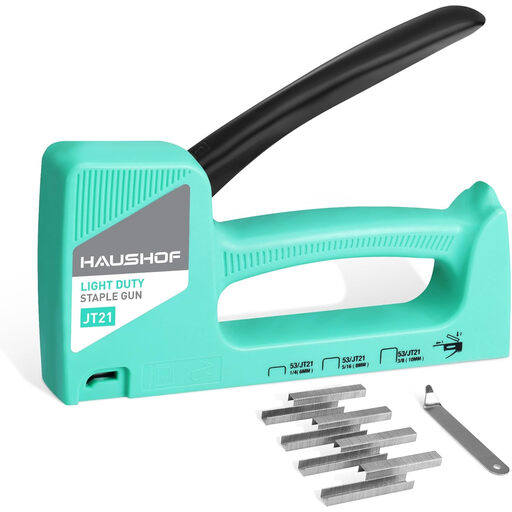
Why this choice suits this profile: This model is designed for repeated work on fabric, upholstery and light decorating where easy-to-find refills are essential.
The quick-release magazine and anti-jam system make long work sessions and frequent reloading much simpler.
Pressure technology designed for easy action, Type 53 compatibility in 6, 8 and 10 mm, 800 staples of 8 mm and staple remover.
We've put together a comprehensive, real-time updated selection of products that meet these selection criteria as well as European safety requirements.
For fixing upholstery fabric or decorative material to pine or spruce, a fabric stapler compatible with Type 53, Type 140 or T50 staples should work. The length depends on the thickness of the fabric and the base. Always test before stapling the entire surface.
This is generally not recommended with models intended for decorating, upholstery and softwood. Hardwood can prevent the staple from penetrating properly, increase the risk of jams and put strain on the mechanism. Always check the usage limits stated on the product page.
The price depends on the format, length and number of staples in the pack. A kit with 3,000 staples helps keep initial costs down, but subsequent refills must be exactly the same reference. Check their shape, length and compatibility before comparing prices.