
Livraison le jour même ou le lendemain

Qualité garantie

Débloquez vos offres de bienvenue: Livraison GRATUITE | Jusqu'à -80 % | 30 jours d'essai gratuits à JoyPlus
Téléchargez l'application
A multifunctional utility knife can be just as handy for opening cardboard boxes as it is for cutting wallpaper, trimming carpet, preparing cables, or tackling various DIY tasks. But not all models are cut out for the same jobs. A folding knife designed for portability won't necessarily replace a professional craft knife, while a kitchen knife has no place on construction materials.
To avoid unpleasant surprises, focus on three key points: the locking mechanism, the blade type, and the actual purpose the tool is intended for.
The term "multifunctional" covers a wide range of very different tools. Some accept standard trapezoidal blades, while others work with 18 mm snap-off segments. A carpet knife with a fixed blade won't necessarily be comfortable for regularly cutting thick boards, PVC, or insulation.
Before placing your order, check:
A blade that slides or folds mid-effort significantly increases the risk of slipping. Whether it's a lockback, a side lock, or a sliding locking system, the mechanism must hold the blade firmly in place during cutting. It should also allow you to retract the blade before slipping the tool into a pocket or a toolbox.
A folding knife with a belt clip can be very practical for an electrician or a decorator. That said, it doesn't replace the need to check the lock before every use.
The mention of an SK5 blade refers to a carbon steel commonly used for craft knife blades. However, on its own, it doesn't tell you how long the blade will last. The geometry of the cutting edge, the heat treatment, the thickness, and how easy it is to replace all play a part.
A blunt blade forces you to press harder and risks veering off course. For a worksite or regular DIY use, a model supplied with several spare blades will often be more practical than a tool whose blade is difficult to replace.
For cardboard, packaging, fabrics, foam boards, or craft projects, an 18 mm snap-off blade knife offers simple adjustment. When the model allows, you just snap off the worn segment using the tool provided.
For carpet, thick cardboard, PVC, or certain renovation materials, a trapezoidal blade will often be more suitable. Look closely at the replacement method: tool-free, with a release button, or by opening the handle. A built-in compartment for storing blades also saves you from carrying a separate box.
A handle that's too short can reduce precision, while a tool that's too bulky quickly becomes awkward in a pocket. For reference, the zenitech electrician's knife measures 10 cm closed and 17.2 cm open. The WORKPRO folding knife with a wooden handle has a folded length of 116 mm and a stated weight of 130 g.
For longer jobs, prioritise:
A construction knife should be kept strictly for the materials it was designed for. The DOBERMAN joint knife, for example, is used to spread and smooth filler, plaster, or mastic. It is not intended for the kitchen or electrical work.
For cables, an electrician's knife can combine stripping, cutting, and slicing functions. However, never use it on a live installation. In the kitchen, choose a kitchen knife or a kitchen knife set explicitly designed for food preparation, then follow the manufacturer's care and washing recommendations.
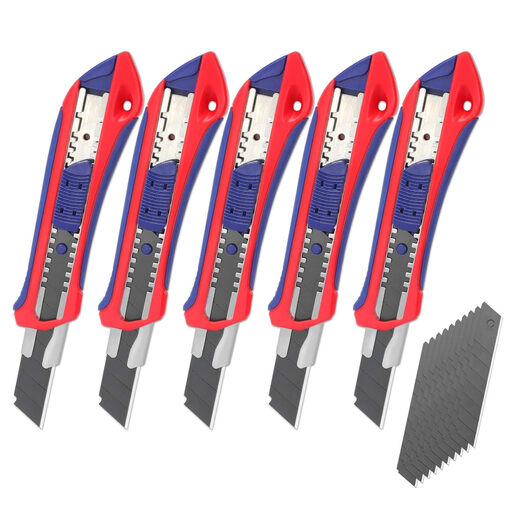
Why this choice suits the profile: with its five cutters and 20 SK5 blades, this kit covers small jobs, opening parcels, craft projects, and everyday DIY around the house.
The snap-off system and supplied blades minimise unexpected replacements. After use, blades must be fully retracted.
18 mm SK5 blades, ABS and TPR handles, 20 spare blades, and a stated length of 160 mm.
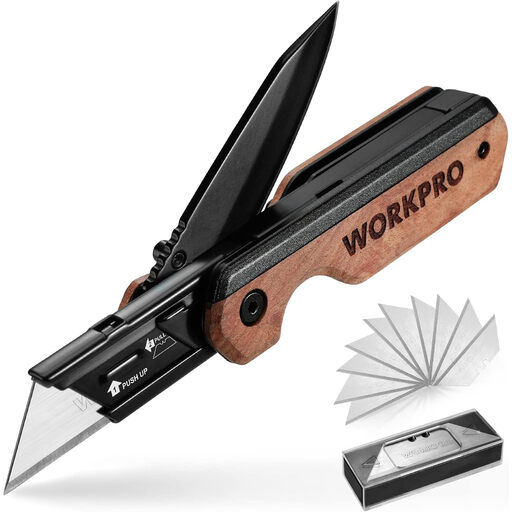
Why this choice suits the profile: its folding format and clip suit tradespeople who regularly switch between standard cutting and tasks requiring an easy-to-carry tool.
The liner lock holds the folding blade in place, while the quick-change mechanism prevents you from continuing to work with a blunt blade.
Two cutting functions, aluminium and wood handle, belt clip, and 10 trapezoidal SK5 blades included.
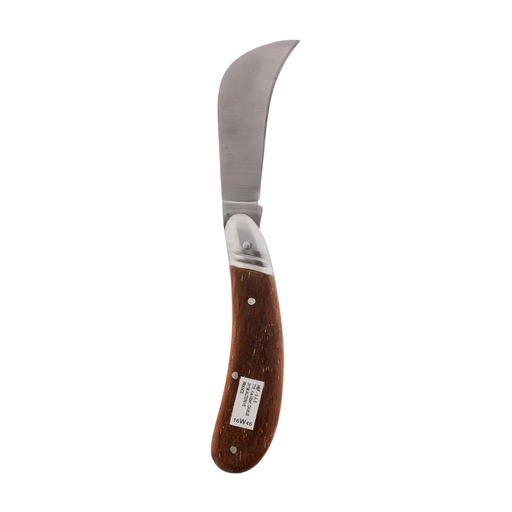
Why this choice suits the profile: its compact size slips easily into a toolbox, and its functions cover cutting and stripping de-energised cables.
Its three functions fit into a folding tool measuring 10 cm when closed. The blade must be locked, and the electrical installation must be de-energised.
Hardened steel, 10 cm closed, 17.2 cm open, stripping, slicing, and cable cutting functions.
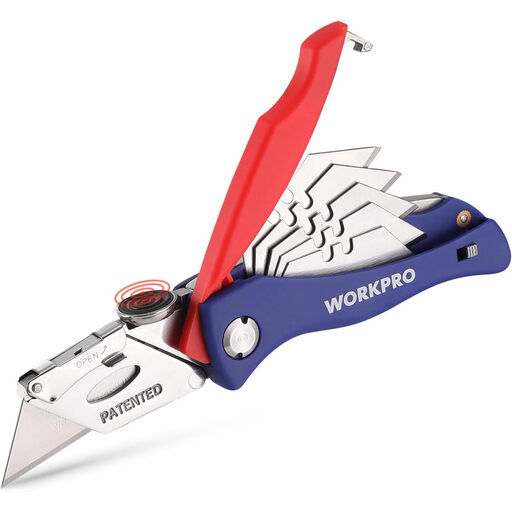
Why this choice suits the profile: it is aimed at fitters, decorators, and DIYers who regularly cut carpet, insulation, PVC, or roofing materials.
The quick-change mechanism and built-in compartment reduce interruptions. Replace the blade as soon as it loses its edge.
Stainless steel and ABS handle, rear lock, belt clip, and five SK5 blades included.
Discover a regularly updated selection of utility knives for DIY, professional work, and everyday needs.
For cardboard, paper, and packaging, an 18 mm snap-off blade is particularly practical. For carpet, PVC, or tougher materials, a replaceable trapezoidal blade generally offers better control. Always check its compatibility with the handle and the stated cutting capacity.
It all depends on the material being cut, the pressure applied, the frequency of use, and the cleanliness of the surface. There is no universal lifespan. Change the blade as soon as it snags, requires unusual effort, or produces an uneven cut.
No. A construction tool or craft knife is designed for cardboard, coverings, plastic, and other technical materials. For food, use a kitchen knife or a dedicated set, maintained according to the manufacturer's recommendations.