
Livraison le jour même ou le lendemain

Qualité garantie

Débloquez vos offres de bienvenue: Livraison GRATUITE | Jusqu'à -80 % | 30 jours d'essai gratuits à JoyPlus
Téléchargez l'application
Can one single pair really work for paper, the kitchen and DIY? Multifunctional scissors are handy, but their versatility doesn't mean they suit every material. A pair designed for snipping herbs won't replace a miter shear for cutting skirting boards. Similarly, school scissors aren't made to tackle thick packaging.
Before you buy, three common pitfalls keep cropping up:
For regular use, stainless steel scissors offer a very real advantage: this material resists moisture and corrosion better than some unprotected steels. In the kitchen, remember to clean and dry the blades after every contact with food.
The blade shape depends directly on the task:
Marketing claims like "ultra-sharp" aren't enough to judge a product. Instead, check the stated material, the scissor length, whether there's a lock, and the materials recommended by the manufacturer.
Length directly affects control and the effort required. School scissors at 13 cm are generally easier for children and users who prioritise precision. A 16 or 17 cm model offers more reach for card, crafts or office tasks.
For food use, look for a wide enough opening and a construction that can handle the pressure applied. Poultry shears and reinforced kitchen models can cut through joints, herbs or certain packaging. However, it's best to stick to the uses explicitly stated on the product page.
Good ergonomic scissors should provide a stable grip without putting excessive pressure on your fingers. Soft rings, a non-slip surface and a symmetrical shape can significantly improve comfort during prolonged use.
For children, choose:
Ambidextrous scissors are practical in a family or classroom, as their design works for both right-handed and left-handed users. However, they don't replace the need for a proper grip or supervision during first use.
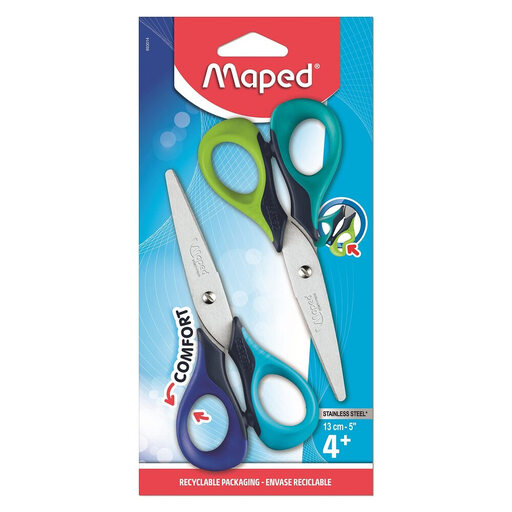
Why this choice suits this profile: This pack of two pairs is ideal for school activities, first cutting practice and home crafts. At 13 cm with an ambidextrous design, these scissors fit small hands, whether right-handed or left-handed.
The soft rings and symmetrical shape reduce the risk of an uncomfortable grip. The blades are intended for paper and card, which prevents wearing them out on materials they aren't designed for.
Two 13 cm pairs, soft rings, stainless steel blades and ambidextrous design.
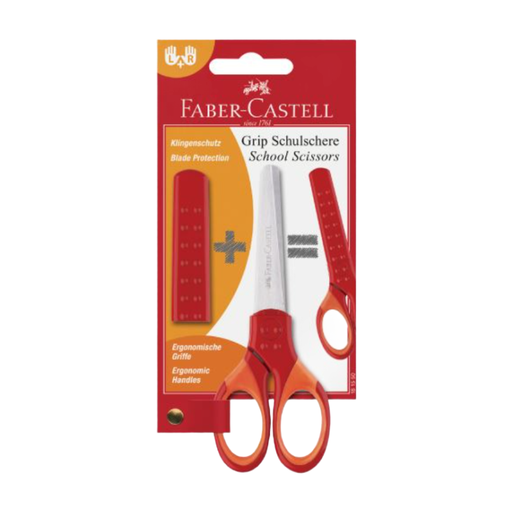
Why this choice suits this profile: This model is aimed at students, office users and craft enthusiasts who want a comfortable pair for regularly cutting paper and thin card.
The two available lengths, 13 or 17 cm, let you choose according to hand size and the reach you need. The rounded tips also provide extra safety for supervised use.
Soft non-slip GRIP handle, stainless steel blades and rounded tips.
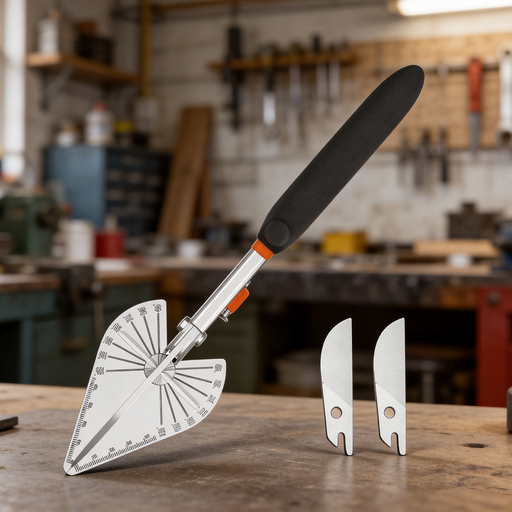
Why this choice suits this profile: This shear is suitable for finishing work, fitting beading, cable trunking, PVC strips and sealant strips. It's aimed at DIYers who need adjustable angles rather than a general-purpose pair.
The scale and adjustment from 45° to 135° make the miter function clearly identifiable. The stated cutting capacity reaches 6.8 cm, depending on the material and configuration.
SK5 steel blade, aluminium alloy handle with non-slip coating and rotating safety lock.
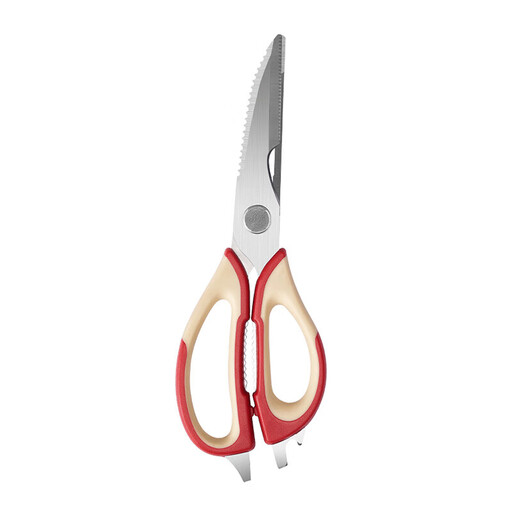
Why this choice suits this profile: These kitchen scissors combine several useful everyday functions: cutting herbs, poultry or certain packaging, and even shellfish, according to the stated features.
The product page details the food-related functions and the stainless steel construction. It's still advisable to clean and dry the blades after each use.
Stainless steel blades, non-slip handle and integrated functions for several kitchen tasks.
For another kitchen option, the Plys 232 mm, SHIBAZIZUO and Zhang Xiaoquan 40Cr13 steel models can be compared based on handle shape, blade opening and stated functions. For school activities, the Maped Sensoft 16 cm model also offers soft rings, stainless steel blades and a symmetrical design.
We've put together a comprehensive, real-time updated list of products that meet these strict selection criteria as well as European safety regulations.
Some models are designed for food use and state functions such as cutting poultry, herbs or cracking shells. Never use school or DIY scissors in the kitchen. After each food-related use, clean the blades according to the manufacturer's instructions, then dry them thoroughly.
A length of 13 cm is generally suitable for children and small hands. For a secondary school student, university student or office use, a 16 to 17 cm model can offer a more comfortable reach. However, the grip and shape of the rings matter just as much as the stated length.
Use each pair for the materials it's intended for, wipe away residue with a soft cloth and store them dry with the blades closed. Avoid cutting metal, thick wire or abrasive materials with scissors designed for paper. For DIY scissors, engage the lock where fitted and wear suitable gloves for tasks that require significant pressure.