
Livraison le jour même ou le lendemain

Qualité garantie

Débloquez vos offres de bienvenue: Livraison GRATUITE | Jusqu'à -80 % | 30 jours d'essai gratuits à JoyPlus
Téléchargez l'application
A multifunctional pull-up bar lets you combine several exercises in a single piece of equipment: pull-ups, dips, leg raises, press-ups and upper-body strengthening. However, not every configuration is suitable for a flat, a beginner or regular use.
Before placing your order, three common pitfalls are worth bearing in mind.
The load capacity is the limit stated by the manufacturer. It is neither a target for use nor a value to exceed, particularly during dynamic movements. A pull-up bar rated for 200 kg may suit different body types, depending on its design. You should also examine the frame material, base width and fixing system.
For a pull-up and dip station, look in particular for:
Load ratings vary from one model to another. For example, the Sportsroyals station states a maximum load of 204 kg, while several Pooboo models indicate a capacity of 480 lb, or approximately 218 kg. Compare these figures carefully: the units and usage recommendations may differ.
An adjustable power tower is more easily suited to several users and allows you to adjust the position for pull-ups, dips or leg raises. Check the height-adjustment range, the equipment’s overall width and the remaining distance from the ceiling.
A no-drill pull-up bar fitted to a door addresses a different need: it avoids drilling into a wall, but depends directly on the strength and dimensions of the door frame. Read the installation conditions carefully and make sure the handles do not obstruct the door closing.
For a free-standing station, leave clear space all around the equipment. Leg movements and lowering from dips require considerably more clearance than a simple vertical pull-up.
Well-designed handles and sufficiently dense padding make workouts more comfortable, but they cannot compensate for an incorrectly tightened installation. A pull-up bar with resistance bands can help you adjust the difficulty or vary your exercises. However, the stated resistance remains a product specification, not a promise of progress.
After assembly, check the bolts, adjustments and feet before every use. Clean the frame with a soft, slightly damp cloth, avoid abrasive products and store the bands away from heat sources. These simple precautions help reduce wear on fitness equipment used at home.
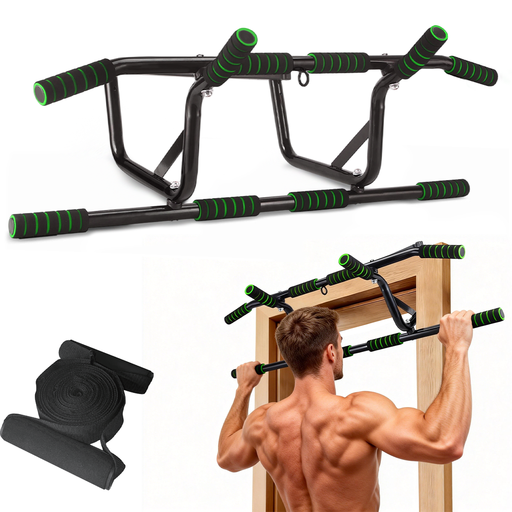
Why this choice suits this profile: This bar attaches to a door without drilling and takes up less space than a free-standing power tower. It may suit someone starting strength training at home who wants to minimise DIY work and the space required.
The no-drill design avoids DIY work, but you must check that the door is compatible and observe the stated 200 kg load limit.
Non-slip handles, included resistance bands and a no-drill design, according to the product details.

Why this choice suits this profile: With its bench, bar with varied grips and dip station, this equipment lets you create a more complete home gym and vary your workouts.
The bench and multiple grips expand the range of exercises, but it is still essential to measure the available space before assembly.
Steel frame, integrated bench, adjustable height and stated capacity of 480 lb.
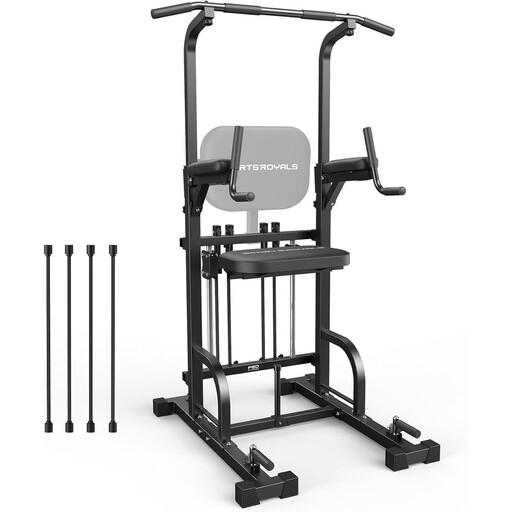
Why this choice suits this profile: This power tower offers six height settings, handles suited to several exercises and an H-shaped base designed for frequent workouts.
The eight non-slip feet and H-shaped base help limit movement, provided the equipment is installed on a perfectly flat floor.
Stated load capacity of 204 kg, adjustment from 164,56 to 221,5 cm and stated resistance bands from 10 to 40 kg.
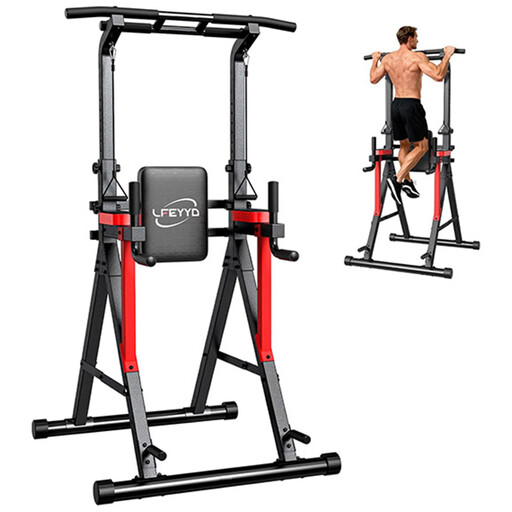
Why this choice suits this profile: Its 13 height settings make it easy for several members of the same household to use. Its free-standing design is suitable for pull-up and dip workouts.
The multi-position adjustment means you are not restricted to a single height, but every lock must be checked before starting a set.
13 height settings, foam handles and a stated maximum load of 480 lb.
We have put together a complete, real-time updated list of products that fully meet these strict selection criteria and European safety regulations.
With a no-drill pull-up bar, inspect the door frame, contact points and instructions before installation. Do not use any fragile or damaged support. For home power towers, ask for help with assembly if the equipment’s weight or height makes it necessary, then gradually tighten all fixings.
Start with slow, controlled movements and do not swing. Beginners can use an assistance band when one is supplied with the model. During assembly and use, keep children and pets away, in accordance with the warnings provided with the equipment.
Yes, provided certain conditions are met. A no-drill door model generally takes up less space, but it must be compatible with the frame. A free-standing pull-up bar requires a stable floor and sufficient ceiling height. Measure the room, door and ceiling before ordering.
Its lifespan depends on how often it is used, the load applied, the quality of the assembly and maintenance. Never exceed the stated capacity. Regularly inspect the bolts, visible welds, handles, bands and non-slip feet. Any deformed or cracked part must be replaced before you resume training.
Bands can support assisted pull-ups, warm-ups or certain strengthening exercises. They are not essential for making progress. Check their stated resistance, attachment system and condition before every workout to choose equipment suited to your level and programme.