
Livraison le jour même ou le lendemain

Qualité garantie

Débloquez vos offres de bienvenue: Livraison GRATUITE | Jusqu'à -80 % | 30 jours d'essai gratuits à JoyPlus
Téléchargez l'application
Installing a multifunctional power tower at home lets you combine several exercises in one piece of equipment: pull-ups, dips, leg raises, press-ups and upper-body strengthening. However, not all power towers meet the same requirements. A structure that is too tall may be unusable in a flat, while a base that is too narrow could move during exercise.
Before placing your order, three common pitfalls are worth avoiding:
Whether you are looking at a power tower, a freestanding pull-up bar or a dip station, stability depends as much on the base design as on the materials used. A steel or steel-alloy frame is a useful initial indicator, but you should also check:
A freestanding tower should not be placed on a very thick carpet or an uneven floor. In some cases, additional fixing may be appropriate, provided it is recommended in the instructions and compatible with your home.
The stated maximum load does not necessarily correspond to the recommended weight for every exercise. It may include the user’s weight and that of any accessories. Carefully check the different values shown in the product listing.
For guidance, some models in this selection state a capacity of up to 200 or 218 kg, while the Sportsroyals tower specifies a maximum load of 204 kg. These figures should be treated as limits not to exceed, rather than training targets. Beginners should also take dynamic movements into account, as they place greater demands on the structure than simply holding a static position.
A height-adjustable pull-up station can suit several users and make it easier to learn pull-ups. In particular, check:
If the tower comes with a bench, also allow enough room for it to be unfolded. An item that looks compact on paper may take up a considerably larger training area once installed and in use.
The models below are presented based on their stated features: materials, adjustments, accessories, dimensions and advertised capacity. They do not guarantee physical results or safety if the manufacturer’s instructions are not followed.
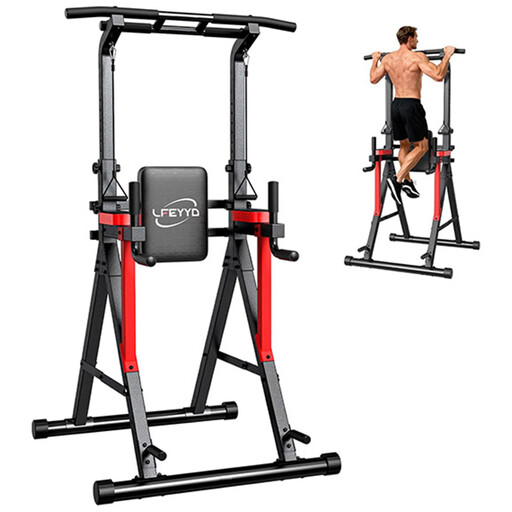
Why this choice suits this profile : its 13 height settings make it possible to adjust the bar and dip station for several users. Its design is intended for strength training and home fitness.
The 13-position adjustment reduces the risk of buying a bar that is too high or poorly suited to the user’s height. The listing also distinguishes between a maximum capacity of 218 kg and a recommended load of 181 kg.
Thirteen adjustment levels, foam-covered handles and a freestanding steel-alloy frame. Assembly is required, along with regular bolt checks.

Why this choice suits this profile : its bench, pull-up bar with climbing grips and dip station are ideal for anyone looking to vary their workouts in a home gym.
This model is more than just a pull-up bar: its bench and various supports let you perform additional exercises. However, check its stated dimensions of 104.1 × 76.2 × 251.5 cm before installation.
Integrated bench, adjustable height, steel frame and a stated capacity of 218 kg. The floor must be level and the tower correctly assembled.
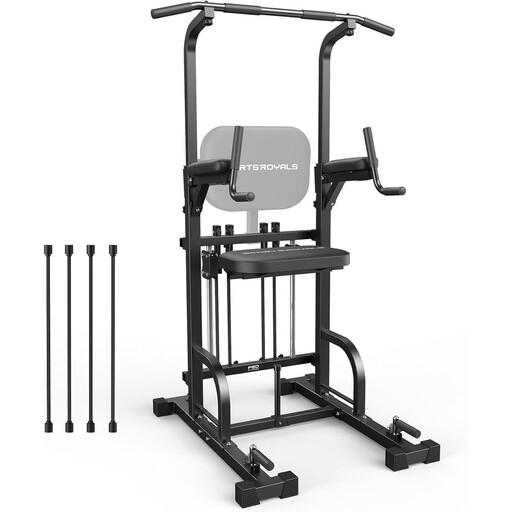
Why this choice suits this profile : its assistance cushion, six height settings and 10 to 40 kg resistance bands may suit regular training with gradual progression.
The listing provides specific measurements: adjustable height from 164.56 to 221.5 cm, a 100.8 cm H-shaped base and eight non-slip rubber feet. These details make it easier to compare the tower with your available space.
Stated maximum load of 204 kg, assistance cushion that converts into a backrest, press-up handles that can be angled at 45 degrees and six height levels.
We have put together a complete, real-time-updated selection of products that meet these strict selection criteria, as well as European safety requirements.
An assisted strength-training station or a multifunctional power cage must be assembled in accordance with its instructions. Before each workout:
Wipe the frame with a soft cloth, either slightly damp or dry, as recommended in the product listing. Avoid abrasive products, particularly on padded handles and painted surfaces. To extend the equipment’s lifespan, regularly inspect visible welds, padding, bands and areas that come into contact with the floor.
Yes, provided you choose an adjustable model and start with exercises you can perform confidently. A tower equipped with an assistance cushion or resistance bands can make your first pull-ups easier. Always check the load limits and progress without swinging or jerking.
Measure the tower’s overall height, then allow enough extra room for your head and full range of movement. Models over 220 cm tall may be difficult to install in some rooms. In a flat, also check the width of doorways and passageways, as well as the space available around the bar.
A freestanding tower does not generally use electricity. Recurring costs mainly relate to the space it occupies, maintenance, the possible replacement of bands or padded components, and the purchase of additional accessories. The overall budget therefore depends more on build quality and the equipment you choose than on energy consumption.