
Livraison le jour même ou le lendemain

Qualité garantie

Débloquez vos offres de bienvenue: Livraison GRATUITE | Jusqu'à -80 % | 30 jours d'essai gratuits à JoyPlus
Téléchargez l'application
A cluttered hallway quickly gives an impression of disarray, especially in a flat or a narrow corridor. A multifunctional hallway unit brings together several uses: coat rack, shoe storage, bench, shelves, mirror or wardrobe. But you need to check what the product actually offers before placing an order.
Some models promise multiple functions on paper, yet end up providing very little usable space. Others turn out to be too deep for a walkway, difficult to stabilise, or delivered without clear information about weight limits. Here are the criteria to examine to avoid ill-suited purchases.
A piece of furniture may have several compartments but still struggle to fit high-top shoes, boots or storage boxes. Check the internal dimensions, the height between shelves and the overall depth. In a small hallway, even a few extra centimetres can noticeably reduce the width of the walkway.
A tall hall stand, loaded with coats and bags, can become unstable if it isn’t properly secured. The presence of an anti-tip device is something to look for, but its effectiveness also depends on the type of wall and the quality of assembly. Tall furniture must be installed according to the instructions, with fixings suitable for your wall surface.
A hallway unit with LED lighting can create a pleasant atmosphere, but this feature doesn’t replace well-thought-out organisation. Examine the type of power supply, the location of the plug, and access to the switch or remote control. Similarly, an open shoe rack makes daily access easier, while a closed model hides items away more effectively.
Measure the available width, maximum depth and ceiling height before browsing different models. For a small hallway, a vertical structure often helps free up floor space. Also consider door swing, the space needed to sit on a bench, and everyday traffic.
A model that is 40 to 45 cm deep can work in some spaces, provided there is enough room to walk past. In a narrow corridor, a wall-mounted or freestanding coat rack may sometimes be more practical than a full wardrobe.
Don’t rely solely on the furniture’s appearance. Check the stated static load for each hook, shelf, rail or bench. A wardrobe with shelves intended to hold coats, for example, needs a rail that is sturdy enough for its intended use.
Structures combining steel and wood-derived panels often offer a good balance between stability and weight. Fabric furniture, such as a spare wardrobe, is easier to move but doesn’t offer the same rigidity as a unit made from panels or metal.
Clear instructions, numbered parts and a complete kit make assembly much simpler. Also check whether the unit needs to be fixed to the wall. In a family with children, avoid placing heavy objects at height and strictly follow the stated weight limits.
A hallway unit with a mirror requires extra care: check how the reflective panel is fixed and avoid impacts during installation. For maintenance, smooth surfaces are generally easier to clean than a textile covering, which can trap dust and fibres.
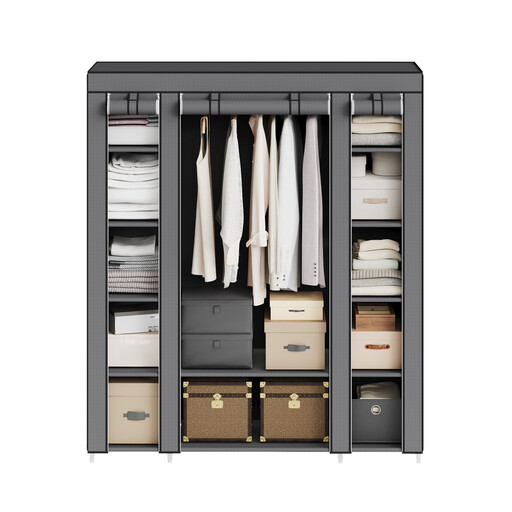
Why this choice suits this profile: This fabric wardrobe is ideal for a first set-up, a bedroom or a secondary hallway that needs plenty of storage without committing to a rigid piece of furniture.
Its stated dimensions of 45 × 150 × 175 cm and 12 compartments let you check the available space precisely before buying, rather than relying on a vague promise of large capacity.
Structure made from 16 mm metal tubes, non-woven cover of 120 g/m², stated load of 5 kg per shelf and 15 kg for the rail.
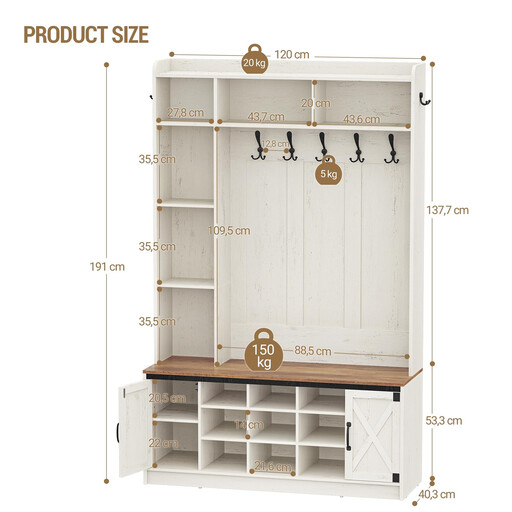
Why this choice suits this profile: This vertical unit combines several functions: bench, hooks, shelves, doors and LED lighting with multiple settings.
The product page specifies the dimensions, materials and maximum bench load, which reaches 150 kg. This information lets you compare the actual footprint with the advertised functions.
15 open compartments, 7 hooks, adjustable shelves and RGB lighting with 25 colours, 6 brightness levels and 3 modes.
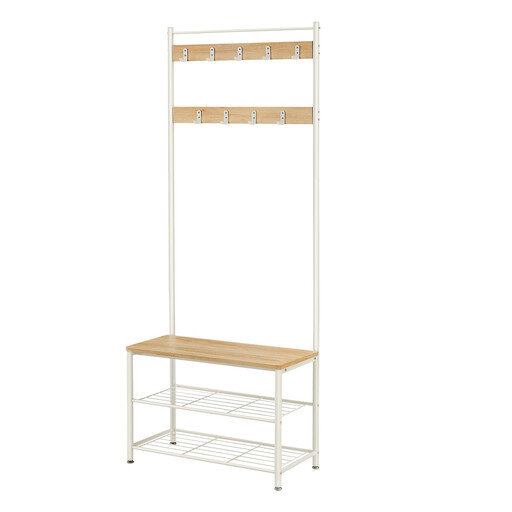
Why this choice suits this profile: With its 70 cm width and combination of hooks, bench and shoe storage, this unit meets the needs of a family or household that uses the hallway every day.
The weight limits are listed separately: 3 kg per hook, 10 kg per wire shelf and 136 kg for the bench. An anti-tip kit is included and must be used.
9 metal hooks arranged in two rows, four adjustable feet, steel frame and wood-derived panels.
We have compiled a comprehensive, real-time list of products that fully meet these demanding selection criteria and European safety regulations.
In a compact space, prioritise a reasonable depth and vertical organisation. A coat rack with a few shelves may be enough if you already have a separate shoe cabinet. To keep the number of items to a minimum, choose a structure that combines hooks, bench and enclosed storage.
Before you finalise your basket, simulate the door opening and measure the distance between the unit and the opposite wall. This check is especially useful in a corridor or a hallway that opens directly into a living area.
Use the kit supplied when available and choose wall plugs suitable for your wall type: concrete, brick, plasterboard or other surface. Do not load the upper sections until you have checked the overall stability. Fixing is particularly important for tall units fitted with a wardrobe rail or shelves.
The depth required depends on the type of shoes being stored. Low shoes take up less space than boots or boxes. Measure your bulkiest items and compare this value to the usable depth, rather than just the stated external dimension.
Consumption depends on the power of the system, how long it is used and the mode selected. A decorative light used occasionally will not have the same impact as continuous operation. Check the electrical information available and plan for a plug socket near the unit to avoid visible extension leads.