
Livraison le jour même ou le lendemain

Qualité garantie

Débloquez vos offres de bienvenue: Livraison GRATUITE | Jusqu'à -80 % | 30 jours d'essai gratuits à JoyPlus
Téléchargez l'application
A multifunction steam cleaner can be used to care for floors, kitchens, windows, upholstery and even your car interior. However, not every appliance marketed as versatile will meet the same needs. Some are designed to loosen dirt from hard surfaces, while others extract dirty water from carpets and sofas.
Before buying, it is therefore better to look beyond the number of accessories or the advertised power. Here are the key criteria to consider when comparing appliances available in France and choosing a solution suited to your home.
A high wattage indicates energy consumption or motor capacity, but it is not enough to assess cleaning quality. For an appliance designed for fabrics, suction power, expressed in kPa, for example, is also very important. This determines how effectively the machine can recover water and residue after cleaning.
A powerful handheld steam cleaner can be useful for grouting or small areas, but it will not necessarily replace an upholstery cleaner with suction and a dirty-water tank.
A window brush, a nozzle for awkward corners or several attachments can expand an appliance’s capabilities. However, these accessories must actually be suitable for the surfaces in question. Hot steam is not suitable for all fabrics, nor for materials that are sensitive to moisture or certain wood and plastic finishes.
It is better to check the compatible surfaces, steam temperature and instructions in the manual than to focus solely on the number of attachments provided.
A small tank often makes it possible to design a compact appliance, but it may also require frequent refilling. In a large home, when cleaning stairs or several car seats, the length of the cable and hose, as well as the operating time, quickly become decisive factors.
On a model with suction, two separate tanks are particularly practical: clean water does not mix with recovered water. After each use, empty and rinse the dirty-water tank to help prevent odours and deposits.
A 2-in-1 steam mop heats water and releases steam onto surfaces. It is mainly suitable for hard floors, worktops, grouting and, with the appropriate attachment, windows. However, it does not generally collect dirty water in the way a carpet cleaner does.
A spray-extraction appliance, sometimes called an upholstery cleaner, moistens the fabric before extracting water containing dirt. This is the format to prioritise for a steam cleaner for sofas, a steam cleaner for carpets, cushions, stairs or car seats.
Some multifunction appliances combine several modes. In this case, check whether the steam mode genuinely includes suction or whether it simply consists of two separate functions.
Pressure, measured in bars, gives an indication of the force at which steam is produced. The stated temperature gives more of an indication of the heat available at the outlet. These figures should be considered alongside the steam flow rate, often expressed in millilitres per minute.
An adjustable flow rate allows you to switch from light cleaning to tackling more ingrained dirt. On delicate surfaces, always test the appliance first on an inconspicuous area and use the amount of steam recommended by the manufacturer. Steam alone does not guarantee disinfection and must not be presented as a medical treatment.
For regular household use, check in particular:
An appliance with a long cable will be more convenient in a flat or house where sockets are limited. For a car, a sufficiently long hose and a narrow nozzle make it easier to reach seat rails and the spaces between different components.
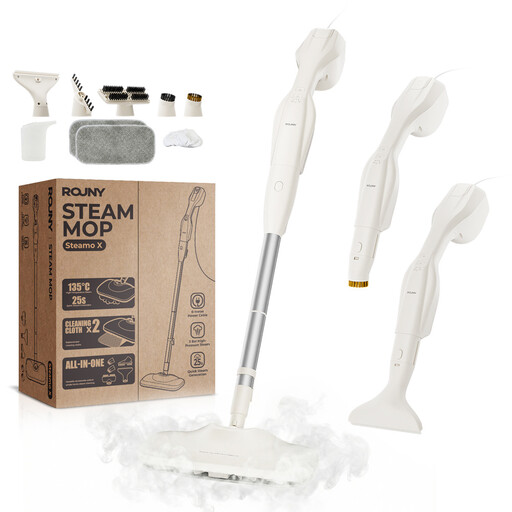
Why this choice suits this profile : This format combines a steam mop and handheld steam cleaner for floors, kitchens, windows, walls and hard-to-reach corners. It is ideal for households looking to get started with a single versatile appliance.
Two steam levels prevent every surface from being treated with the same intensity. The stated heat-up time is around 25 seconds, reducing waiting time for quick tasks.
Advertised power of 1,050 to 1,250 W, 6 m cable, steam pressure of 2.5 to 3 bar and five accessories for floors, windows and kitchen surfaces.
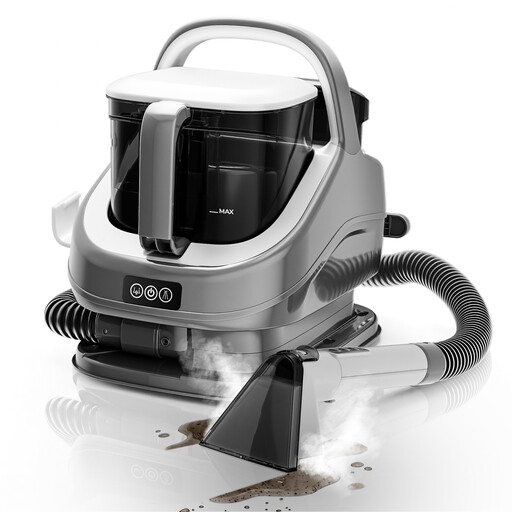
Why this choice suits this profile : This model is aimed at users who want to clean carpets, sofas, stairs, cushions, pet areas and car seats regularly, thanks to its extraction function.
The three modes — cold water, hot water and steam — allow you to adapt cleaning to the situation. The two tanks separate 1,400 ml of clean water from 1,200 ml of dirty water.
1,300 W motor, advertised suction power of 13 kPa, 1.1 m hose and 3 m cable. The manual states that it must not be used on fabrics that are not water-resistant.
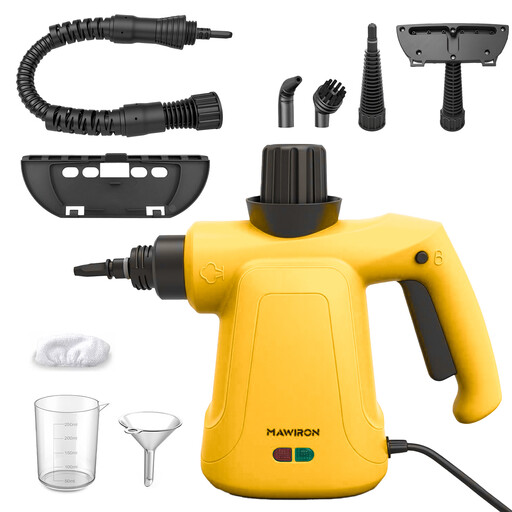
Why this choice suits this profile : Its compact design and accessories are suited to targeted cleaning in the kitchen, car, upholstery and hard-to-reach areas.
The 400 ml tank and nine accessories provide concrete details, rather than making a vague promise of versatility. You should still consult the manual before treating a sensitive surface.
Advertised power of 1,000 W, 400 ml capacity and nine attachments for a range of cleaning tasks around the home.
We have put together a complete, real-time updated list of products that fully meet these strict selection criteria and European safety regulations.
Before you begin, vacuum up dust and test the appliance on an inconspicuous area. On a sofa or carpet, check the care label and avoid soaking the fabric. In a car, protect electrical components and allow the seats to dry in a properly ventilated space.
For the kitchen and windows, use the appropriate brush or squeegee, and never direct steam towards a socket, electrical appliance or person. After each session, unplug the appliance, allow it to cool, empty the tank and rinse the removable parts according to the manufacturer’s instructions.
Not always. A standard steam appliance is mainly intended for hard surfaces and certain compatible fabrics. For a sofa or carpet, look instead for a model with spray extraction, as well as a nozzle designed for fabrics. Always check that the upholstery is moisture-resistant.
Unless the manual states otherwise, use clean water and follow the minimum and maximum markers. In areas with very hard water, consult the manufacturer’s recommendations for maintaining the system. Never add detergent or essential oil unless this is expressly permitted.
The cost mainly depends on the appliance’s power, heat-up time and duration of use. A 1,000 W appliance used for 30 minutes consumes around 0.5 kWh. You may also need to factor in the cost of replacing cloths, filters or maintenance parts. Steam can reduce the need for certain household cleaning products, but it does not remove the need to adapt your cleaning method to each surface.