
Same-day & Next-day Delivery

Quality Guaranteed

Unlock Your Welcome Offers: FREE Delivery | Up to 80% OFF | Free 30-day JoyPlus trial
Download the APP
A multifunction pliers set can quickly become a disappointing purchase if all the pliers look alike, their dimensions do not match your projects, or the manufacturer is vague about their cutting capacity. Whether you are a DIY enthusiast, mechanic, plumber or electrician, versatility does not mean that every tool is suitable for every task.
Before comparing a professional pliers set, start by identifying your needs. Tightening a pipe fitting, cutting a cable, removing a circlip, pulling out a nail or taking off an oil filter does not require the same jaw design.
A 10- or 20-piece case may seem particularly appealing, but some pliers may duplicate one another. Conversely, a more compact set may omit long-nose pliers, diagonal cutters or a specialised tool.
The right approach is to check the function of every item:
Product listings sometimes use vague phrases such as “high strength” or “heavy duty”. These claims are not enough to distinguish between two tools. Instead, look at the steel type, pliers length, maximum jaw opening and cutting capacity.
A 180 mm pair of tongue-and-groove pliers and a 305 mm model will not perform in the same way. The latter generally provides a wider opening, but it also takes up more space and may be less manoeuvrable in confined areas.
Pliers for nylon hose clamps may be suitable for flexible hoses, but not for rigid, reinforced or high-pressure lines. Similarly, diagonal cutters designed for 2 mm wire should not be used to cut a harder or larger-diameter cable.
Always observe the stated capacity, wear safety glasses when cutting and never use standard pliers on a live electrical circuit.
Chrome vanadium steel, forged carbon steel and chrome-molybdenum steel may each be suited to different applications. Heat treatment generally strengthens the areas subject to the greatest stress, while a nickel-plated, black-oxide or corrosion-resistant finish makes storage in a workshop or garage easier.
This does not eliminate the need for basic maintenance: wipe the jaws after every use, remove any moisture and occasionally apply a thin layer of oil to the pivot.
The stated specifications should match your intended use:
For plumbing tools, also check the maximum opening and tooth profile. For automotive repairs, compatibility with the diameter of filters, hoses or rings is decisive.
Non-slip handles help prevent slippage, but they cannot compensate for incorrectly sized pliers. A quick-adjustment mechanism can also make it easier to move between different fittings. Finally, a case or pouch helps keep the bits and smaller pliers together.
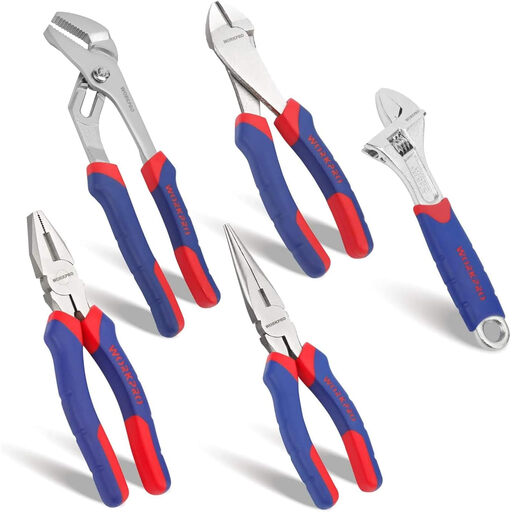
Why this choice suits this profile: five tools cover common DIY, plumbing, electrical and household maintenance tasks.
The contents are clearly detailed: 250 mm tongue-and-groove pliers, combination pliers, diagonal cutters, long-nose pliers and an adjustable wrench.
Treated alloy steel, TPR and PP handles, serrated jaws and hardened cutting edges, according to the product listing.
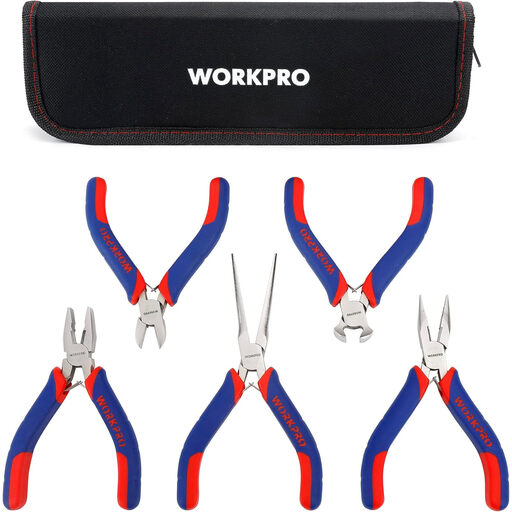
Why this choice suits this profile: this set is designed for precision work, electronics, jewellery making and small assemblies requiring several jaw shapes.
The product listing specifies the five included shapes and advises against cutting materials beyond the stated capacity.
Jaws rated at HRC 55–65, Ni-Fe coating and a 600D nylon storage pouch.
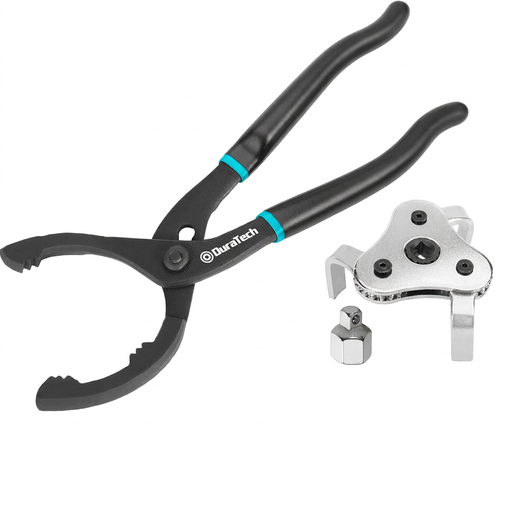
Why this choice suits this profile: a dedicated solution for car and motorcycle maintenance, designed to remove stubborn oil filters.
The compatible diameter is clearly stated: the three-jaw adjustable wrench fits filters measuring 63 to 103 mm.
The set includes 300 mm pliers and a three-jaw wrench made from treated steel, compatible with a 3/8- or 1/2-inch adapter according to the product listing.
We have brought together an updated selection of products suited to a range of DIY, plumbing, electrical and maintenance needs.
For automotive repairs, the DURATECH 6-Piece Hose Clamp Pliers Set includes straight and angled models suitable for several flexible hose diameters. The product listing specifies that it is not suitable for rigid or high-pressure lines.
Work involving retaining rings calls instead for the ValueMax 4-Piece Circlip Pliers Set, comprising internal, external, straight and angled models. However, the 1.6 mm tips and stated opening range should be compared with the specifications of the circlip being used.
For electrical work, the WORKPRO 2-in-1 Wire Stripper and Cutter accommodates 10, 12, 14 and 16 AWG gauges according to the product description. Check that these specifications match the cross-section of your conductors before beginning any work.
A set of four to five tools is generally enough for everyday tasks: gripping, cutting, reaching into tight spaces and working on fittings. You can then add a specialised tool based on your projects, such as oil filter pliers or circlip pliers.
Clean the jaws after use, dry the metal components and store the tools in a well-ventilated place. A small amount of oil on the pivot and metal surfaces helps limit oxidation. Never exceed the stated cutting or opening capacities.
No. They are primarily designed to grip and hold parts, whereas a wrench is intended to apply force to a nut or bolt. To avoid marking surfaces, use the tool suited to the shape and material of the part.