
Livraison le jour même ou le lendemain

Qualité garantie

Débloquez vos offres de bienvenue: Livraison GRATUITE | Jusqu'à -80 % | 30 jours d'essai gratuits à JoyPlus
Téléchargez l'application
A multifunction oven can replace several appliances, allowing you to cook a pizza, roast poultry, bake cakes or achieve crispy results with little oil. The key is making sure the advertised functions match the way you plan to use it. A compact model can quickly feel cramped, while an overly powerful built-in oven may offer more than a small household needs.
Before comparing programmes, it is therefore worth starting with the practical constraints of a French kitchen: available space, electrical connection, usable capacity, cleaning and frequency of use.
A display showing 15 or 21 programmes does not guarantee that each one will be useful in everyday life. Instead, check the functions that are genuinely available: fan-assisted cooking, grilling, conventional cooking, defrosting, keeping food warm, hot-air cooking or a rotisserie. Some appliances count several barely different variations as separate modes.
For a family, being able to cook on several levels or prepare a large joint of meat will often be more useful than a long list of automatic menus.
Like an air fryer, a mini oven needs clear space around its air vents. The stated capacity refers to the oven cavity, not the actual space occupied on your worktop. Measure the appliance’s width, depth and height, then add the clearance recommended by the manufacturer.
A 30 L model may be perfectly suitable for a small kitchen, but it will not necessarily fit inside a unit. Conversely, a 60 to 76 L oven will generally require dedicated installation or a suitably sized housing when built in.
A hot-air oven or air fryer can reduce the amount of added oil, but the result depends on the quantity of food, its moisture content and how the air circulates. An overfilled basket or cavity will circulate air less effectively and may extend cooking times. Manufacturers’ stated percentages should therefore be treated as indications obtained under their own test conditions, not as a guarantee for every recipe.
Capacity is not everything: also check the number of shelf positions, the dimensions of the trays and whether they are compatible with the dishes you usually use.
Measured in watts, power affects preheating times and the load placed on the electrical circuit. The models featured range from 1 500 W to 3 650 W. An 1 800 W appliance can be practical on a worktop, while a built-in oven rated at 2 950 W or more must be installed in accordance with the manufacturer’s electrical recommendations.
Plug the appliance into an earthed wall socket and avoid extension leads or low-quality multi-plug adaptors, particularly with a powerful air fryer. For a mobile kitchen such as the AWOOM trolley, the single power cable simplifies installation, but the rated power of 2 000 W still needs to be taken into account.
A self-cleaning oven may use catalytic cleaning, steam or pyrolytic cleaning. None of these systems completely eliminates the need for maintenance: accessories, the glass door and heavy soiling must still be cleaned in accordance with the instructions. Catalytic cleaning uses microporous walls, while pyrolytic cleaning heats the cavity to a very high temperature to reduce residue to ash.
For safety, look for a double- or triple-glazed door, an insulated handle, automatic shut-off, a child lock and stable feet. For an A+ rated oven, check the energy label as well as consumption in conventional mode and fan-assisted mode. The energy rating alone is not enough to calculate your bill: how often you use the oven and how long you cook for remain decisive factors.
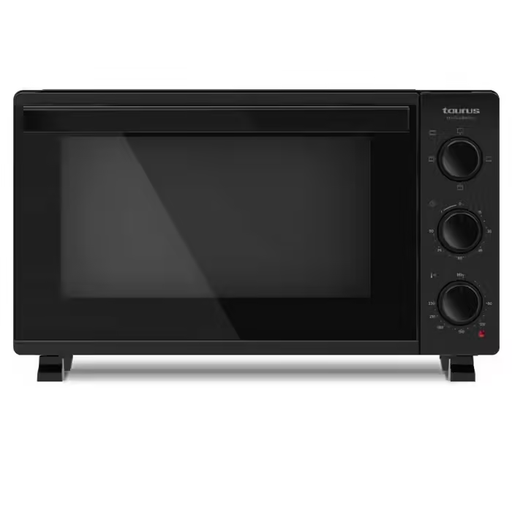
Why this choice suits this profile: With its 23 L capacity and mechanical controls, it is ideal as a first worktop oven, with no complicated menus or screens to get used to.
The three heating modes, 40 to 230 °C thermostat and 90-minute timer are clearly defined, without a multitude of almost identical programmes.
23 L capacity, 1 500 W power, double-glazed door, interior light and baking tray included.
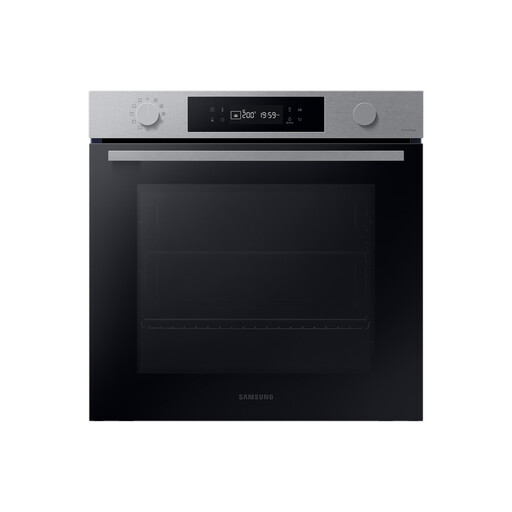
Why this choice suits this profile: This built-in oven is designed for fitted kitchens and for people who regularly prepare large dishes or several recipes at once.
Its 76 L capacity, 20 programmes and catalytic cleaning with steam provide genuinely useful functions rather than simply accumulating modes.
A+ rating, stated consumption of 0,71 kWh in fan-assisted mode, LED display and Wi-Fi connectivity.
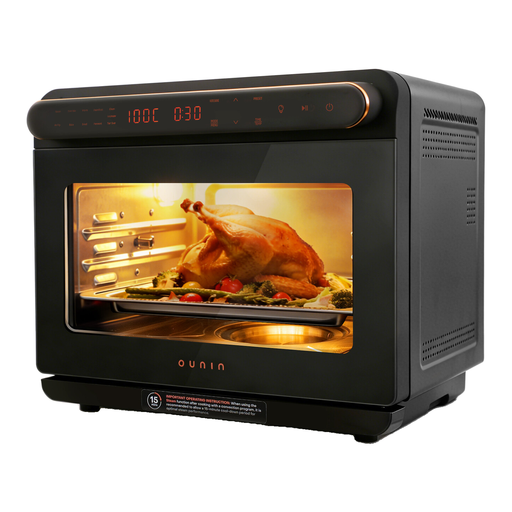
Why this choice suits this profile: Home cooks who switch between bread, vegetables, roasts, dehydrating and crispy cooking get genuinely targeted functions here.
The steam function uses a removable 1 L water tank and an assisted cleaning mode, making it easier to incorporate into your daily routine.
304 stainless steel interior, 24 L capacity, steam, air fryer, dehydrating and rotisserie functions, with seven accessories.
We have put together a complete, real-time updated list of products that meet these demanding selection criteria and European safety standards.
In a small kitchen, a 23 to 30 L electric oven or a 4 to 6,5 L air fryer can help keep the footprint down. Models with a viewing window, timer and mechanical controls are particularly easy to use.
For a household of several people, a 30 L or larger hot-air oven offers greater flexibility. A rotisserie, several cooking levels and a pizza-compatible tray may prove far more useful than a programme you rarely use.
If you are renovating your kitchen, a 71 to 76 L built-in oven will generally fit into a standard housing, although this should be confirmed in the installation instructions. Cleaning functions, the energy rating, door safety and after-sales service availability should also be factored into the total cost.
It can replace a small toaster oven for cooking chips, vegetables, chicken wings or individual portions, as well as reheating certain foods. Its more compact cavity heats up quickly, but it is less suitable for a large dish, a sizeable bake or cooking on several levels.
For two people, 4 to 6,5 L may be enough, depending on the portions you prepare. For three or four people, allow around 11 to 30 L if you mainly cook crispy foods or medium-sized dishes. Families preparing large roasts or several dishes at once will benefit from choosing a 45 to 76 L family-sized oven.
The cost depends on the appliance’s power, how long it runs and the tariff set out in your electricity contract. The calculation is simple: power in kW × duration in hours × price per kWh. Also compare the stated consumption in fan-assisted and conventional modes, only preheat when the recipe requires it and avoid running an appliance while empty.