
Livraison le jour même ou le lendemain

Qualité garantie

Débloquez vos offres de bienvenue: Livraison GRATUITE | Jusqu'à -80 % | 30 jours d'essai gratuits à JoyPlus
Téléchargez l'application
A multifunction kitchen appliance can replace several pieces of equipment on your worktop: food processor, blender, electric meat grinder, dough mixer, or even grating and slicing attachments. A real space-saver… at least on paper. Because behind a name like "7-in-1", performance can vary considerably from one use to another.
Before comparing prices, it's best to know how to spot misleading promises and distinguish the features that really matter.
Spec sheets sometimes mix up maximum power, nominal power and stall power. These figures don't measure the same thing. A motor with a high wattage doesn't automatically guarantee even kneading or fast chopping.
To compare two models, check:
A 5 or 6.5 QT bowl may suit a family, but it will take up more space on your worktop and in a cupboard. Conversely, a compact bowl is easier to store, but may require several cycles to prepare a dough or chop a large quantity of food.
Measure the available space, taking into account the height of the tilting head, the blender lid and the accessories you need to store.
A multifunction appliance is only truly practical if its various parts are easy to dismantle. Accessories that are a pain to rinse or hard-to-reach crevices around the blades can quickly put you off using it daily.
In particular, look at:
For making smoothies, soups or sauces, a 600 W multifunction blender can be enough for many households, depending on the ingredients used. For kneading bread dough, whipping cream or mincing meat, the motor design, transmission and stability of the appliance are just as important as the wattage displayed.
A multi-speed dial lets you adapt the operation to each preparation:
The stated capacity doesn't always match the recommended volume for each recipe. A 5 L stainless steel bowl is suitable for family-sized quantities, while a 500 to 800 ml container is better for a small sauce, a purée or baby food.
For a family, choose a bowl that's large enough, but also check the limits for thick doughs. Sticking to the maximum quantity prevents unnecessary strain on the motor.
Stainless steel blades and plates are suitable for food contact when designed for that purpose by the manufacturer. A safety lock, non-slip feet and a dedicated pusher are also real plus points for everyday use.
The contents of the box should above all match your recipes: whisk, beater, dough hook, grating and slicing discs, mincer, sausage filler or blender. An accessory that's included but you'll never use doesn't justify a higher price.
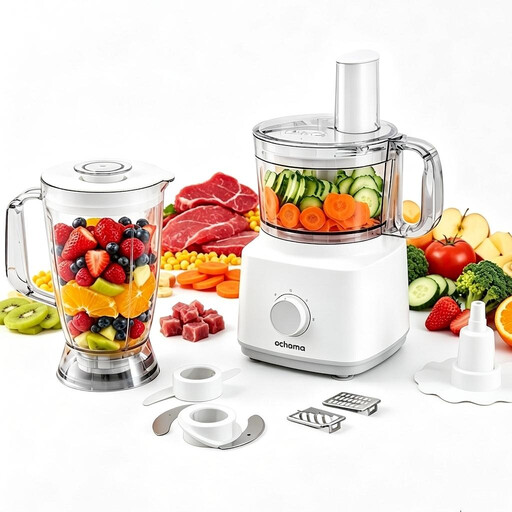
Why this choice suits this profile: With its 1.8 L bowl, this model handles everyday preparations without taking up as much space as a full-size stand mixer. It combines chopping, blending, extracting and grinding.
The removable parts make washing easy, and the 750 W power is clearly stated, without pretending the appliance can handle all intensive tasks back-to-back.
1.8 L bowl, blender, mincer, discs for slicing, grating and chopping, removable parts.
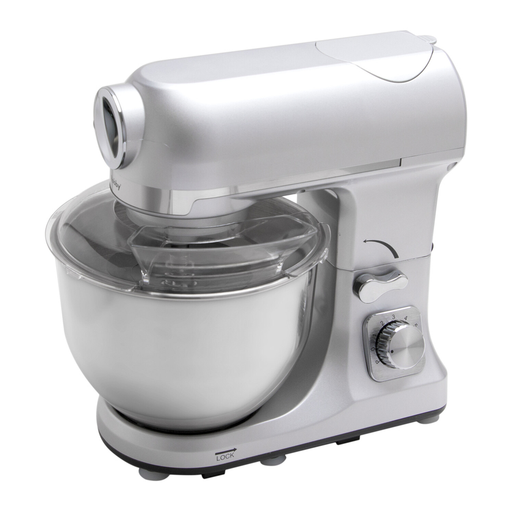
Why this choice suits this profile: Its 5 L stainless steel bowl and six speeds cover the needs of baking, homemade bread and family meals.
The spec sheet details the functions and accessories instead of just listing a number of programmes: dough hook, whisk, mincer, sausage filler and fresh pasta attachments.
1,000 W motor, 5 L bowl, 1.5 L glass blender, six speeds and Pulse function.
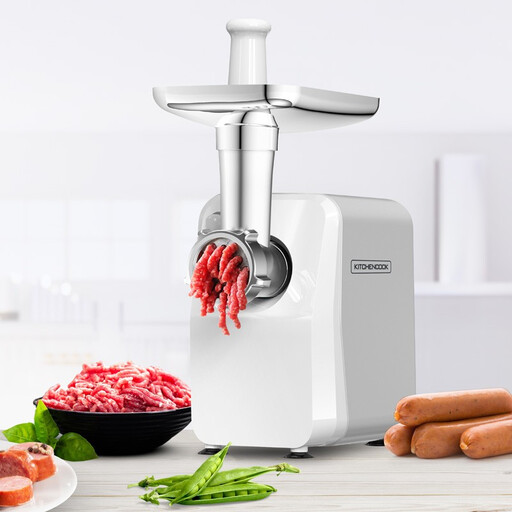
Why this choice suits this profile: This appliance specialises in mincing meat, preparing burgers, sausages and kibbeh, rather than trying to do everything.
The reverse function helps clear the meat if it gets jammed, while the two plates (5 and 7 mm) let you achieve a finer or coarser texture.
Stall power stated up to 1,300 W, stainless steel blades and plates, sausage and kibbeh kits, two-year warranty stated.
We've selected a full, up-to-date range of products that meet these demanding criteria, while complying with European safety regulations.
To make your multifunction appliance last, cut food into suitable pieces and don't exceed the recommended quantities. With a mincer, remove bones and particularly hard parts before feeding them in. Always use the pusher provided: fingers and kitchen utensils have no place in the feed tube.
Unplug the motor block before removing a blade or accessory. Dry the removable parts thoroughly before putting them back in place, and clean the motor with a slightly damp cloth. If the appliance heats up, take breaks between cycles: this precaution reduces strain on the motor.
A multifunction blender or a stick blender will do the job. For small quantities, a stick blender with its beaker is particularly handy and can be used directly in a saucepan. For making smoothies for the whole family, a 1.5 L container is usually more suitable.
Not always. A multifunction robot fitted with a dough hook can knead and whisk, but you need to check the bowl capacity, the stated power and the maximum permitted quantities. If you bake often or work with thick doughs, a 5 L bowl or larger will generally be more comfortable than a small multifunction mincer.
The consumption depends on the motor power and the duration of use. A 600 W appliance running for ten minutes uses about 0.1 kWh, not counting idle phases and depending on the actual power drawn. To avoid wasting electricity, prepare several portions in a row, stick to the recommended quantities and don't let the motor run unnecessarily.