
Livraison le jour même ou le lendemain

Qualité garantie

Débloquez vos offres de bienvenue: Livraison GRATUITE | Jusqu'à -80 % | 30 jours d'essai gratuits à JoyPlus
Téléchargez l'application
A multifunction kitchen appliance can make meal preparation much easier. But only if its promises actually match your needs. With models claiming to be versatile, fiddly accessories to fit, and theoretical capacities that are hard to put to use, it pays to check a few things before you head to the checkout.
In a typical family kitchen, the choice really comes down to how often you’ll use it, how much space you have, and the recipes you actually cook. A food processor isn’t the same as a stick blender, a stand mixer or a plant-based milk maker.
An appliance that comes with a stack of discs and blades is only worthwhile if those extras are easy to fit, store and clean. An electric chopper with a blender function, vegetable slicer and multifunction grater can replace several tools – provided the advertised functions actually match the way your household cooks.
Make sure you check:
The wattage gives you a rough idea, but it doesn’t tell you how comfortable the appliance will be to use. The bowl capacity, blade design, pulse function and run-time limits matter just as much.
A 200 W mini chopper with a 0.5 L bowl is fine for herbs, garlic, nuts and small portions. You can’t compare it directly with a 750 W machine that has a 1.8 L bowl. For a family, that difference can mean several extra batches.
The blades on a kitchen blender, meat grinder or vegetable slicer stay very sharp after use. A practical appliance should let you take it apart without awkward handling. The motor block, cord and plug must never be immersed.
Before you buy, look for clear information on:
For one or two people, a compact bowl takes up less space and stops you making too much. For a family, a capacity of 1.5 to 1.8 L gives you more room to chop vegetables, make soup or blend a sauce in one go.
A plant-based milk maker around 1 L can handle several servings, while a 5 L stand mixer is far more comfortable with doughs, sweet mixtures and family-sized recipes. Just be sure to follow the fill lines to avoid spills.
Go for bowls that are described as food-safe, and blades made from stainless steel where that information is given. For plastics, labels like BPA-free or “approved for food contact” are a useful clue. They don’t replace reading the manual and the manufacturer’s instructions, though.
Glass bowls – like those on some electric chopper models – resist stains well and let you see what’s inside. They are heavier than plastic bowls, however.
A compact appliance is more likely to be used if it stays out on the worktop. Check its dimensions, weight, cord length and how much space the accessories take up.
The run time deserves your attention too. The KitchenCook MATT POD mini chopper states a maximum continuous use of 15 to 20 seconds, followed by a one-minute rest. The KitchenCook HAND X stick blender has a one-minute limit, with two minutes of cooling between cycles. These instructions must be followed to avoid overheating the motor.
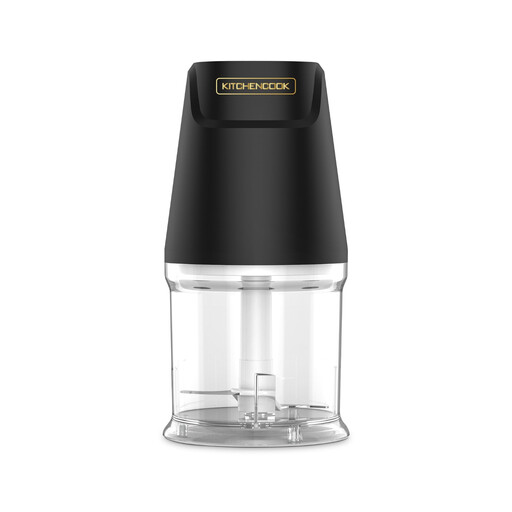
Why this suits this profile: Its 0.5 L bowl and compact size are ideal for small kitchens, single portions, and making apple purée or baby food.
The stated capacity is clearly defined, and the manual specifies the maximum run time and cooling period.
200 W motor, stainless steel blades, BPA-free bowl described as food-safe, and parts that can be washed in water.

Why this suits this profile: Baking fans who regularly make bread, brioche, cakes or pasta get a 5 L bowl and three dedicated attachments.
The functions are based on clearly identified attachments – whisk, dough hook and beater – rather than a vague list of promises.
5 L stainless steel bowl, 10 speeds plus Pulse function, tilt-head design and suction feet.
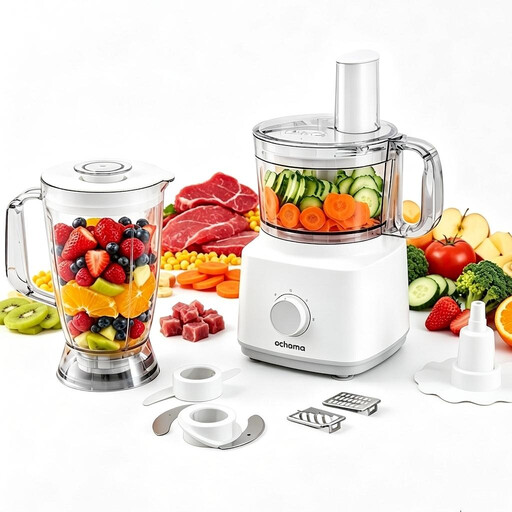
Why this suits this profile: Households that switch between chopping, blending, slicing and grating can combine several tasks in one machine.
The 1.8 L capacity and advertised functions are clearly detailed, and the removable parts make cleaning easy.
Stated power of 750 W, 1.8 L bowl, functions for chopping, blending, grinding, slicing, cutting and grating.
We’ve put together a full, real-time selection of products that meet these demanding criteria and European safety standards.
Depending on the recipes you make, a few targeted tools can be more practical than a bulky appliance:
A specialist tool can therefore complement a multifunction appliance without leading to a pile of unnecessary purchases.
For simple preparations, a power of 200 to 600 W can be enough, depending on the type of appliance. For a food processor intended for larger quantities, a stated power of 750 W gives you more headroom. The bowl capacity and run-time limits are still the deciding factors, though.
Stick to the maximum quantities, run times and cooling breaks given in the manual. Remove food without forcing the blades, dry the parts before storing them, and wipe the motor block with a slightly damp cloth.
The consumption depends on both the wattage and how long you use it. A 600 W appliance used for five minutes uses less than a 400 W model that runs for much longer. Short cycles, the right fill level and well-maintained blades all help to reduce run time.