
Livraison le jour même ou le lendemain

Qualité garantie

Débloquez vos offres de bienvenue: Livraison GRATUITE | Jusqu'à -80 % | 30 jours d'essai gratuits à JoyPlus
Téléchargez l'application
Drying, straightening, curling and adding volume with a single device can simplify your hair routine considerably. But a multifunction hot air brush isn’t just about the number of attachments or the wattage on the spec sheet. Weight, settings, how it feels in the hand and how easy it is to clean all have a direct impact on comfort and styling results.
Before you fall for a 5-in-1 hot air brush, a 7-in-1 hot air brush or a more traditional hair dryer brush, take the time to look at the features that really make a difference.
A device marketed as a “multi-styler for hair” can come with a host of accessories without actually meeting your needs. On fine hair, a volumising brush and a smoothing brush may be more than enough. Thick or curly hair will benefit more from well-designed drying and curling attachments.
The fixing system is also worth a closer look. If the attachments are hard to remove, heat up quickly or don’t lock on properly, the device can become a chore to use every day.
Power, measured in watts, mainly tells you about electricity consumption and the potential for heat or airflow. It doesn’t guarantee faster drying or better results. A hot air brush for all hair types should first and foremost offer several temperature and speed settings to suit fine, thick, wavy or damaged hair.
A cool shot setting can help set your style at the end of a session. That said, it doesn’t mean you can skip limiting exposure to excessive heat.
Terms like “negative ions”, “Coanda effect” or “intelligent temperature control” refer to technologies, not a promise of identical results for everyone. In this context, the Coanda effect is an airflow that draws hair around a cylindrical attachment. Your technique, the size of the sections and how damp they are still play a decisive role.
The CE mark, meanwhile, confirms that the product meets the applicable European safety and compliance requirements. It doesn’t guarantee performance or how long the device will last. Be sure to check the instruction manual, the contact details of the responsible party established in the European Union and the warranty terms.
Aim for at least two speeds and three temperature levels, or clearly marked combinations. For everyday use, start with a moderate temperature on towel-dried hair. Only increase the heat if you really need to.
A hot air smoothing brush or blow-dry brush should let you control the pass over roots as well as lengths. Avoid leaving a section of hair still under the hot airflow: work in small sections, keeping the device constantly moving.
A round or oval brush is good for creating volume. Nylon bristles can help with detangling, while a ceramic coating is designed to distribute heat more evenly across the styling surface. None of these materials, however, eliminates the risks associated with excessive temperature.
For curling, check whether the attachments are designed for both sides of the head. A concentrator nozzle lets you direct the airflow more precisely. As for a diffuser, it can help preserve the shape of wavy or curly hair, provided you follow the instructions in the manual.
A lightweight device reduces arm fatigue during blow-drying – a real advantage on long hair. A 360° swivel cord makes it easier to move around your head. Also check the cable length, how you store the attachments and how easy the filter is to access.
Before cleaning, unplug the device and wait until it is completely cool. The air intakes must stay completely clear. Magnetic or quick-lock attachments can make things easier, but every accessory must stay securely fixed during styling.
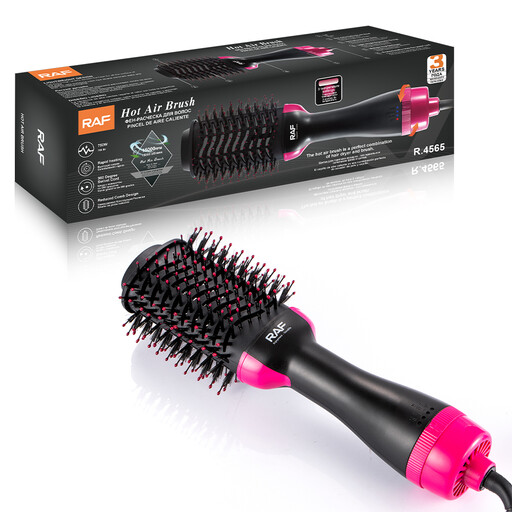
Why this choice suits this profile: With its 750 W, this blow-dry brush focuses on a simple routine: drying and styling hair in one go. Its compact size is handy in a small bathroom or when travelling.
It avoids cluttering your bathroom with multiple devices to achieve a soft blow-dry. The product listing mentions a ceramic coating, nylon bristles and a 360° swivel cord.
750 W, dimensions 33.5 × 7.6 cm, suitable for use on dry or damp hair according to the product description.
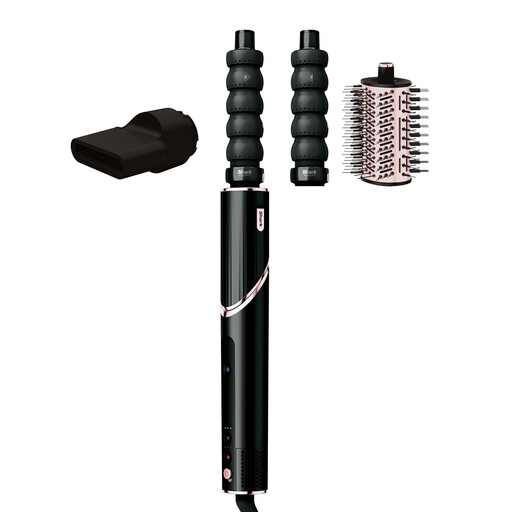
Why this choice suits this profile: This multi-styler for hair combines drying, curling, smoothing and volume in a 700 g device. Its rotating handle lets you switch from hair dryer to styling mode in one motion.
Each use has its own attachment: two Auto-Wrap attachments, an oval brush and a concentrator. The listing also mentions several temperature and speed settings.
Rated power of 1,650 W, weight of 700 g and temperature measurement claimed to occur 1,000 times per second.
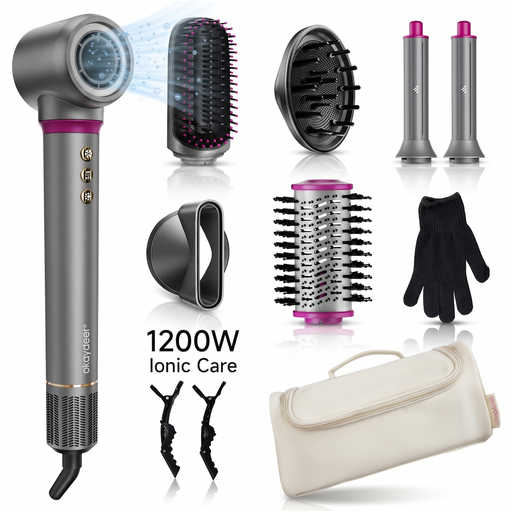
Why this choice suits this profile: This 7-in-1 hot air brush includes two curling attachments, a volumising brush, a smoothing brush, a diffuser, a concentrator and a hair dryer attachment. It suits people who regularly switch between different styles.
The quick-release fixing system and double lock are designed to avoid fiddly changes. The magnetic filter also makes maintenance easier.
The listing states 2 speeds, 3 temperatures, a brushless motor rated at 130,000 rpm and a device weight of 280 g.
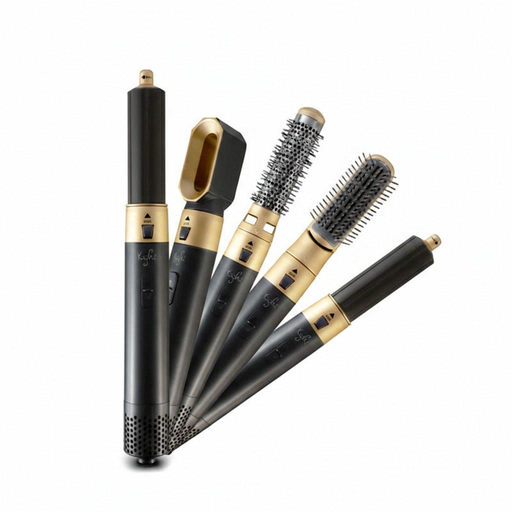
Why this choice suits this profile: With a smoothing brush, a volumising brush, two curling attachments and a concentrator, this model is suitable for versatile use at home or on the go.
The three air and heat levels mean you don’t have to make do with a single setting. The 1.8 m swivel cord and travel pouch are handy for everyday use.
Rated power of 1,000 W, weight of 615 g, handle described as ergonomic and interchangeable accessories.
We’ve put together a full selection, updated in real time, of products that meet these exacting criteria as well as European safety regulations.
Some models come with a concentrator or a removable brush and can therefore handle general drying. If your hair is very wet, a separate hair dryer is still more practical for removing most of the moisture before you move on to styling.
Its lifespan depends on how often you use it, how well you clean the filter, how you store it and the quality of the cable and accessories. Following the manual, avoiding knocks and not blocking the air intakes all help to preserve the device. Also check the warranty period and whether replacement accessories are available.
That depends mainly on its power and how long you use it. A 750 W device used for less time isn’t necessarily more economical than a 1,650 W model. To estimate the cost, multiply the power in kilowatts by the usage time, then by the rate on your electricity bill.