
Livraison le jour même ou le lendemain

Qualité garantie

Débloquez vos offres de bienvenue: Livraison GRATUITE | Jusqu'à -80 % | 30 jours d'essai gratuits à JoyPlus
Téléchargez l'application
Drying, straightening, curling and adding volume with a single device can significantly simplify your hair routine. But not all multifunction hot air brushes are created equal, and they don’t all meet the same needs. Some product listings rely on a long list of attachments without explaining what they actually bring to the table. As for motor speed or the number of ions quoted, these figures alone aren’t enough to judge ease of use.
Before buying a multi-styler for hair, take the time to check the available functions, the temperature settings and compatibility with the UK mains supply.
A 5-in-1 or 7-in-1 hot air brush may bundle several attachments with very similar functions. Check exactly what’s in the box: a drying nozzle, a smoothing brush, a volumising brush and, if you want to curl your hair, two attachments that allow you to reverse the curl direction.
A device marketed as a hair dryer and heated brush doesn’t necessarily include a true automatic air curler. This function relies on a system that wraps the section of hair using the airflow, often with Coanda technology.
A quoted speed of 110,000 or 130,000 rpm alone won’t let you estimate drying time. The result also depends on power, airflow, hair density and the size of the sections you work with.
For everyday use, it’s better to choose a device with multiple temperature and airflow settings. A high-speed hair dryer with few adjustments can be too harsh for fine, coloured or sensitised hair.
A multifunction device can quickly become bulky when there are many attachments that are difficult to store. For travel, a pouch, a 360° swivel cord and an easily accessible filter are real daily bonuses.
Also remember to let the attachments cool down before storing them, clean the filter regularly and never block the air inlets or outlets. Ions, ceramic and Coanda airflow don’t replace these basic precautions.
To choose a styling tool suitable for all hair types, look for at least three temperature levels and two or three air speeds. A cool shot button can also help set your style once drying is complete.
Fine or fragile hair generally needs a moderate temperature and quick passes. Thick or curly hair may require more airflow, but still avoid holding the device in one spot for too long.
A styling brush with interchangeable attachments should let you change accessories easily, without excessive play. Whether it uses clips, a locking mechanism or magnets, the fixing system must hold the attachment firmly during use.
For automatic curling, check for a left and a right attachment if you want curls that are symmetrically oriented. For volume, a round or oval brush is usually more suitable than a simple smoothing brush.
Power, expressed in watts, affects drying capability, but it shouldn’t be looked at in isolation. A device from 1,000 to 1,600 W can suit very different uses depending on the motor design and airflow efficiency.
Weight matters particularly when styling long or thick hair. Also check the voltage, plug type, cord length and whether there’s overheat protection. In the UK, choose a device compatible with the 220–240 V mains and consult the manual and compliance information provided by the seller.
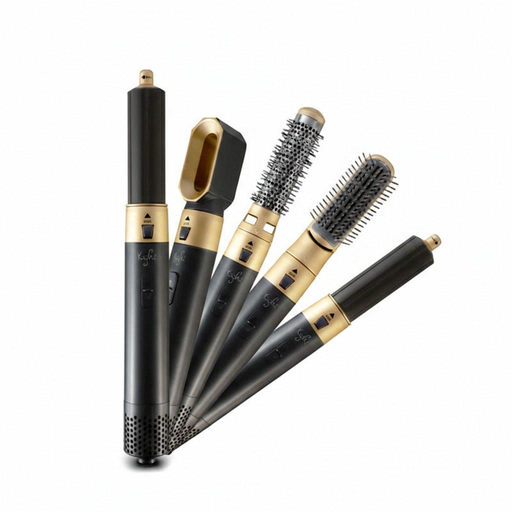
Why this choice suits this profile: Its 5-in-1 format covers the essential needs: drying, straightening, creating volume and two types of curls. With its 1,000 W and quoted weight of 0.615 kg, it can be a good first solution for styling your hair at home.
The functions are clearly divided between five attachments, without multiplying near-identical nozzles. The three air and heat levels mean you don’t have to make do with a single setting.
Interchangeable attachments, 360° swivel cord and travel pouch included.
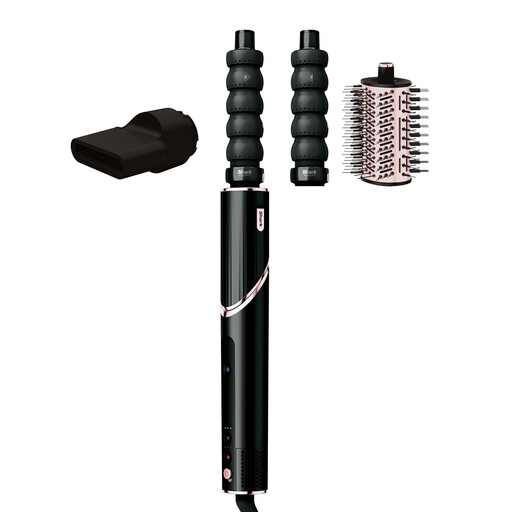
Why this choice suits this profile: This multi-styler keeps the format of a hair dryer while transforming into a styling tool. It includes two Auto-Wrap attachments, an oval brush and a concentrator: a formula designed to limit the number of tools you need to use.
The listing claims heat control with a measurement taken 1,000 times per second. This data tells you about the claimed operation, but doesn’t on its own guarantee identical results on all hair types.
Quoted power of 1,650 W, stated weight of 700 g and adjustable handle.
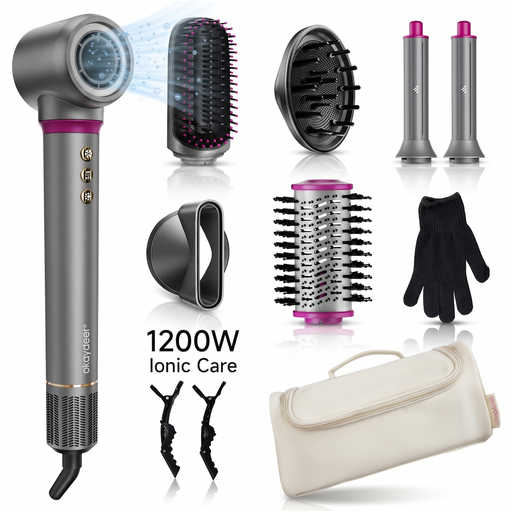
Why this choice suits this profile: Its spec sheet mentions a 130,000 rpm brushless motor, three temperature levels, two speeds and seven attachments. The set is aimed at users who regularly switch between drying, straightening, volume and curls.
The left and right Auto-Wrap attachments meet a real need for curling hair in both directions. The claimed magnetic filter also makes maintenance easier to access.
Claimed Coanda technology, travel case and cool shot setting.
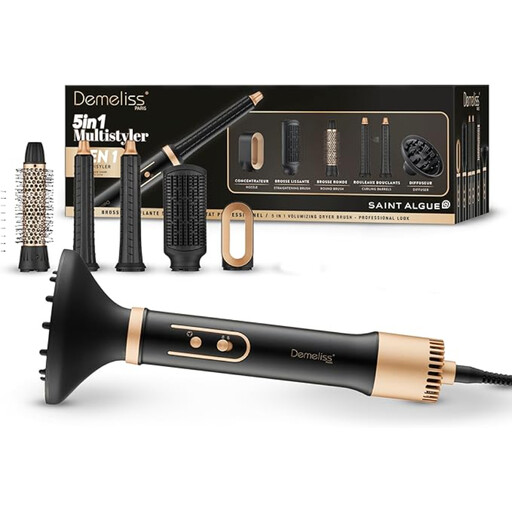
Why this choice suits this profile: Its five attachments cover drying, straightening, creating volume and automatic curling. The separate temperature and airflow settings allow you to adapt it to different hair routines.
The listing specifies the 220–240 V power range, three temperatures, three airflow levels and the cool shot button. These concrete details are more useful than a simple promise of versatility.
Claimed ionic generator, 360° swivel cord and storage pouch.
We’ve put together a complete, real-time updated selection of products that meet these demanding criteria as well as European safety regulations.
It depends on the model. Some devices are designed to dry towel-dried or still-damp hair, while certain heated brushes should only be used on dry hair. Consult the manual and never use a device not intended for it on soaking wet hair.
The lifespan depends on how often you use it, filter maintenance, storage conditions and the condition of the cord. A brushless motor may be presented as more durable by the manufacturer, but its actual longevity varies with use. Switch the device off immediately if it overheats, gives off an unusual smell or makes an abnormal noise.
Consumption mainly depends on the device’s power and how long you use it. As an example, a 1,200 W device used for ten minutes consumes around 0.2 kWh. To limit consumption, towel-dry your hair properly, choose an appropriate power level and avoid leaving the device running when you’re not using it.