
Livraison le jour même ou le lendemain

Qualité garantie

Débloquez vos offres de bienvenue: Livraison GRATUITE | Jusqu'à -80 % | 30 jours d'essai gratuits à JoyPlus
Téléchargez l'application
Lighting is the finishing touch that can transform any room. The multicolor LED strip light has become an essential solution for creating custom ambient lighting. Perfect for enhancing a living room, building an immersive gaming setup, or simply modernising the lighting in a bedroom, its versatility is unmatched. But with an overwhelming number of options on the market, making the right choice can be difficult.
Our guide is here to break down the market and help you find the LED strip that truly fits your needs by examining key technical specifications and practical uses.
Before you buy, let's review the essential points that will make all the difference. A clear understanding of these factors will ensure a hassle-free installation and a result that lives up to your expectations.
It all starts with precisely measuring the area you want to light. LED strips come in various lengths, most commonly between 1 and 10 metres. For a perfect fit, opt for a cuttable LED strip. These models can be trimmed at designated marks (often indicated by a scissor icon), allowing you to perfectly follow the contours of furniture, a headboard, or a cornice.
The control method is a key convenience factor that shouldn't be overlooked.
The acronym RGB (Red, Green, Blue) refers to LEDs capable of producing millions of colours by mixing these three primary hues. It's the core technology of any multicolor LED strip. Some models, known as RGBW, add dedicated white LEDs for a purer, more natural white light. Finally, the LED density (the number of chips per metre) directly impacts the uniformity of the light: the higher the density, the less visible the "dotted" effect will be.
To help you decide, our editors have selected three standout products, each catering to a specific need—from the simplest solution to the most advanced smart home integration.
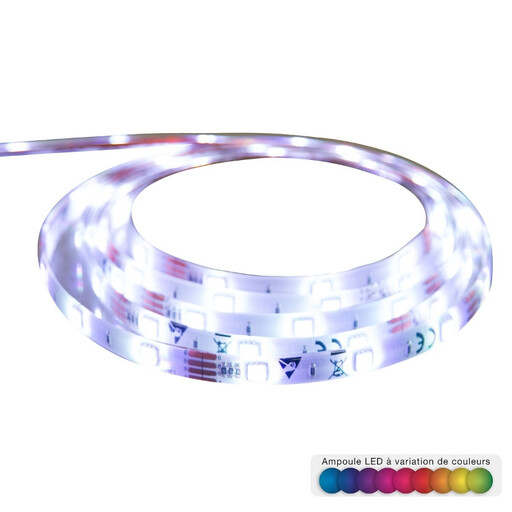
Why we love it: This is the perfect model for getting started with decorative lighting without breaking the bank. It gets straight to the point: a wide range of colours, pre-programmed effects, and an ultra-fast installation.
The pros:
Who is it for? For those looking for an effective and affordable "plug-and-play" ambient lighting solution, without the complexity of smart features. Ideal for a first decorative project with an indoor LED light strip.
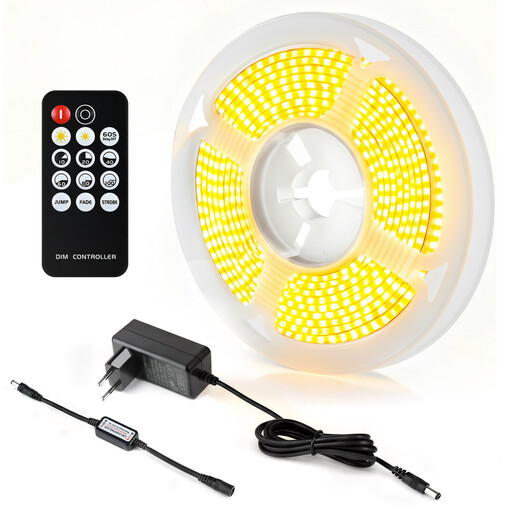
Why we love it: This strip trades multicolor options for impeccable light quality. Thanks to COB (Chip-on-Board) technology, it emits a perfectly continuous line of light, without the "dotted" effect of traditional LEDs. The result is stunning.
The pros:
Who is it for? For purists who prioritise light quality and uniformity over a rainbow of colours. It's the perfect choice for architectural indirect lighting: under shelves, in a bookcase, or to enhance alcoves.
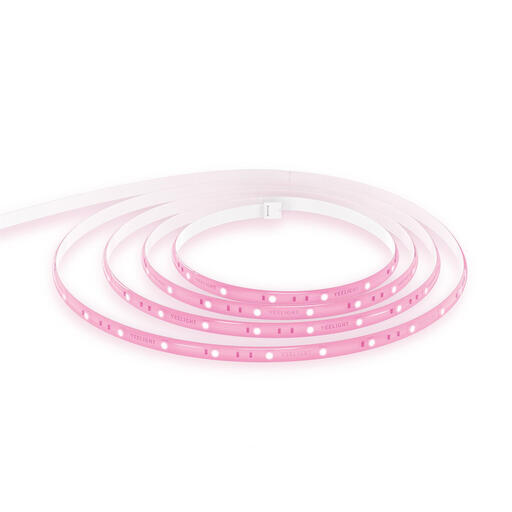
Why we love it: This is the gold standard of smart LED strips. Designed for smart home enthusiasts and gamers, it integrates perfectly into a smart home ecosystem and delivers completely immersive experiences.
The pros:
Who is it for? For tech enthusiasts, demanding gamers, and anyone who wants absolute control over their lighting ambiance with perfect integration into their smart home setup.
LED strips are just one of many ways to customise your home. If our suggestions don't perfectly match your project, or if you're looking for more seasonal lighting, other options are worth exploring.
Take a look at our selection of warm LED Christmas lights and our other lighting solutions to get inspired.
It couldn't be simpler. The surface must be clean, dry, and smooth. Most strips come with an adhesive backing: just peel off the protective film and stick it on. Then, plug the adapter into a socket, connect it to the strip, and you're all set!
Yes, most models allow it. A cuttable LED strip has cutting marks (usually a small scissor icon) every 5 or 10 cm. Warning: you must cut only on these marks to avoid damaging the electrical circuit.
An RGB strip uses spaced-out diodes that mix red, green, and blue to create all colours. Their main drawback is the "dotted" effect, where you can distinguish each individual light source. In contrast, a COB (Chip-on-Board) strip integrates a multitude of micro-LED chips under a uniform layer of phosphor. The result is a perfectly continuous and seamless line of light with no visible dots. COB models are often single-colour (warm or cool white), but their light quality is significantly higher and more professional.