
Livraison le jour même ou le lendemain

Qualité garantie

Débloquez vos offres de bienvenue: Livraison GRATUITE | Jusqu'à -80 % | 30 jours d'essai gratuits à JoyPlus
Téléchargez l'application
The multicolor LED strip has become a must-have for personalising your home's interior. Whether you want to create ambient lighting in the living room, energise a teen's bedroom, or elevate a gaming setup, the solution seems simple and affordable. Yet, disappointment is often just around the corner with products that fail to live up to their promises.
As a product specialist at Joybuy, I'm here to break down the most common pitfalls for you. The goal: to help you make an informed choice without falling for misleading marketing claims.
A tempting price often hides flaws that can render an LED strip unusable after just a few weeks. Here are the red flags you should never, ever ignore.
This is the number one problem, and by far the most frustrating. You've spent time installing your LED strip behind the TV, the result looks flawless, but after just a few days, the strip starts to peel away. The heat from the screen or a slightly porous surface is all it takes to defeat a low-end adhesive. The result: a strip dangling pathetically and a decor project that's back to square one.
What you expect from an LED strip is a continuous, uniform halo of light. However, entry-level models often skimp on the number of LED chips per metre. Instead of a smooth line of light, you end up with a series of very visible dots. This creates a cheap "Christmas light" effect, a far cry from the modern look you were hoping for.
A poor-quality or undersized power adapter isn't just a performance issue: it's a real safety hazard. It can overheat, cause unpleasant flickering, or even fail prematurely. Sometimes, it's simply unable to properly power the entire length of the strip at full brightness. The consequence: washed-out or inaccurate colours at the end of the strip.
To avoid getting tricked, focus on a few key technical specifications. These are the true measures of a product's quality.
This is THE key criterion for a flawless visual result. Density is expressed in the number of LEDs per metre.
Before buying, take out your tape measure and precisely measure the area you want to light. Strips are often sold in standard lengths, like the 5m LED strip. Two crucial points to check:
The classic LED strip with an infrared (IR) remote remains the most common solution. While simple and effective, it requires you to point the remote directly at the receiver. For more flexibility, models controlled by a mobile app (via Bluetooth or Wi-Fi) open up a whole new world of possibilities: a nearly infinite colour palette, complex dynamic modes, and advanced features like music synchronisation.
There's no one-size-fits-all product. The key is to find the one that perfectly matches your use case.
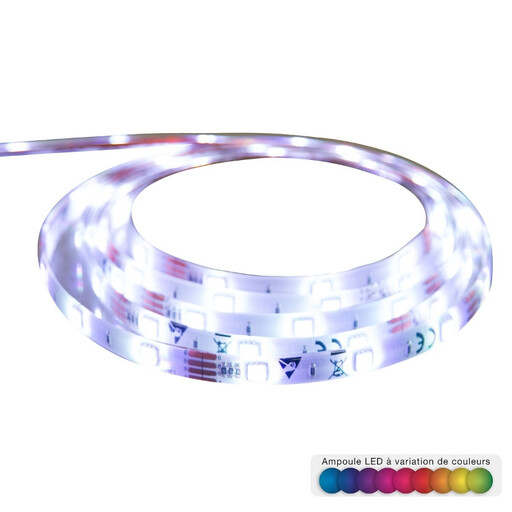
Why we chose it: Perfect for a first project or a defined space like a desk, a headboard, or for creating a string light effect in a bedroom. Its 3-metre length is easy to handle, and the kit is ready to use right out of the box.
Sold as a complete kit (strip, remote, power adapter), it eliminates any risk of choosing an incompatible or underpowered supply.
The simplicity of "plug-and-play." You plug it in, and it works. Control is hassle-free with the included remote.
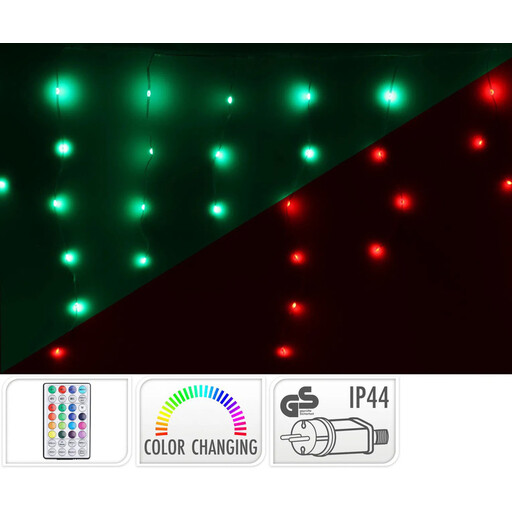
Why we chose it: At 5 metres long, this strip is perfect for backlighting a large TV or highlighting the lines of a bookshelf. It represents an excellent balance between length and performance for the living room.
With 172 LEDs over 5 metres (approx. 34 LEDs/m), its density is higher than entry-level models. This reduces the "hotspot" effect, creating a much more uniform ambient light for the living room.
Its versatile 5m length makes it an all-rounder for the most common projects. Its self-adhesive backing ensures quick installation on any clean, dry surface.
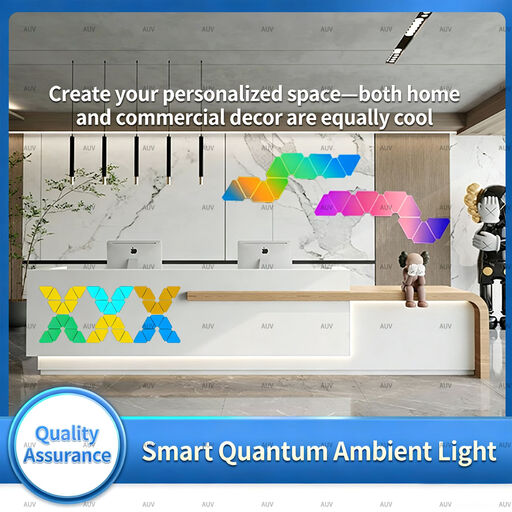
Why we chose it: For those who want to go beyond a simple strip. This modular panel system lets you create unique shapes on your wall, with advanced control via an app and music synchronisation.
This is a complete ecosystem designed for performance. It bypasses the pitfalls of classic strips by focusing on cutting-edge features and an aesthetic tailor-made for gaming *setups*.
Extreme customisation thanks to its modular design, app control (over 210 modes), and music sync for total immersion.
We have selected a full range of products that meet our quality criteria and current safety standards.
Yes, most LED strips can be cut to fit your desired length perfectly. Be careful: it is essential to cut only on the designated markings, which are usually indicated by a line and a scissors icon. Cutting in the wrong place will damage the circuit and render that section unusable.
The lifespan of an LED strip is one of its key strengths. It is generally estimated to be between 20,000 and 50,000 hours, which represents several years of use, even on a daily basis. Of course, this longevity directly depends on the quality of the components (LED chips, printed circuit board) and good heat dissipation.
No, and that's one of the major advantages of LED technology, which is renowned for its energy efficiency. An LED strip consumes far less electricity than traditional lighting (incandescent or halogen) for an equivalent brightness. The exact consumption varies depending on the length, LED density, and chosen intensity, but it remains very modest overall.