
Livraison le jour même ou le lendemain

Qualité garantie

Débloquez vos offres de bienvenue: Livraison GRATUITE | Jusqu'à -80 % | 30 jours d'essai gratuits à JoyPlus
Téléchargez l'application
A multi-surface disinfecting cleaner can make cleaning your home, office, shop or public premises much simpler. But you need to pick a formula that’s right for the job. A ready-to-use spray, professional cream, household degreaser or concentrated solution shouldn’t be chosen just on the basis of its scent or the promises on the packaging.
A multi-purpose cleaner removes visible dirt, grease and residue. A surface disinfectant, on the other hand, must be applied for a specific contact time and according to a precise protocol, both stated on the label. A formula that cleans well isn’t necessarily a biocidal product suitable for every situation.
To disinfect, check the claimed uses, compatible surfaces and any standards mentioned. References such as EN 1276, EN 13697, EN 1650 or EN 14476 correspond to very specific test conditions. They don’t guarantee the product is suitable for all surfaces or all applications if the instructions aren’t followed.
Bleach can meet certain whitening or disinfecting needs, but it isn’t suitable for all materials. Chlorine-based products can attack some metals and require good ventilation. They must never be mixed with a descaler, vinegar, ammonia or any other household product.
In the kitchen, a chlorine-free degreasing cleaner will often be more practical for tackling everyday grease. In the bathroom, a limescale-removing formula will generally be more effective against water marks and soap scum.
A 500 to 800 ml bottle is fine for occasional use or cleaning small areas. In a hotel, cleaning company or restaurant, a professional format of 2 to 5 litres can reduce refills and lower the cost per use. However, you’ll need suitable storage space and must follow the dilution instructions.
Another detail that’s often forgotten: the no-rinse claim doesn’t necessarily apply to surfaces that come into contact with food. In that case, rinsing with drinking water may still be required, in line with the instructions on the label.
Start by identifying the problem you need to tackle:
Always test on a small, inconspicuous area first, especially on painted surfaces, aluminium, marble, treated wood and materials sensitive to acidic or chlorine-based products.
A disinfecting spray is handy for handles, worktops, toilets and small areas. A cream is applied with a damp sponge or cloth. It can be useful for ingrained dirt, as long as you follow the manufacturer’s recommendations to avoid scratching.
Bottles and refills that need diluting are better suited to cleaning large areas. They require precise dosing: a solution that’s too concentrated increases the risk of irritation and leaves more residue, while one that’s too diluted may no longer deliver the expected performance.
Read the hazard pictograms, active substance and safety advice carefully. Hydrogen peroxide, ethanol and chlorine-based agents each come with different precautions. Wear gloves when the product recommends it, ventilate the room and keep the bottle closed and out of reach of children.
A lemon, eucalyptus or pine scent makes the product more pleasant to use, but it isn’t a sign of effectiveness. Similarly, a no-rinse formula should be interpreted according to the surfaces involved and the protocol stated on the label.
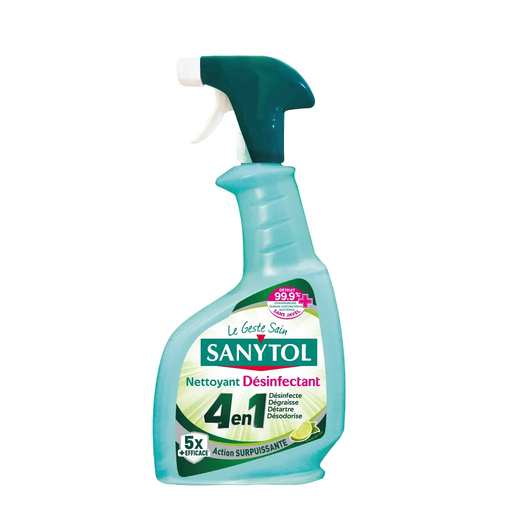
Why this choice suits this profile: Its ready-to-use spray is ideal for anyone who wants to combine everyday cleaning and disinfecting of small areas in a single bottle.
The product description lists four distinct actions: disinfecting, deodorising, grease removal and limescale removal. However, the instructions specify the contact time that must be observed.
500 ml format, foam described as clingy and a formula based on 1.5% hydrogen peroxide. Rinsing depends on the use and the instructions on the label.
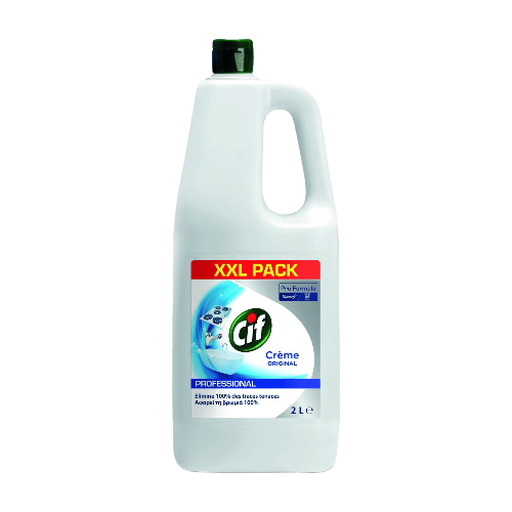
Why this choice suits this profile: With its 2-litre capacity and cream texture, this product is aimed at discerning households and professional spaces that require frequent cleaning.
It isn’t marketed as a universal disinfecting solution – it’s a rinse-off cleaning cream to be used only on compatible surfaces.
Formula described as non-scratch, easy rinse and 2 L format. It’s suitable for stubborn dirt that requires moderate mechanical action.
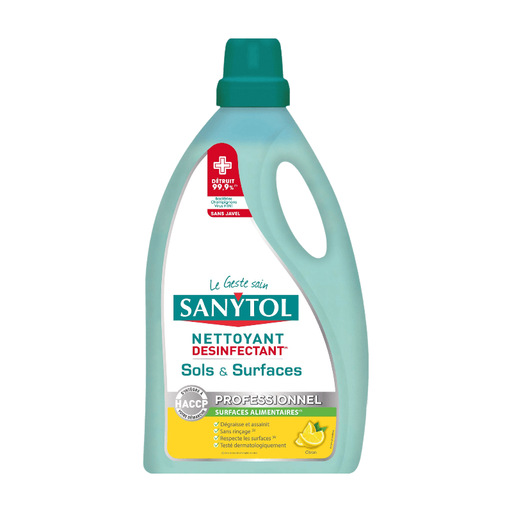
Why this choice suits this profile: Its 5-litre bottle is designed for floors and washable surfaces in offices, shops, hotels and other environments that need repeated cleaning.
Its bleach-free formula is aimed at those looking for an alternative to chlorine-based products. Dilution, contact time and rinsing of food-contact surfaces must strictly follow the label.
5 L capacity, claimed use on floors and surfaces, lemon scent and references to EN 13697, EN 1650 and EN 14476 standards in the product description.
We’ve put together a comprehensive, regularly updated selection of products that meet these demanding criteria, while also taking European safety regulations into account.
Yes, but only if the label explicitly allows these different uses. A multi-surface product may need rinsing on worktops or areas that come into contact with food. As for delicate surfaces, it’s always best to test on a small, inconspicuous area first.
It depends on how often you use it, the yield and the packaging. A ready-to-use spray reduces handling, while a concentrated bottle can be more cost-effective for large areas. To compare properly, look at the price per use rather than just the price of the bottle.
The shelf life varies depending on the formula and the date on the packaging. Store the product in its original container, tightly closed, away from heat and light. Don’t use a diluted solution beyond the time stated in the instructions, and never mix different products.