
Livraison le jour même ou le lendemain

Qualité garantie

Débloquez vos offres de bienvenue: Livraison GRATUITE | Jusqu'à -80 % | 30 jours d'essai gratuits à JoyPlus
Téléchargez l'application
Drying, straightening, curling and adding volume with a single appliance can simplify your beauty routine. But a multi-styler hair dryer brush should not be chosen solely based on the number of attachments or the motor speed. Whether your hair is fine, thick, wavy, curly or prone to frizz, certain technical features have a direct impact on ease of use and results.
Before placing your order, it is worth keeping three common pitfalls in mind.
A motor boasting an impressive number of revolutions per minute does not, by itself, guarantee effective, suitable drying. Also look at the airflow, the number of speed settings, the available temperatures and whether you can maintain a reasonable distance between the appliance and your hair.
A 5-in-1 hair dryer can be highly practical, but it will not necessarily replace a specialised appliance for every use. The attachments should be different enough to be genuinely useful for drying, straightening, curling or creating volume.
Terms such as ‘ionic’, ‘ceramic’ and ‘Coanda effect’ describe a technology, not a guarantee of results for every hair type. Excessive heat, prolonged use or several passes over the same section can weaken the hair fibre.
For fast styling while helping to minimise damage, choose an appliance with several temperature settings, a cool-air mode or thermal control. You will then need to adjust the settings to suit your hair type and condition.
An appliance ordered online may be supplied with a plug that is not directly compatible with French sockets. Check the voltage, the type of plug supplied, whether instructions are available in French when necessary, as well as the contact details of the responsible person established in the European Union and the safety instructions.
The filter also deserves your attention. When it becomes clogged, the airflow decreases and the risk of overheating increases. A removable or magnetic filter makes regular cleaning much easier.
A good drying brush should offer several combinations of heat and airflow. Fine or weakened hair generally copes better with a moderate temperature, while thick hair may require more time or a stronger airflow.
Blow-drying appliances are generally used on towel-dried or slightly damp hair, depending on the manufacturer’s instructions. Traditional heated brushes, on the other hand, are often designed for dry hair. This difference is essential for avoiding incorrect use.
A multi-function styling appliance is only worthwhile if its attachments genuinely match your routine. In particular, check for:
Weight, cord length and the ability to control everything with one hand also matter. A handle that is too heavy can quickly become tiring during a full drying session, especially with thick or long hair.
A professional high-speed hair dryer can reduce drying time, but the stated figures should be treated with a little caution. Compare the information that is actually available: power in watts, motor speed, airflow, number of settings and overheating protection.
For use in France, also check the product listing, the type of plug supplied and the warranty terms. These details are often more informative than a simple promise of salon-like results.
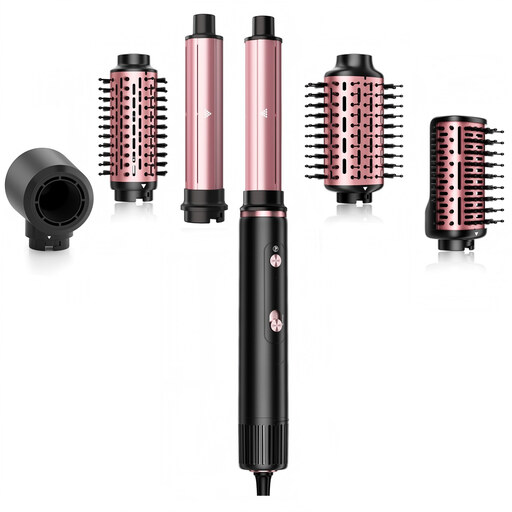
Why this model suits this profile: Its five functions cover drying, curling, straightening, volume and styling. A sensible choice for anyone buying their first versatile appliance for home use.
Its three temperature settings and three airflow settings mean you do not have to rely on a single setting that could be too hot for some hair types.
Brushless motor rated at 110 000 rpm, nine settings and a 360° swivel cord.
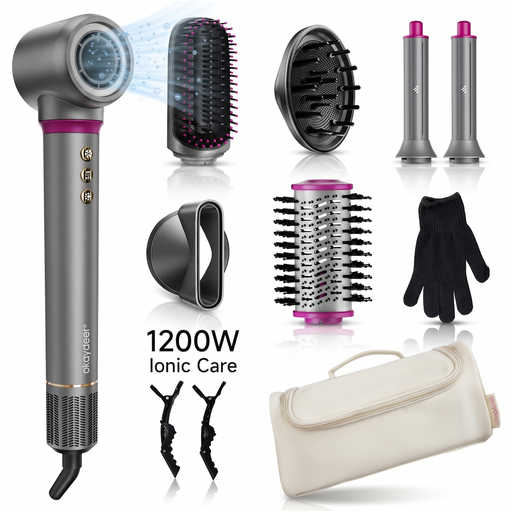
Why this model suits this profile: It is designed for people who want to create different styles with a comprehensive kit. Its storage case also makes it convenient to take when travelling.
With a diffuser, a concentrator nozzle and two curling attachments, it focuses on complementary accessories rather than duplicates.
Seven functions, two airflow settings, three heat levels and a motor rated at 130 000 rpm.
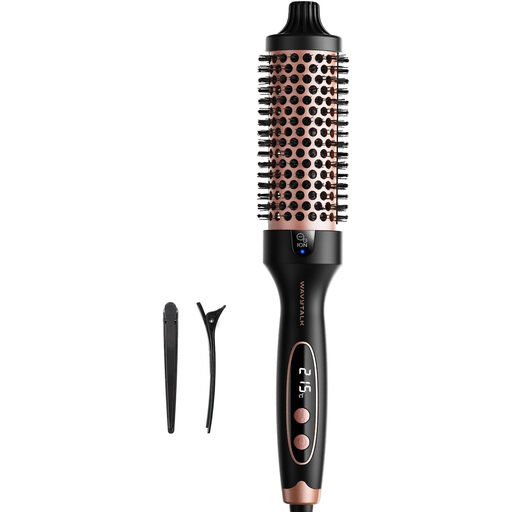
Why this model suits this profile: This heated straightening brush is designed for use on dry hair to create a rounded style, waves or extra volume.
The listing specifies that this is not a hair dryer brush and must not be used on wet hair.
Five displayed temperature settings, 38 mm barrel, two PTC heating elements and ionic technology stated by the manufacturer.
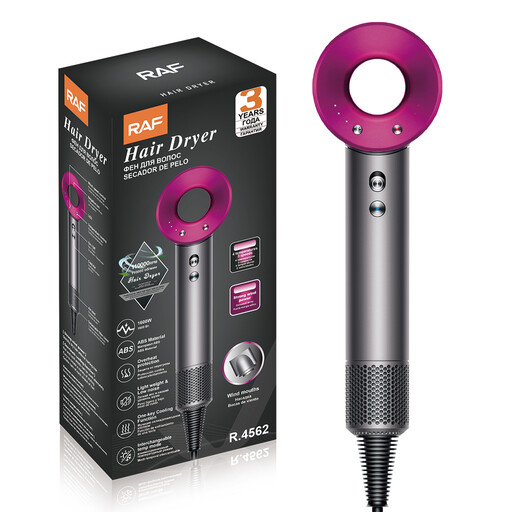
Why this model suits this profile: This hair dryer is aimed at households that prioritise fast drying and control over the airflow rather than versatility.
Its settings are focused on drying, without adding multiple attachments that are rarely used. Overheating protection is also stated.
Stated power of 1 600 W, three speeds, four temperatures and an air intake filter that should be cleaned regularly.
We have put together a complete, real-time selection of products that meet these demanding criteria, as well as European safety requirements.
Most blow-drying models are used on towel-dried or slightly damp hair, but not immediately after a shower. Always consult the manufacturer’s instructions. A traditional heated brush, such as the Wavytalk featured above, must be used on dry hair.
Start with the lowest temperature and increase it only if the result is not sufficient. Work in small sections, keep the appliance moving and finish with a cool shot when this function is available. An ionic hair dryer brush may help reduce static electricity, depending on the stated features, but it does not replace these precautions.
It depends on how often it is used, how regularly the filter is cleaned, storage conditions and whether the manufacturer’s instructions are followed. Avoid blocking the air intakes, unplug the appliance after use and wait for it to cool down before storing the attachments. For an appliance used every morning, ease of maintenance and warranty terms matter just as much as the number of functions.