
Livraison le jour même ou le lendemain

Qualité garantie

Débloquez vos offres de bienvenue: Livraison GRATUITE | Jusqu'à -80 % | 30 jours d'essai gratuits à JoyPlus
Téléchargez l'application
Drying, straightening, adding volume or creating curls with a single device can significantly streamline your hair-care routine. However, not every blow-dry brush is designed for the same uses. A multifunction blow-dry brush can be used on damp hair, whereas a heated brush is intended for dry hair only.
Before placing your order, it is therefore worth distinguishing marketing claims from the features that genuinely matter: the number of attachments, temperature settings, power, weight, electrical compatibility and ease of maintenance.
A heated hair brush, also known as a thermal brush, heats the hair directly but does not necessarily replace a hair dryer. Some Wavytalk models, for example, are designed exclusively for dry hair and do not offer hot-air drying.
A drying brush, by contrast, blows air and can be used on towel-dried or slightly damp hair, depending on the manufacturer’s recommendations. This distinction is far from trivial: it helps prevent you from ending up with a device that does not suit your routine.
A 5-in-1 blow-dry brush or multi-styler may come with a wide range of accessories, but not all of them will necessarily suit your hair type. A smoothing attachment is useful for quick styling, while a slimmer barrel is better suited to well-defined curls.
Take the time to check the purpose of each accessory: flat brush, round brush, concentrator nozzle, diffuser or curling attachments. An extra accessory does not guarantee the same results as a specialised device.
A versatile device can be bulkier than a simple blow-dry brush. Even a few hundred extra grams quickly become noticeable when styling the entire head section by section. A 360° swivel cord makes movements around the head smoother and helps prevent twisting.
If you plan to take it travelling, also consider its size, whether it comes with a pouch and its electrical voltage. A 220–240 V device will generally work with French sockets, but always check the technical specifications and plug type.
Measured in watts, power indicates electrical consumption and, to some extent, airflow. However, it cannot predict styling speed on its own. A 750–1,200 W blow-dry brush can suit a wide range of needs, depending on hair length and density.
Prioritise a model with multiple speed and temperature settings. Fine or sensitised hair generally responds better to moderate heat, while thick hair may require stronger airflow. In every case, use the lowest temperature that delivers the desired result.
Brush diameter has a direct impact on the finish:
For a device that can be used on both damp and dry hair, make sure both modes are clearly explained in the instructions. A standard thermal brush must never be used on wet hair.
Attachments and plates can reach high temperatures. Check that the instructions clearly cover hot surfaces, the appropriate distance from the scalp, changing attachments and allowing the device to cool before storing it.
In France, pay particular attention to regulatory information, CE marking where applicable, the identity of the manufacturer or the responsible person in the European Union, and the availability of clear instructions. Never use the device near a bathtub or sink, do not immerse it and unplug it after every use.
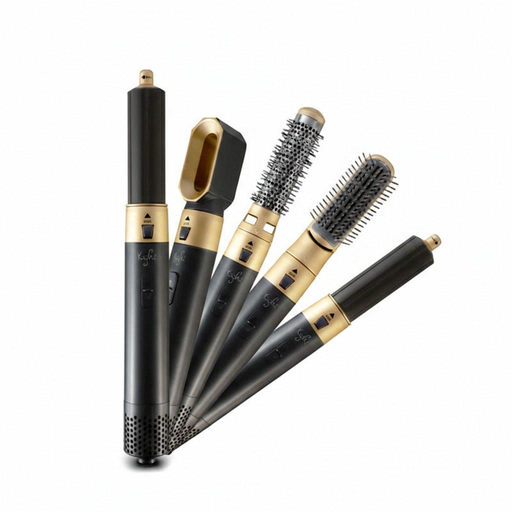
Why we chose it: its five attachments cover drying, straightening, volumising and two types of curls. At a stated 615 g, with a 1.8 m swivel cord and storage pouch, it is practical for everyday use and travel.
Each function has a dedicated attachment, reducing confusion between the smoothing brush, curling brush and drying nozzle.
1,000 W of power, three airflow and heat settings, five interchangeable heads and a travel pouch included.
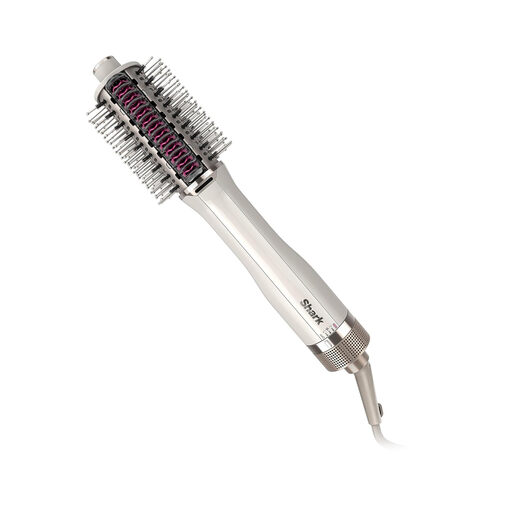
Why we chose it: this hair-dryer brush features one mode for damp hair and another for dry hair, with drying, volumising and smoothing functions.
The two modes are clearly separated: styling dry hair is not performed in the same way as drying.
Stated power of 900 W, three temperature settings, three speeds and a listed weight of 730 g.
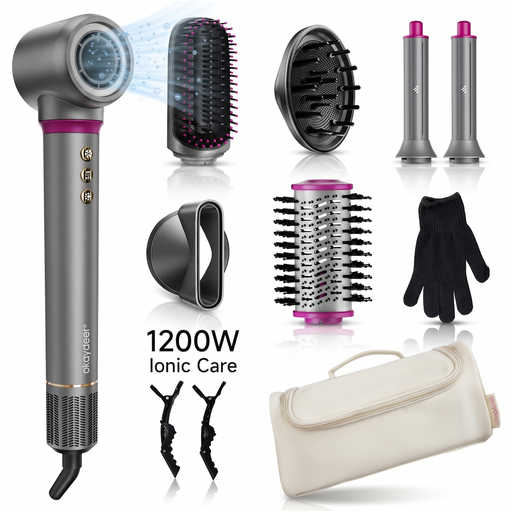
Why we chose it: its line-up includes two curling attachments, a volumising brush, a smoothing brush, a diffuser and a concentrator.
The accessories are designed for distinct uses: targeted drying, volume, smoothing, curls or defining wavy hair.
Stated power of 1,200 W, three temperature settings, two speeds and a storage case included.
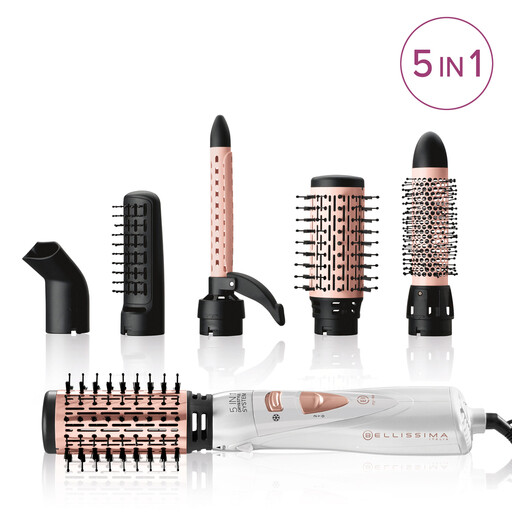
Why we chose it: its 50 mm and 32 mm round brushes are designed for volume, waves and blow-outs. The flat brush, meanwhile, handles detangling and smoothing.
The different diameters make it possible to match the attachment to the hair length and the desired volume.
1,000 W motor, ceramic coating, two speeds, two temperature settings and a cool-shot button.
Towel-dry your hair before using a drying brush, without vigorously rubbing the lengths. Work in small sections and avoid holding the device in the same place for too long. Once it has been unplugged and allowed to cool completely, regularly clean the bristles, air inlets and any product residue.
A thermal brush, on the other hand, should only be used on dry, detangled hair. Models with multiple temperature settings offer greater control over heat, but they still require careful handling. Before ordering, also check whether replacement accessories and warranty coverage are available.
We have brought together an up-to-date selection of products that meet these criteria and the safety requirements applicable in France.
As a general rule, hair should be towel-dried or squeezed dry, not dripping wet. Check the instructions for your chosen model: some devices feature a mode for damp hair, while standard thermal brushes are designed exclusively for dry hair.
It can replace a hair dryer for drying and styling, provided the manufacturer specifies this use. However, a concentrator nozzle or separate hair dryer may still be useful for quickly removing a large amount of moisture before a blow-out.
Consumption depends on the device’s power and how long it is used. As an indication, a 1,000 W model used for 10 minutes consumes approximately 0.167 kWh. The actual cost will then vary according to your electricity tariff. Reducing operating time and maintaining the device regularly can help limit consumption, without ever compromising on safety instructions.