
Livraison le jour même ou le lendemain

Qualité garantie

Débloquez vos offres de bienvenue: Livraison GRATUITE | Jusqu'à -80 % | 30 jours d'essai gratuits à JoyPlus
Téléchargez l'application
A multi-purpose strong glue can come in handy for fixing a skirting board, repairing a decorative object or joining two materials together. But a poorly chosen product can end up peeling off, leaving a visible mark or damaging the surface. So the label "extra-strong" alone isn't enough to tell you whether a glue is actually right for your project.
Before buying a fixing glue or repair adhesive, consider three factors: the materials you're joining, the environment you'll be using it in, and the type of hold you need. Here are the main pitfalls to avoid, along with a selection of products suited to different household tasks.
A glue can hold an object after a few seconds without having yet reached its maximum strength. Depending on its formulation, full curing can take several hours. Removing clamps too early or applying weight immediately risks weakening the bond.
Check the difference between instant grip and final strength, then follow the time stated on the packaging.
Not all plastics react the same way to adhesives. Polyethylene, polypropylene, PTFE, certain PVCs and other low-surface-energy materials can be particularly difficult to bond.
A clear glue or an adhesive designed for indoor and outdoor use may also have specific exclusions. Always check the list of compatible surfaces before applying, especially for plastic items, metal parts and flexible materials.
A small tube is fine for occasional repairs, while a cartridge of no-nails-no-screws glue is more practical for fixing skirting boards, battens or shelves. For a lightweight item you might want to remove later, a strong double-sided tape can be more suitable than a permanent glue.
The quantity and format directly affect ease of application, dosage and the cost of each project.
Start by identifying the two surfaces:
A gel glue can work on several porous and non-porous surfaces. Conversely, a fixing glue intended for walls may require at least one of the two surfaces to be porous.
For use in a dry room, a solvent-free glue can be more pleasant to apply and give off less odour. For a fixing exposed to moisture, temperature changes or UV rays, look for an explicit outdoor-use indication.
Please note: "moisture-resistant" does not necessarily mean the product is suitable for prolonged immersion. The actual conditions — rain, condensation, frost or high heat — must match the manufacturer's instructions.
Check the following information:
Always clean, dry and degrease the surfaces. A dusty or wax-coated surface will greatly reduce adhesion, even with a glue marketed as particularly strong.
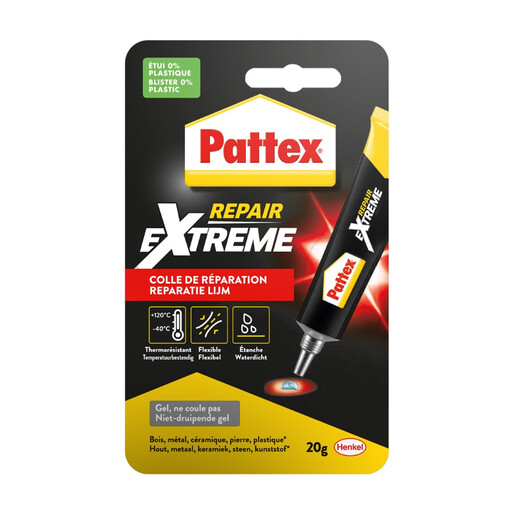
Why this suits this profile: Its small tube is ideal for everyday household repairs, without needing to buy a cartridge for occasional use. The gel can be applied to vertical surfaces without dripping easily.
The description lists compatible materials and specifically excludes PE, PP, PTFE, ABS, rigid PS, copper and brass. Useful information to avoid unsuitable attempts.
A solvent-free gel with an instant initial grip, suitable for both indoor and outdoor small repairs.
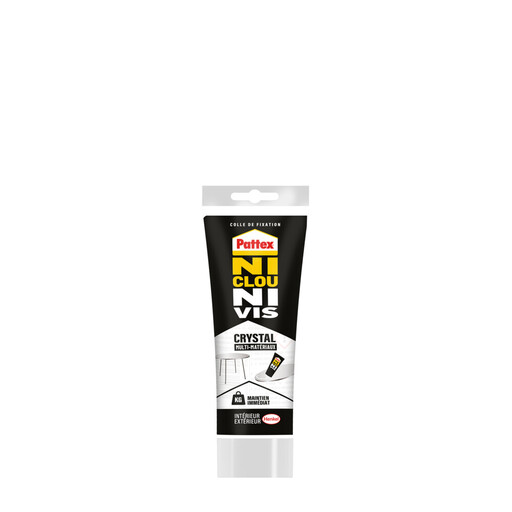
Why this suits this profile: This product is aimed at projects where the appearance of the bond matters, especially on glass, mirrors or decorative materials. Its clear formula allows for a discreet fixing.
The product page lists its exclusions, including PE, PP, PTFE, acrylic glass, copper, brass and flexible PVC. So checking the material is still essential before buying.
A transparent, solvent-free adhesive with no reported odour, repositionable for up to 15 minutes according to the product page. Final strength is stated at 24 hours.
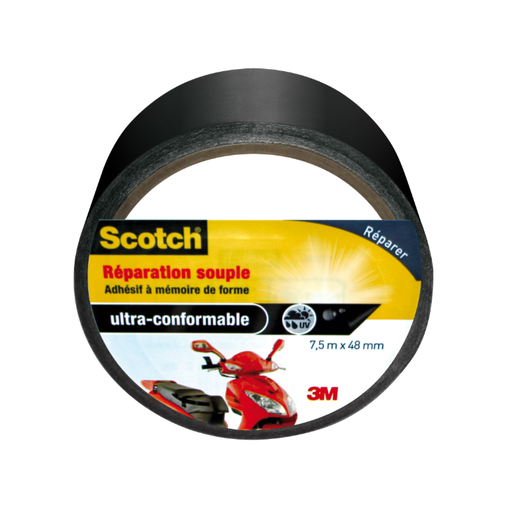
Why this suits this profile: This flexible repair tape conforms to irregular shapes. It's suitable for repairs and reinforcements that need quick application, both indoors and outdoors.
It doesn't present itself as a universal glue: it's a single-sided adhesive tape intended for repair and reinforcement. The product page also states it is not suitable for electrical insulation.
Flexible polyurethane, 48 mm wide and 7.5 m long. The tape conforms to irregular surfaces and resists twisting, according to the product page.
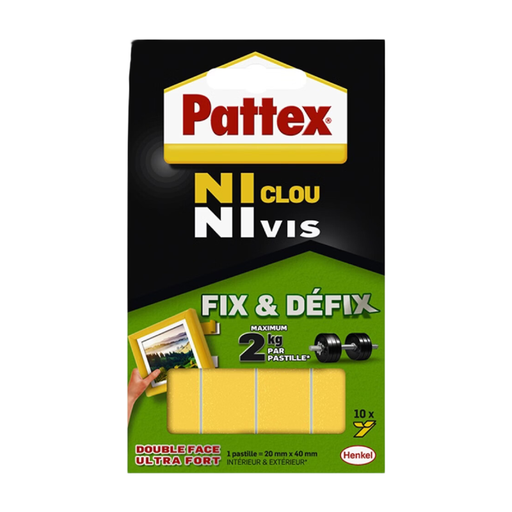
Why this suits this profile: These pads are ideal for installing small items you might want to move or remove, such as picture frames, hooks, cables or decorative pieces.
The product states it should be used on clean, smooth, dry and degreased surfaces. It advises against using on wallpaper as well as textured or fragile surfaces.
Each pad measures 20 x 40 mm and can support up to 2 kg after 24 hours, according to the stated load capacity. Under the intended conditions, the fixing is designed to be removed without leaving marks.
For a heavy wall fixing, also check the type of wall and the contact surface. A no-nails-no-screws glue does not automatically replace a mechanical anchor when the load, vibrations or moisture levels are significant.
A multi-surface gel can work on wood, cardboard, ceramic, glass or certain plastics, but always check the exclusions. For a wall fixing, choose a glue designed for porous materials. For a flexible or uneven repair, a flexible repair tape may sometimes be more suitable.
Not necessarily. The term "solvent-free" describes the formulation, but doesn't guarantee resistance to rain, UV or temperature changes. Look for an explicit outdoor-use indication and follow the stated limits for moisture or immersion.
The time depends on the product and the surface. Some solutions offer a quick initial grip, while final strength usually takes several hours, or even 24 hours. Always check the instructions and avoid putting stress on the bond before the recommended time.