
Livraison le jour même ou le lendemain

Qualité garantie

Débloquez vos offres de bienvenue: Livraison GRATUITE | Jusqu'à -80 % | 30 jours d'essai gratuits à JoyPlus
Téléchargez l'application
A multi-purpose strong glue can be a real lifesaver around the house, in the workshop or for a craft project. But not all glues are suitable for the same materials or the same demands. Using an instant glue on a large surface, a construction adhesive on a non-porous substrate or a waterproof glue in immersion risks causing premature failure.
So before you place an order, it’s best to look beyond claims like “ultra-strong” or “universal”. Compatibility with the material, the packaging, the setting time and the conditions of use are far more decisive.
A cyanoacrylate glue, better known as super glue, sets in seconds. It’s suitable for small repairs where surfaces fit together perfectly. However, it’s not necessarily ideal for assemblies subject to movement, repeated impact or strong flexing.
For fixing a skirting board, a shelf or a panel, a construction adhesive based on hybrid polymer will generally be more appropriate. The initial hold may be quick, but maximum strength is often only reached after several hours.
Claims of “all materials” should be taken with a pinch of salt. Polyethylene (PE), polypropylene (PP) and PTFE are often among the excluded substrates. Some formulas are also not compatible with flexible PVC, copper, brass, acrylic glass or bitumen.
Always check the list of compatible substrates on the product page. If in doubt, test on an inconspicuous area.
A 3 g tube slips easily into a toolbox and is perfect for a one-off repair. However, it’s impractical for fitting several metres of skirting boards. Conversely, a 290 to 470 g cartridge requires a dispensing gun and delivers far more product than needed for a small repair.
Packaging also affects storage and waste. Small formats are handy for occasional use, while a large bottle or cartridge makes more sense if you DIY regularly.
For repairing porcelain, metal, wood, rubber or small compatible plastic parts, a liquid or gel instant glue can do the job. The liquid formula penetrates better into narrow joints, while a gel glue stays in place better on a vertical surface.
For fixing wood, stone, plaster or wall panels, go for a construction adhesive that clearly states its compatibility with porous substrates. Some products require at least one of the two surfaces to be porous.
A waterproof glue or moisture-resistant glue isn’t necessarily designed to withstand permanent immersion. For indoor and outdoor use, check the information on moisture, UV rays and the supported temperature range.
Some construction adhesives, for example, claim resistance to temperature variations from -30 °C to +80 °C, while hybrid sealant-adhesives may show a different range. Always compare these figures with the actual conditions of use: bathroom, balcony, kitchen or unheated workshop.
The term “instant set” generally means the parts start to hold quickly. It doesn’t mean the assembly can immediately bear its maximum load. A cyanoacrylate glue may need a few minutes to reach sufficient strength, while a construction adhesive can require 24 hours before fully curing.
During this time, keep the parts in place and avoid mechanical stress, water and movement.
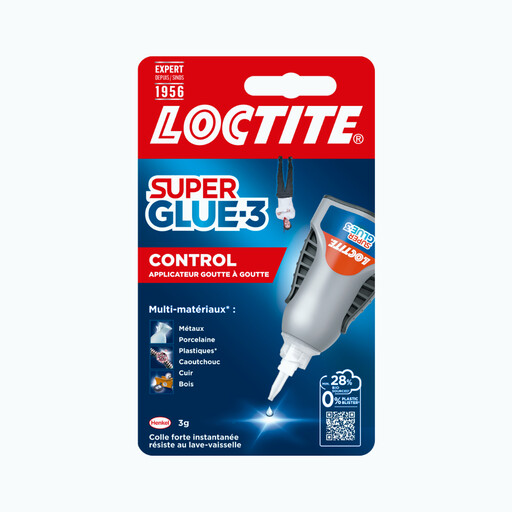
Why this choice suits this profile: Its push-button bottle makes dosing easy and lets you apply just the right amount for everyday repairs on porcelain, metal, wood, rubber or compatible plastic.
The controlled flow reduces drips, excess glue and waste on small surfaces. The product page does note, however, that PE, PP and PTFE substrates are excluded.
A 3 g format, a transparent formula and claimed resistance to water and the dishwasher once the glue has cured.
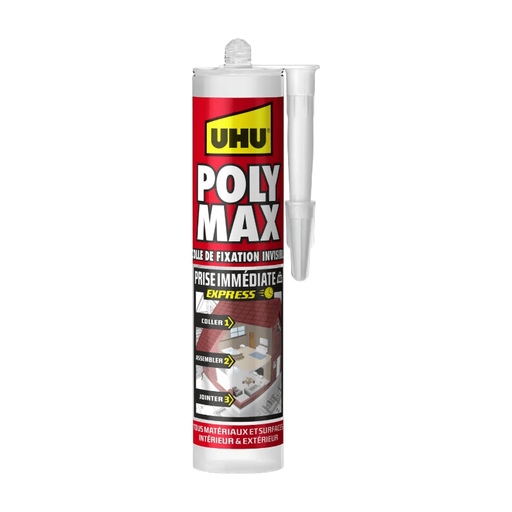
Why this choice suits this profile: Its hybrid polymer technology is designed for bonding, assembly and sealing projects, indoors and outdoors.
The formula doesn’t rely solely on a fast set – it remains elastic and the product page claims resistance to water and UV. The excluded substrates must still be carefully observed.
A 300 g cartridge, a transparent finish, gun application and a claimed temperature range of -40 °C to +100 °C.
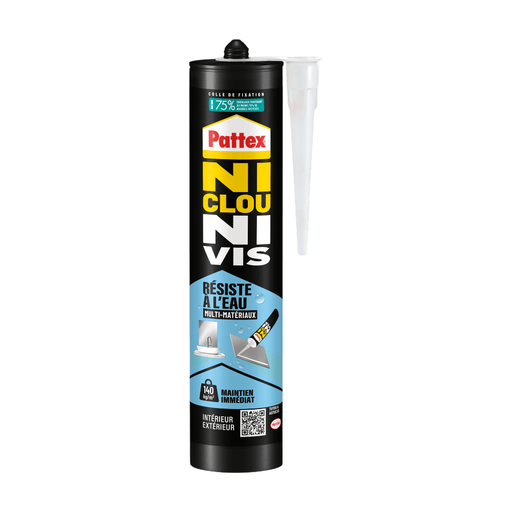
Why this choice suits this profile: Its large format is designed for repeated fixing of skirting boards, shelves, frames, panels and decorative items.
This formula is designed to fix without nails or screws, with repositioning possible for 10 minutes. However, it doesn’t replace mechanical fixing when weight or load demands it.
A solvent-free and isocyanate-free formula, claimed resistance to moisture and UV, and final curing stated after 24 hours.
It all depends on the precise compatibility of the materials. A cyanoacrylate glue is often suitable for small repairs on wood, metal, glass, ceramic and certain plastics. However, PE, PP and PTFE are frequently excluded. For a large fixing job, a multi-material polymer adhesive will generally be more suitable.
Not necessarily. Resistance to water or moisture doesn’t automatically mean the product can withstand permanent immersion. Check the technical data sheet and choose a formula explicitly designed for that purpose.
An instant glue generally starts to hold in seconds, but it’s best to wait several minutes before any significant handling. With a construction adhesive, final strength can take around 24 hours. Temperature, humidity, the nature of the substrate and the amount applied also affect the result.