
Same-day & Next-day Delivery

Quality Guaranteed

Unlock Your Welcome Offers: FREE Delivery | Up to 80% OFF | Free 30-day JoyPlus trial
Download the APP
A multi-purpose pliers set can quickly prove disappointing if its contents do not match your needs. A generous assortment is not necessarily more useful than a compact set, especially when the pliers are too short, the jaws lack grip or the cutter is not designed for the materials you need to work with.
Whether you are a casual DIYer, tradesperson, plumber, mechanic, electrician or maintenance technician, three mistakes come up time and time again:
For routine household maintenance, a versatile pliers set will generally include:
For automotive mechanics, circlip pliers, hose-clamp pliers or bent-nose pliers can be far more useful than several pairs of combination pliers. Jewellery-making and electronics enthusiasts will generally prefer precision pliers, flat-nose tips and cutting edges suited to small components.
Product descriptions often mention heat-treated alloy steel, carbon steel or chrome vanadium steel. These details provide information about the tool’s construction, but they do not, on their own, guarantee the same service life for every pair of pliers.
In particular, check for:
On pincers or side cutters, edge hardness may be expressed in HRC. This figure should always be considered alongside the stated cutting capacity: high hardness does not mean that the tool can cut any cable, nail or steel wire.
Pliers measuring 160 to 200 mm are generally suitable for everyday tasks and relatively open spaces. A 244 to 305 mm model provides greater leverage, but it also takes up more room and may be less manoeuvrable inside a cabinet or engine compartment.
For pliers intended for plumbing, pay particular attention to:
Tools used for cutting and mechanical work also require the use of safety goggles. Before each use, check that the jaws are not deformed, that the tips are intact and that the joint has no abnormal play. For electrical work, only use a tool displaying the insulation rating required for the operation concerned. Never work on a live circuit without suitable equipment.
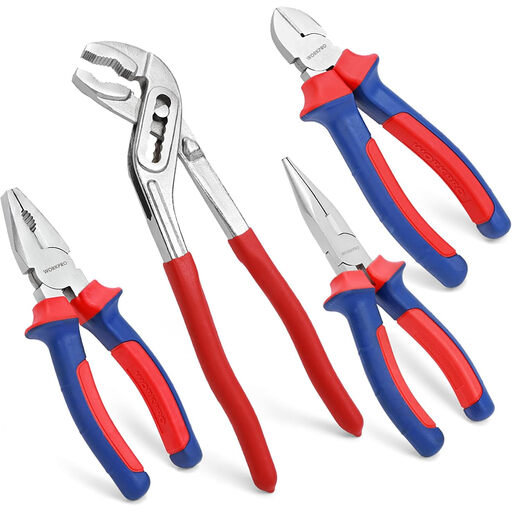
Why this choice suits this type of user : It brings together four essential tools for small household repairs, DIY and routine maintenance, without filling your toolbox with pliers you rarely use.
The contents are clearly specified : combination pliers, long-nose pliers, side cutters and water-pump pliers. Sizes range from 160 to 244 mm.
Forged, heat-treated alloy steel, non-slip PP and TPR handles, and four complementary sizes.
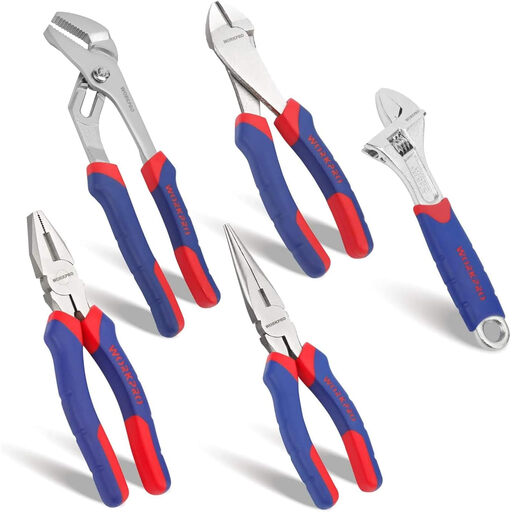
Why this choice suits this type of user : This professional-quality pliers kit combines five tools for plumbing, electrical, mechanical and maintenance work.
Each tool has a clearly defined function : 250 mm water-pump pliers, combination pliers, side cutters, long-nose pliers and an adjustable wrench.
Heat-treated alloy steel, nickel-plated finish, TPR and PP handles, and hardened cutting edges.
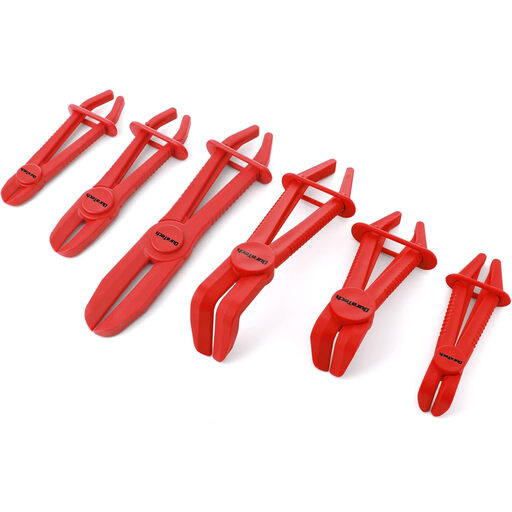
Why this choice suits this type of user : It is designed for working on flexible brake, fuel, coolant and radiator hoses.
All six sizes are clearly specified, including straight and 90° angled models. The jaws are designed to close off flexible hoses without crushing them excessively.
Heat-resistant PA6 reinforced nylon, non-conductive material, safety locking mechanism and non-slip handles.
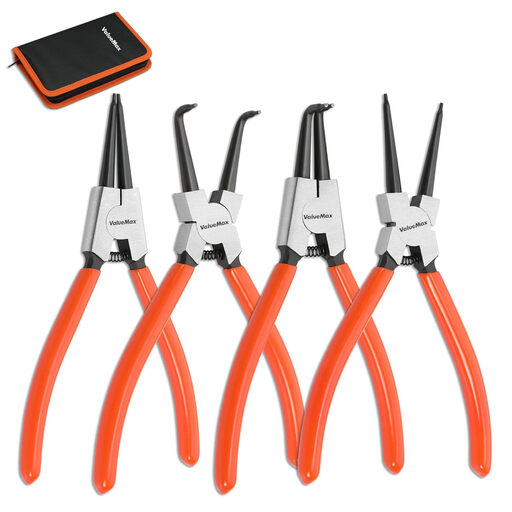
Why this choice suits this type of user : Mechanics, automotive repair specialists and DIYers working on compact assemblies have four configurations for internal and external circlips.
The set distinguishes between straight and angled pliers for internal and external circlips. The tips have a diameter of 1.6 mm, while the stated opening reaches 33 or 36 mm depending on the configuration.
Forged carbon steel, rubber handles, zip-up case and four tips for hard-to-reach areas.
We have put together a comprehensive, real-time updated list of products that meet these demanding selection criteria and European safety regulations.
After each use, wipe your tools with a dry cloth to remove moisture and residue. A small drop of oil on the joint and metal surfaces will help limit oxidation while the tools are stored. Keep the set in a box, pouch or case, especially when it includes precision pliers or circlip pliers.
Never use pliers as a hammer, lever or makeshift spanner. Follow the cutting capacity, maximum opening and material type specified by the manufacturer. When using hose-clamp pliers, make sure the line is suitably flexible and compatible with the tool.
A set of four or five tools will generally cover everyday needs: gripping, cutting, reaching a narrow area and working on fittings. You can then add a specialist pair of pliers to suit your tasks, such as circlip pliers or precision pliers.
Clean the tools after every use, dry them before storing them and lubricate the joints regularly. Avoid working on materials that exceed the stated cutting capacity. Pliers with chipped jaws or excessive play in the joint should be replaced.
They may be suitable for some nuts and fittings, but their capabilities vary from model to model. For pipes or bulky components, compare the maximum opening, leverage and jaw shape before making your choice.