
Livraison le jour même ou le lendemain

Qualité garantie

Débloquez vos offres de bienvenue: Livraison GRATUITE | Jusqu'à -80 % | 30 jours d'essai gratuits à JoyPlus
Téléchargez l'application
Multi-purpose pliers can be useful for all sorts of tasks: cutting wire, holding a component or removing a staple. However versatile they may be, an ‘all-in-one’ model will not always replace every specialist tool. To avoid a disappointing purchase, it is worth taking a close look at the design, actual capabilities and tasks you intend to use them for.
Whether you are a weekend DIYer, electrician, plumber, mechanic or keen DIY enthusiast, here are the criteria to review before choosing your multi-purpose pliers.
Pliers that combine several functions can be extremely practical, but every mechanism has its limits. Wire strippers do not necessarily accept every cable size. Similarly, cutters designed for a specific wire diameter may become damaged if used on a material that is too hard.
So check the cutting capacity, jaw opening and cable sizes supported. This information is far more useful than a simple marketing claim such as ‘multi-purpose’.
The material directly affects the tool’s strength, precision and maintenance requirements. Commonly used in DIY tools, chrome vanadium steel offers a good balance between rigidity and wear resistance. Some manufacturers also specify whether the tool has anti-corrosion treatment or state the hardness level of the jaws.
This does not make the pliers invincible, however. Prolonged exposure to moisture, excessive twisting force or use on a live component can shorten their service life.
A set of pliers may seem like good value, but some tools may never leave the box. For network installation, a set containing crimping pliers, cutters, wire strippers and a cable tester makes sense. For plumbing, water pump pliers with a wide opening will generally be more suitable.
Before placing your order, make a list of the jobs ahead: household repairs, assembly, wiring, mechanics, plumbing or precision work.
Cutting capacity should be considered alongside the material to be worked on: soft wire, hard wire, cable, staples or nails. For example, cutters may state a maximum capacity of 2 or 3 mm for medium-hard wire. This value cannot be applied in the same way to hardened steel or an especially rigid material.
For gripping fittings, nuts or tubes, focus instead on the maximum opening. 305 mm water pump pliers may open up to 50 mm, while a shorter model will be easier to handle in a confined space.
Non-slip rubber or TPR handles improve grip, particularly during repeated use. An offset lever design can also reduce the effort needed for cutting. This is a design feature, however, not a guarantee that every user will achieve identical results.
Also consider the weight. Heavy pliers can be useful for pulling out nails, but may become tiring when carrying out precision work for several minutes.
When using electrician’s tools, never work on a live circuit with pliers that are not explicitly designed and marked for this purpose. Also wear safety goggles when cutting or removing circlips.
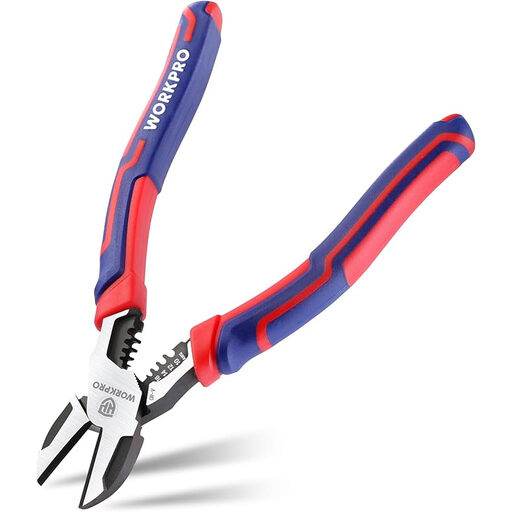
Why this choice suits this profile : these pliers combine wire stripping and side cutting for small electrical installations, household repairs and DIY projects.
The stripping slots are designed for 10, 12, 14 and 16 AWG wires, with a stated capacity of up to 2.0 mm for hard wire. This makes it easier to check compatibility before buying.
Chrome vanadium steel, non-slip TPR handles and a 200 mm format. The manufacturer states that the offset design is intended to reduce cutting effort.
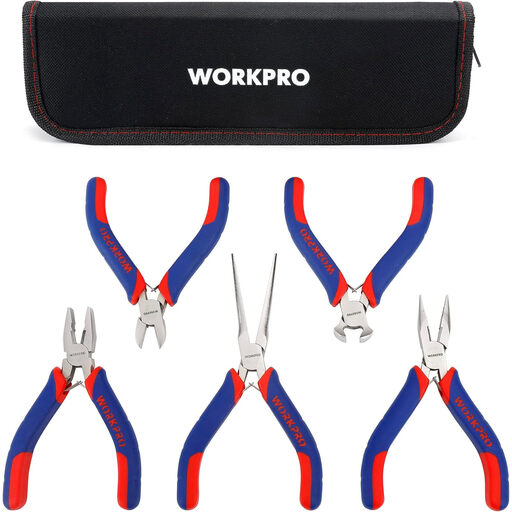
Why this choice suits this profile : this assortment is designed for intricate work in electronics, jewellery, model-making and DIY.
The set includes several jaw shapes: long-nose, flat-nose, combination, side-cutting and end-cutting pliers. Each tool therefore performs a specific function, rather than relying on versatility that can be difficult to define.
Five carbon steel pliers with a Ni-Fe coating, rubber handles and a 600D nylon storage pouch. The jaw hardness is stated as HRC 55-65.
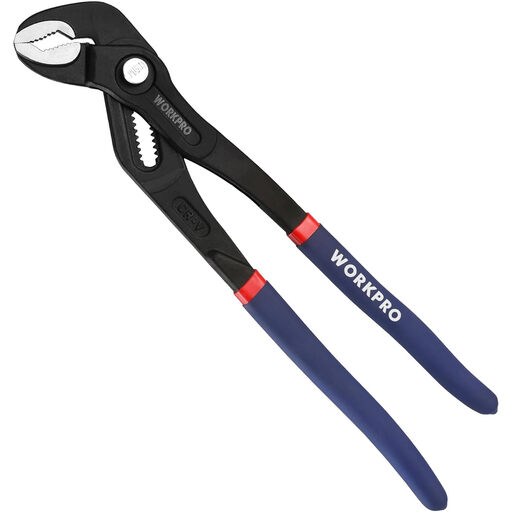
Why this choice suits this profile : their extended length and wide opening are suited to plumbing, maintenance and mechanical work involving large components.
The quick-adjustment button adapts the opening up to 50 mm. This is useful information for checking compatibility with the pipes and fittings you intend to handle.
Heat-treated chrome vanadium steel, teeth suited to several component shapes and contoured plastic handles. Stated weight: 630 g.
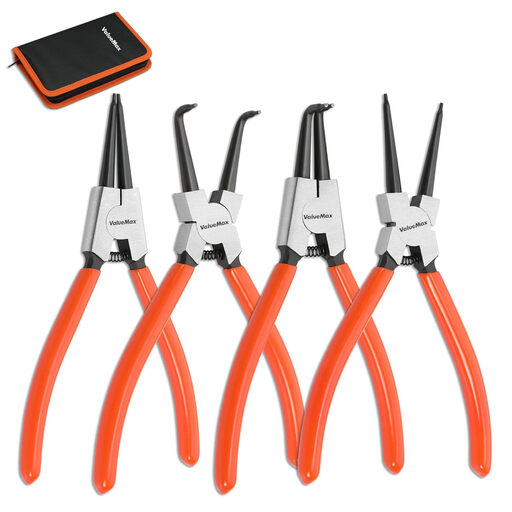
Why this choice suits this profile : its four configurations cover mechanical and automotive work on internal or external circlips, whether straight or installed at an angle.
The set includes pliers for internal and external circlips, with straight and 90° angled tips. Their stated diameter is 1.6 mm.
Stated opening of up to 36 mm for the straight models and 33 mm for the angled versions, with a storage pouch and rubber handles.
We have brought together a complete, real-time updated selection of products that meet these demanding criteria, as well as European safety requirements.
After each use, wipe the metal parts with a dry cloth. Before storing the pliers for an extended period, apply a thin layer of oil to the pivot and metal surfaces if necessary. Keep your pliers in a dry place, ideally in a pouch or toolbox.
Regularly inspect the jaws, handles and adjustment mechanism. Pliers with excessive play, a crack or damaged cutting edges should be replaced. For electrical work, check the model’s markings and the condition of its insulation, then follow the safety regulations in force.
For small jobs carried out with the power switched off, pliers combining side cutting and wire stripping can cover most requirements. Check the compatible cable sizes and consider a dedicated crimping tool if your work involves particular terminals or connectors.
A set can reduce the cost per tool if you genuinely intend to use several formats. For an occasional need, however, buying individually avoids paying for pliers that will remain at the bottom of the toolbox. Compare the contents, dimensions, capacities and storage quality rather than relying solely on the number of pieces.
Dry them after each use, remove any residue and occasionally apply a light coating of oil to the metal parts. Storing them in a dry environment remains essential, even when anti-corrosion treatment is advertised.