
Livraison le jour même ou le lendemain

Qualité garantie

Débloquez vos offres de bienvenue: Livraison GRATUITE | Jusqu'à -80 % | 30 jours d'essai gratuits à JoyPlus
Téléchargez l'application
Drying, straightening, curling and adding volume with a single device can make your morning routine much simpler. But you need to know what those “5-in-1” or “7-in-1” promises actually mean. Between motor speed, ionic technology, the number of attachments and the claimed results, product specs aren’t always crystal clear. To make the right choice for everyday use, it’s best to focus on the features you’ll actually need, how you’ll use it, and the level of adjustment on offer.
A hot air brush combines an airflow with a styling function. It’s generally used on towel-dried hair, following the manufacturer’s instructions. The hair dryer brush falls into this category.
A heated styling brush, on the other hand, heats up directly and is most often used on dry hair. The Wavytalk Thermal Brush, for example, states that it is not a hair dryer brush and should not be used on wet hair. Buying this type of tool thinking you can dry your hair with it will likely lead to disappointment from the very first use.
A styling tool marketed as “5-in-1” or “7-in-1” won’t necessarily replace several tools in every situation. You need to look closely at the attachments supplied, their diameter and the intended styling technique.
A small-diameter attachment is better suited to defined curls, while a wider one will give soft movement and more volume. Similarly, the presence of a straightening brush doesn’t guarantee it will be effective enough on very thick hair. Versatility is only useful if the attachments and settings match your hair type and your habits.
On some models, anti-frizz ionic technology is presented as a way to reduce static electricity and make hair look smoother. However, this is a technical feature, not a guarantee of the same result for everyone.
Temperature, exposure time, hair moisture and frequency of use remain the most important factors. To limit heat exposure, start with the lowest setting suitable for your hair type and use the cool shot button if the tool has one.
Fine or damaged hair generally needs more care when it comes to heat. Thick hair may require a more powerful airflow or several passes, but maximum temperature isn’t always necessary.
Choose a tool that offers multiple heat and speed settings. The NICEBAY offers 3 temperatures and 3 air speeds, while the MOVA Master 10 provides 4 heat settings and 3 speeds. These details are more meaningful than a simple promise of fast drying: they allow you to adapt the tool to fine hair as well as thick hair.
A fast motor can speed up drying, but electrical power alone doesn’t predict the user experience. The shape of the attachments, airflow, weight and handle ergonomics all matter just as much.
To estimate energy consumption, look at the wattage and the typical length of a session. The MOVA Master 10 is rated at 1,600 W. The Wavytalk thermal brush is rated at 68 W, but it doesn’t dry hair. A lower wattage doesn’t necessarily mean better efficiency: it may simply reflect a tool that heats without producing an airflow intended for drying.
Check for overheat protection, a sufficiently long cord and, if possible, a swivel cable. The air inlets and outlets must never be blocked during use.
In a bathroom, always keep the tool away from water, unplug it after use and let the attachments cool down before storing them. Also remember to check the type of plug supplied. Some descriptions mention international compatibility while specifying a particular plug: it’s best to verify this before placing your order.
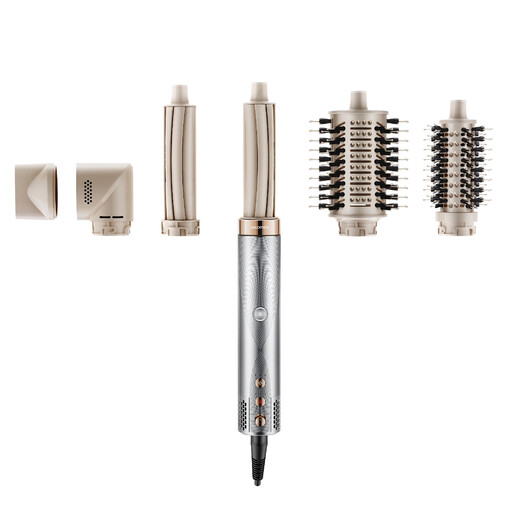
Why this choice suits this profile: its multi-function format combines drying and automatic styling in one device priced at €54.90, with an instant €5 discount mentioned on the product page.
The product page recommends starting on towel-dried hair and adjusting the heat and airflow to your hair type.
Automatic air-flow curling, claimed ionic technology and reportedly lightweight design.
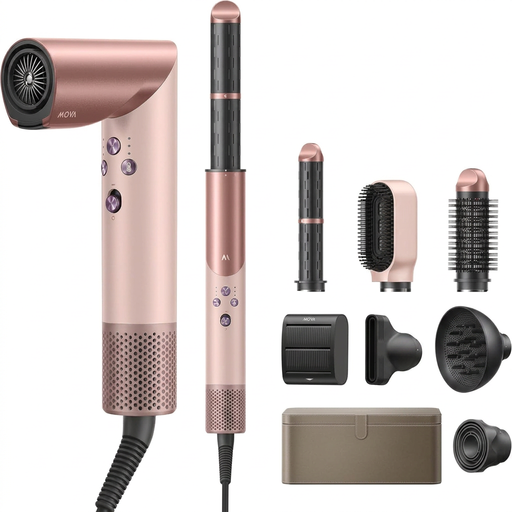
Why this choice suits this profile: it’s aimed at those looking for a complete solution for drying, straightening, curling and adding volume at home.
The product page details the functions, temperatures, speeds and cool shot button, rather than just listing a long set of attachments.
Attachment recognition, mode memory, claimed 110,000 rpm motor and storage case.
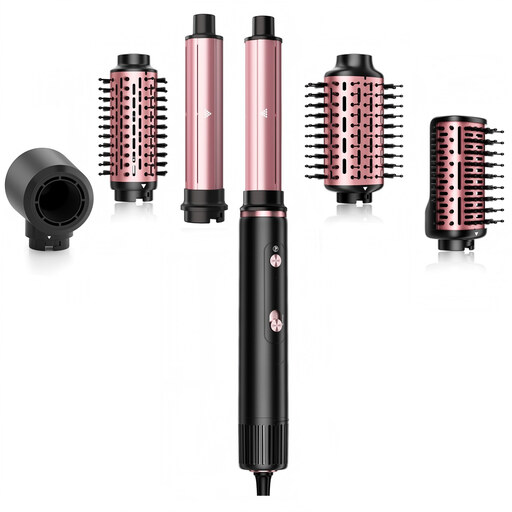
Why this choice suits this profile: its settings and features are designed for varied routines, especially on thick hair, for creating volume or curls.
The product page distinguishes 3 temperatures and 3 air speeds, avoiding the same setting being imposed on all hair types.
Claimed 110,000 rpm brushless motor, automatic air-flow curling and 360° swivel cord.
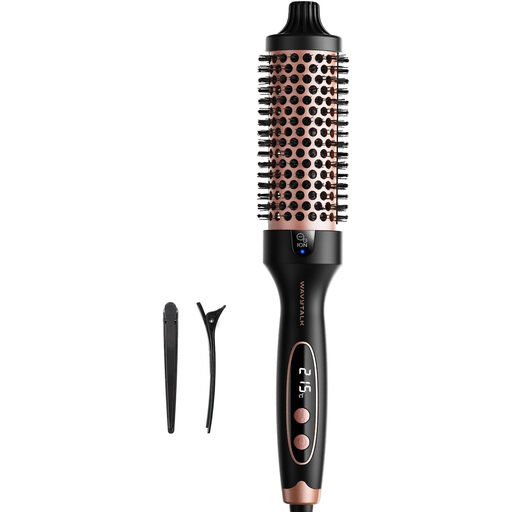
Why this choice suits this profile: this heated brush is ideal for touch-ups, adding volume and creating waves on already dry hair.
The product page clearly states that it is not a hot air brush and should not be used on wet hair.
38 mm barrel, 5 displayed temperatures, claimed ionic technology and 360° swivel cord.
We’ve put together a comprehensive, real-time updated selection of products that meet these strict selection criteria and European safety regulations.
Most models are designed for towel-dried hair, not soaking wet hair. Always check the instructions and start by removing excess water with a towel. A standard heated styling brush, on the other hand, may require completely dry hair.
Start with the lowest temperature on fine, dry or damaged hair. Thick hair may need a higher setting, but first test on a small section. A tool with multiple temperature levels makes this adjustment easier.
The lifespan depends on how often you use it, how well you clean the filter, the condition of the cord and whether you follow the safety instructions. Regularly remove dust and hair, don’t block the air intake and let the tool cool down before storing it. These steps help keep it working well, but don’t guarantee a specific lifespan.