
Livraison le jour même ou le lendemain

Qualité garantie

Débloquez vos offres de bienvenue: Livraison GRATUITE | Jusqu'à -80 % | 30 jours d'essai gratuits à JoyPlus
Téléchargez l'application
A multi-purpose cleaner can make household cleaning easier, but not all cleaning products are created equal. A spray designed for a worktop will not necessarily replace a floor cleaner, kitchen degreaser or disinfectant.
The right choice mainly depends on three factors: the level of dirt, the surfaces to be cleaned and the most convenient format for everyday use. Here are the common mistakes to avoid, the key points to check and a few products suited to different needs.
A multi-surface cleaner removes visible dirt, but that does not mean it disinfects. A product may be perfectly effective against grease marks and unpleasant odours without making any biocidal claims.
If you are looking for a disinfectant, check the label and regulatory information carefully. Some products mention European standards such as EN 13697, EN 1650 or EN 14476. These standards apply under specific conditions: dosage, contact time, type of micro-organism and surface treated. They are therefore not a guarantee that the product will be effective in every situation.
A 5 L container can be very cost-effective for a large family, a shop or intensive cleaning. In a small home, however, it takes up space and is not very practical if you only clean a few surfaces each week.
Instead, compare the amount you can actually use after dilution, rather than just the price shown on the bottle. A concentrated product should always be measured according to the manufacturer’s instructions: a solution that is too concentrated will not necessarily be more effective and may leave residue or even damage certain materials.
A lemon, eucalyptus or floral fragrance can make cleaning more pleasant, but it says nothing about how effective the product is against grease or limescale. Likewise, a formula advertised as “streak-free” will only deliver good results if you use the recommended amount with a clean cloth.
On a delicate surface, always test the product in an inconspicuous area first. Screens, varnished surfaces, natural stone, untreated wood and porous materials often require specific precautions.
Start by listing the areas you need to clean: washable floors, sinks, hobs, tiles, windows, mirrors or food-contact surfaces. A product advertised as suitable for most hard surfaces may be appropriate for everyday cleaning, provided you follow the restrictions stated on the packaging.
For a bathroom cleaner, limescale-removing action can be useful. For a kitchen degreaser, a formula that can remain on the surface for a few minutes often makes it easier to remove ingrained grease. On a worktop that comes into contact with food, rinsing with drinking water is generally required after application.
Read the hazard pictograms, look out for fragrance substances and follow the storage instructions. A bleach-based product may be corrosive and must never be mixed with an acid, ammonia or another cleaner: these mixtures can release dangerous gases.
Disinfectants are biocides. Depending on the information on the label, wear gloves, ventilate the room and carefully observe the contact time. With an alcohol-based product, keep it away from heat sources and naked flames. Bottles must always be kept out of the reach of children.
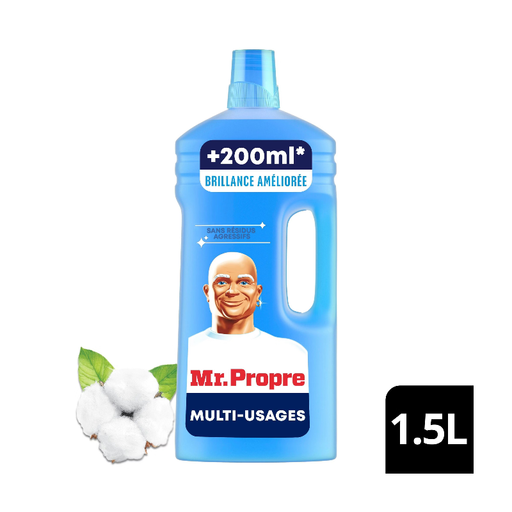
Why this choice suits this profile : Its 1.5 L format and dilution option make it suitable for everyday cleaning of floors, sinks, hobs and other hard surfaces.
Its dilutable format means you do not always have to use the product neat. However, follow the stated dosage and rinse surfaces that come into contact with food.
1.5 L container, neat or diluted use, cotton blossom fragrance and a streak-free cleaning claim according to the product details.
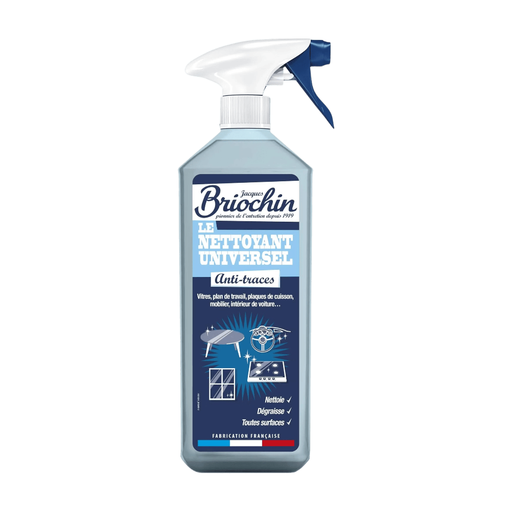
Why this choice suits this profile : This ready-to-use spray is ideal for households that want to move easily from glass and mirrors to furniture or worktops.
The product details state that it has a streak-free, no-rinse formula for numerous surfaces. To clean a screen, always spray the product onto the cloth, never directly onto the device.
750 ml spray, plant-based non-ionic surfactants and French manufacturing, according to the product details.

Why this choice suits this profile : With its 5 L container, this product is designed for regular use on floors and surfaces, whether in a large home or a professional environment.
It is presented as a bleach-free disinfectant cleaner. However, its biocidal action depends on following the dosage and contact time stated on the label.
5 L format, lemon fragrance, bleach-free formula and EN 13697, EN 1650 and EN 14476 standards mentioned in the product details.
We have put together a complete, up-to-date selection of products that meet these demanding criteria, while also taking European safety regulations into account.
To avoid streaks and reduce waste, follow this simple method:
Never mix a bleach-based product with a limescale remover, vinegar or another household cleaner. Keep bottles in their original packaging, tightly closed and out of the reach of children.
For everyday cleaning, choose a multi-surface cleaner that is compatible with washable floors, worktops and hard surfaces. A dilutable product is better suited to large areas, while a spray is more convenient for smaller cleaning jobs. Always check the surfaces excluded on the label.
Not necessarily. A disinfectant may also have cleaning properties, but its effectiveness depends on the stated procedure: dilution, contact time and whether rinsing is required. For removing dust or light stains, a standard cleaner is generally sufficient. Save disinfection for situations where it is genuinely necessary.
The actual cost depends on how much you use each time. Refills and 5 L containers can reduce the price per litre, especially if you clean frequently. For occasional use, a 750 ml or 800 ml bottle is a better choice, as it avoids storing a product that could sit in the cupboard for months.