
Livraison le jour même ou le lendemain

Qualité garantie

Débloquez vos offres de bienvenue: Livraison GRATUITE | Jusqu'à -80 % | 30 jours d'essai gratuits à JoyPlus
Téléchargez l'application
As a product expert at Joybuy, my mission is to help you navigate the jungle of high-tech accessories. Today, we're tackling an essential item: the multi-port fast charger. Say goodbye to backpacks distorted by an army of power bricks and power strips on the verge of collapse. A single, efficient solution exists, but the market is flooded with often misleading marketing promises. This guide is here to separate fact from fiction and help you make the right choice.
To ensure you don't regret your purchase, here are the common mistakes that can turn a great deal into a disappointment.
To make the right investment, here are the three technical specifications that are true game-changers.
The total power, in Watts (W), is the first number to look at. For a laptop, aim for between 65W and 100W. But what really matters is how this power is distributed among the ports.
Always check the maximum power per port and, crucially, its distribution when multiple ports are in use. A good fast power adapter must guarantee high power on at least one USB-C port to charge a power-hungry device (like your laptop), even when your other gadgets are plugged in. Power Delivery (PD) technology is the gold standard here: it allows the charger and the device to "negotiate" to deliver the right amount of power, safely.
Gallium nitride, or GaN, is the game-changing semiconductor. A GaN charger is much more compact, lighter, and more efficient than a traditional silicon model.
The point of a multi-port charger is to centralise everything. The right balance between port types is therefore crucial.
A 3-port or 4-port wall charger that mixes USB-C and USB-A is often the winning combination for maximum versatility at home, in the office, or on the go.
To put theory into practice, here are a few models that suit different user profiles.
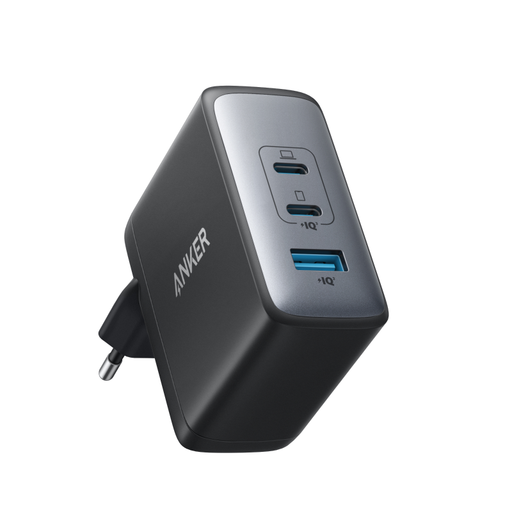
Why this choice? For those who work on the go, this is the ultimate weapon. It can power a MacBook Pro, an iPhone, and AirPods simultaneously, all in a pocket-sized format thanks to GaN II technology.
It delivers a true 100W on a single USB-C port and distributes power intelligently. Its GaN technology ensures a minimal size and controlled heat.
Its 100W output can power the most demanding laptops. The 2 USB-C + 1 USB-A port combo offers maximum versatility.
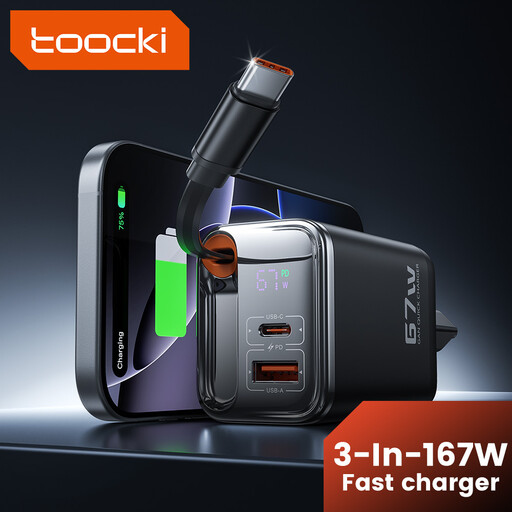
Why this choice? Its integrated retractable USB-C cable is the game-changing detail for those who hate tangled cords. It's the ultimate all-in-one solution, with 67W sufficient for a MacBook Air and other devices.
No need to remember to bring a cable—the classic oversight! The 67W power is clearly stated and the distribution is optimised for multiple uses.
The retractable USB-C cable, for a tidy desk and hassle-free transport. Its 3-in-1 design (cable + 2 ports) is a model of versatility.
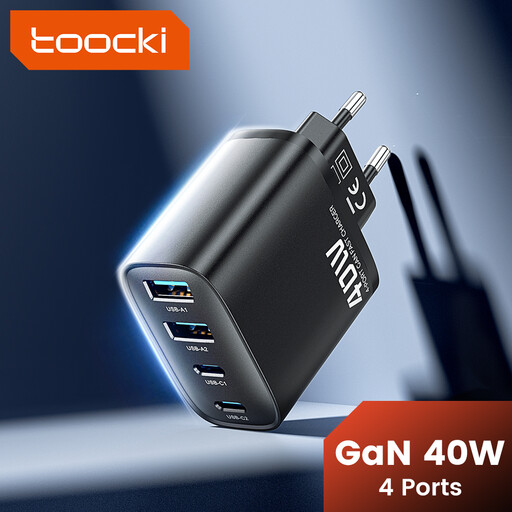
Why this choice? With its four ports, it's the smart solution for centralising the charging of the whole family's devices (smartphones, tablets...) on a nightstand or desk, without breaking the bank.
It doesn't promise insane power, but focuses entirely on versatility with 4 ports. Its 40W is sufficient for smartphones and tablets, avoiding the trap of an overrated power spec.
Four ports to plug in a maximum number of devices. An excellent versatility-to-price ratio for family use where extreme power isn't the priority.
Discover our full selection of chargers that meet our quality criteria and European safety standards.
Yes, without a doubt. For the same power output, a GaN charger is smaller, lighter, and generates less heat than a conventional charger. This improved efficiency translates to less energy waste and greater durability. It's a real advantage, especially for a travel charger.
Absolutely. Modern chargers, especially those compatible with Power Delivery, are "smart." The charger communicates with your device to provide only the maximum power it can safely accept. Using an overpowered charger will not damage your device: it will only "draw" the power it needs, with no risk involved.
It all depends on the build quality and your usage. A well-made charger, equipped with protections against overheating, overvoltage, and short circuits, will serve you faithfully for several years. GaN models, by running cooler, tend to have a longer lifespan, as heat is the number one enemy of electronic components.