
Livraison le jour même ou le lendemain

Qualité garantie

Débloquez vos offres de bienvenue: Livraison GRATUITE | Jusqu'à -80 % | 30 jours d'essai gratuits à JoyPlus
Téléchargez l'application
Does the endless dance of chargers on your desk sound familiar? Laptops, smartphones, tablets, smartwatches... each one demanding its own outlet, quickly turning your space into a tangled mess. For professionals, students, and digital nomads, optimising your workspace and lightening your travel bag has become a constant quest.
A multi-port fast charger is the perfect solution to finally bring order and simplify charging for all your devices. This guide is here to help you cut through the noise and choose the perfect model for your needs by breaking down the essential criteria: power, technology, and compactness.
Before diving into our selection, here are the key points to check to make the right choice.
Power, measured in watts (W), determines charging speed. A laptop like a MacBook Pro requires high power (65?W, 100?W, or more), while a smartphone is happy with 20 to 45?W. The challenge for a good multi-port charger isn't just to boast a high total wattage, but more importantly, to distribute it intelligently among the different ports. Check the maximum power delivered by each USB-C port, especially if you plan to charge a laptop at the same time as other devices.
The acronym GaN stands for gallium nitride. This semiconductor technology allows for the creation of chargers that are smaller, lighter, and more energy-efficient than traditional silicon models. A GaN charger runs cooler, ensuring safer charging and a longer lifespan. For a compact travel charger, GaN technology is now a must-have.
Most modern devices, including recent MacBooks and iPhones, have adopted the USB-C port for its versatility and fast-charging capabilities. A USB-C charging station with several of these ports is therefore a future-proof choice. However, the presence of one or two USB-A ports remains valuable for compatibility with older devices or accessories like smartwatches. Take stock of your daily devices to determine the ideal port configuration.
Here are our current favourites, selected for their technical specs and their ability to meet specific needs.
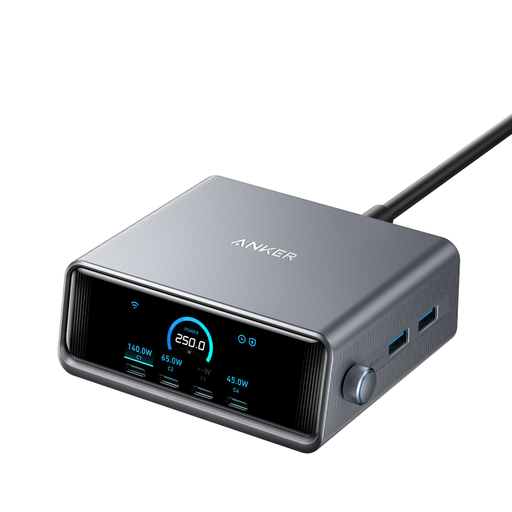
Why it stands out
With a massive 250?W of power distributed across six ports, the Anker Prime 250W is aimed at the most demanding users. It's a true desktop charging station, capable of simultaneously powering multiple power-hungry devices, including two laptops. Its LCD screen is a real bonus, displaying the power delivered by each port in real time, so you can keep everything under control.
Highlights
Who is it for? This model is for desk-bound professionals, content creators, and families who need to centralise charging for numerous devices on a single desk. It's the ideal solution for a complete workstation (computer, tablet, smartphone, accessories).
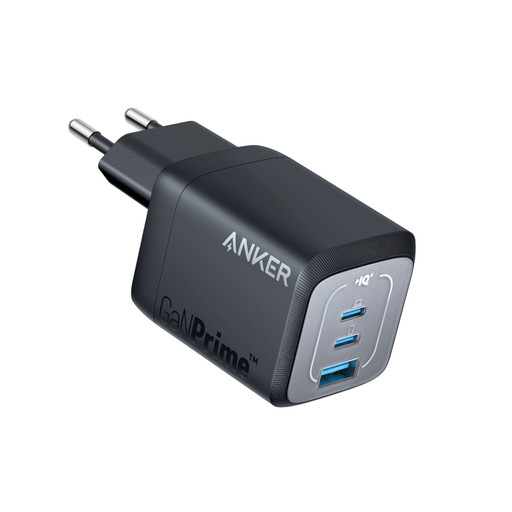
Why it stands out
This GaN charger strikes the perfect balance between power and portability. At 67?W, it's powerful enough to charge a MacBook Air or 13-inch Pro, an iPad, and an iPhone. 51% more compact than the original Apple 67?W charger (according to the brand), it stands out as a top-tier compact travel charger.
Highlights
Who is it for? Ideal for digital nomads, students, and business travellers. It's an excellent charger for MacBook and iPhone that lets you travel light without compromising on charging speed.
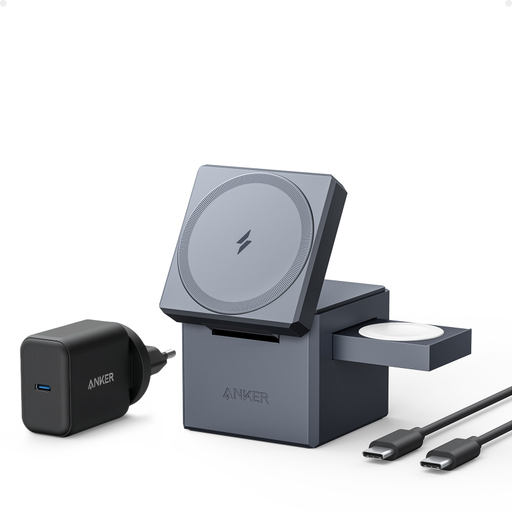
Why it stands out
This 3-in-1 wireless charger was tailor-made for fans of the Apple ecosystem. Its foldable, cubic design is both elegant and extremely practical. It allows you to simultaneously charge an iPhone (via MagSafe), an Apple Watch, and AirPods, all without any messy cables.
Highlights
Who is it for? Exclusively for Apple fans looking for a wireless charging solution that is both sleek and seamlessly integrated. It's the perfect choice to declutter a nightstand or to travel with your entire Apple ecosystem.
Our selection is just a glimpse. To explore an even wider range and find the perfect charger for your devices and budget, check out our full category.
? Discover our entire selection of fast phone chargers
GaN (gallium nitride) technology is a semiconductor material that replaces silicon in modern chargers. It allows for the production of smaller components that conduct electricity more efficiently and generate less heat. In practical terms, a GaN charger is more compact, lighter, and more powerful than a traditional charger of the same wattage.
Yes, it's perfectly safe. Modern devices (smartphones, tablets, etc.) have built-in power management circuits that communicate with the charger to only 'draw' the power they need. Using a 100?W charger for a phone that only accepts 25?W will not damage it; it will simply charge at its maximum speed of 25?W.
Generally, yes. Chargers using the USB Power Delivery (PD) standard for USB-C and Quick Charge (QC) are compatible with a vast majority of devices. However, you should still check that the charger's power output is sufficient for your most power-hungry devices, like a laptop. An Anker fast charger, for example, is typically designed to offer maximum compatibility.