
Livraison le jour même ou le lendemain

Qualité garantie

Débloquez vos offres de bienvenue: Livraison GRATUITE | Jusqu'à -80 % | 30 jours d'essai gratuits à JoyPlus
Téléchargez l'application
A multi-material strong glue can save the day at home, in the workshop or during a creative project. However, not every formula is suitable for the same surfaces or conditions. An instant adhesive that works well on a crack in a figurine will not necessarily replace a mounting adhesive designed for a skirting board or panel.
Before placing your order, don’t focus solely on terms such as ‘super glue’, ‘extra-strong adhesive’ or ‘universal glue’. Compatibility with the materials, texture, strength and drying time are much more revealing. Here are the key criteria to consider to avoid the wrong purchase and choose a glue that is genuinely suited to your needs.
‘Multi-material’ does not mean ‘compatible with everything’. Cyanoacrylate adhesives, often called instant adhesives, generally bond to metal, wood, ceramic, rubber, leather and some plastics. However, polyethylene (PE), polypropylene (PP) and PTFE are often excluded.
You should also check the usage conditions for each product. A plastic adhesive may require an activator, while a universal glue may require at least one of the surfaces to be porous.
A highly fluid glue easily penetrates cracks and small joints. On a wall, sole or vertically positioned part, however, it may run before it sets. A gel glue or flexible formula is generally easier to control.
The packaging also makes a difference. A long nozzle, precision tip or dosage button allows you to apply the required amount without spreading onto nearby areas.
A fast setting time does not mean that the repair can immediately withstand a load, twisting or moisture. Depending on the technology and application, maximum strength may only be reached after several hours or even 24 hours. Follow the stated drying time and avoid putting stress on the joint before it has fully cured.
Start by identifying both materials precisely. A plastic adhesive, metal adhesive, wood adhesive, ceramic adhesive or leather adhesive may not be designed to handle the same conditions.
To give yourself the best chance of success:
When working with difficult-to-bond plastic, test the product first on a concealed area. Products used with an activator are designed to improve adhesion on certain plastics, but their instructions must be followed exactly.
For a bathroom, kitchen, sole or outdoor fixture, look for a water-resistant glue and check its operating temperature range. Resistance to vibration, twisting and ultraviolet light is also important for flexible objects or items exposed to the weather.
The term ‘water-resistant’ does not necessarily mean ‘designed for permanent immersion’. When a fixing needs to support a substantial load, screws or additional mechanical reinforcement may still be essential.
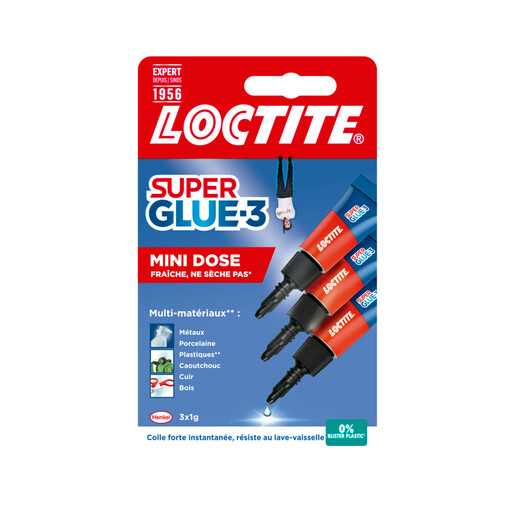
Why this choice suits this profile: Its three 1 g doses are ideal for occasional repairs. There’s no need to leave a large tube to dry out between uses.
The individual doses minimise waste and make it easier to apply the glue to small parts. However, PE, PP and PTFE surfaces are not compatible.
3 × 1 g format, liquid cyanoacrylate and a finish described as transparent.
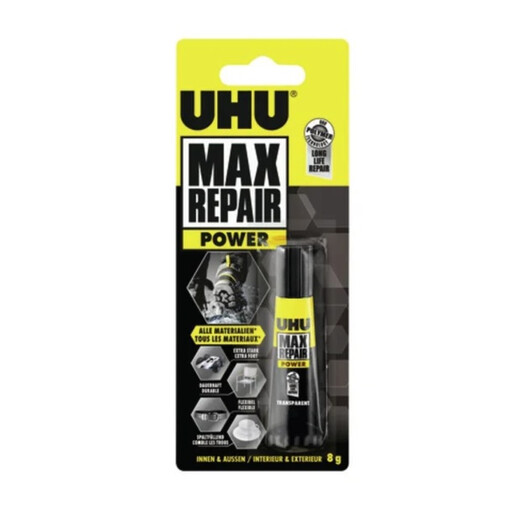
Why this choice suits this profile: This solvent-free polymer adhesive is aimed at users looking for a flexible formula for a range of repairs, both indoors and outdoors.
Its flexible texture is better suited to joints exposed to vibration than a rigid instant adhesive.
Advertised resistance to water, impact and UV, with an operating range of -40 °C to +120 °C.
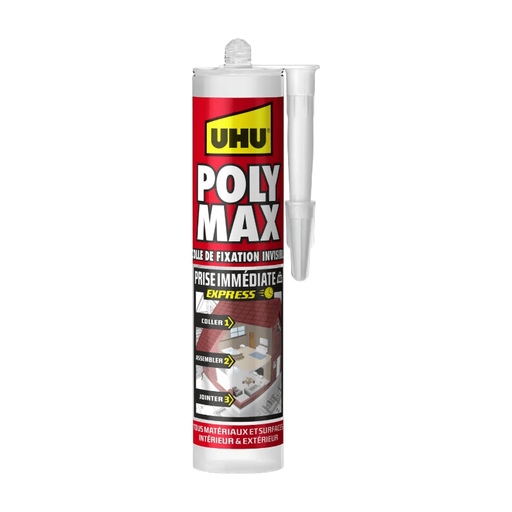
Why this choice suits this profile: With 300 g of product, this cartridge is suitable for assembly, bonding and jointing work carried out with a sealant gun.
Its format and polymer technology are designed for long adhesive lines, unlike a small tube of super glue.
Advertised solvent-free formula, resistance to water and UV, for use from -40 °C to +100 °C.
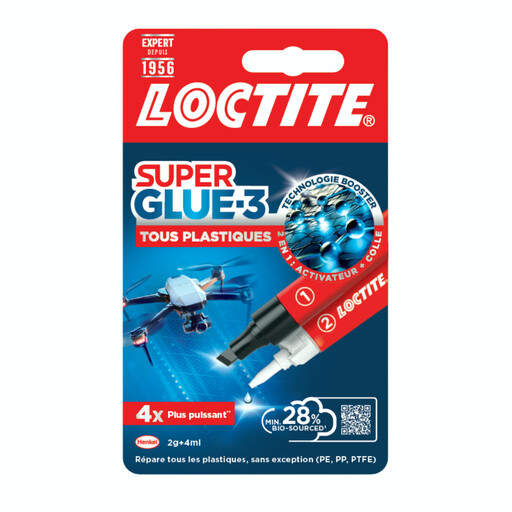
Why this choice suits this profile: This kit combines a 2 g adhesive with a 4 ml activator pen, making it suitable for plastics known to be difficult to bond.
The activator addresses the specific challenges of bonding certain plastics, rather than presenting a standard glue as a universal solution.
Two-step system, transparent application and advertised fast setting time.
We have compiled a comprehensive, real-time updated list of products that meet these demanding selection criteria and European safety regulations.
Cyanoacrylate adhesives can bond skin and eyes in just a few seconds. Wear suitable gloves, work in a well-ventilated area and keep the product out of children’s reach. Never pull apart glued fingers: soak them in warm soapy water and consult the product instructions.
For cartridge mounting adhesive, use a compatible gun and follow the stated application temperature. Where the instructions allow it, wipe away excess adhesive before it hardens. Once dry, it may sometimes need to be removed mechanically.
For small repairs, liquid or gel cyanoacrylate adhesive is often suitable for metal, wood, ceramic, rubber and certain plastics. For a larger fixing or one exposed to movement, a flexible polymer adhesive will generally be more suitable. Always check the list of compatible and excluded materials.
Some products are advertised as water-resistant and may even be suitable for dishwasher use once fully cured. It all depends on the formula: this indication does not guarantee resistance to permanent immersion. Allow the recommended curing time to elapse before exposing the adhesive to moisture.
Close the cap carefully, clean the nozzle if recommended in the instructions and store the product in a cool, dry place away from sunlight and frost. Small single-dose formats reduce the risk of the glue drying out between repairs.