
Livraison le jour même ou le lendemain

Qualité garantie

Débloquez vos offres de bienvenue: Livraison GRATUITE | Jusqu'à -80 % | 30 jours d'essai gratuits à JoyPlus
Téléchargez l'application
A multi-level cat tree can transform a flat into a real playground, with spaces for climbing, resting and scratching. But just because a structure is imposing does not mean it is necessarily right for your home. Between the stated dimensions, flattering photos and promises of stability, certain details can quickly turn an appealing purchase into a disappointing surprise.
Here are the main points to check before choosing an XXL cat tree, a cat scratching tower or a model designed for several pets.
A very tall cat tree can look impressive, but platforms that are too narrow or too far apart make it difficult to move around. An older, heavier or less agile cat may then struggle both to climb up and to get back down.
Check the platform dimensions, the distance between levels and whether the sleeping areas are easily accessible. For a large cat, a wide platform will often be more useful than record-breaking height.
A lightweight base, an unbalanced structure or a lack of fixings can cause wobbling when cats jump from one level to another. The weight stated on the product page is not enough to assess stability: the width of the base, the thickness of the panels and the anti-tip system also play an essential role.
Always place the cat tree on a completely level floor. For very tall models, wall mounting may be a sensible option, provided it is included in the instructions and compatible with the type of wall in your home.
Cushions, hideaways and hammocks quickly collect fur and dust. When they cannot be removed, cleaning soon becomes a chore. Sisal also eventually wears out from scratching, particularly in a home with several cats.
Choose removable or easy-to-vacuum elements and regularly inspect the ropes, screws, hanging toys and platforms.
For one or two small cats, a compact structure may be perfectly adequate. However, for a cat tree for several cats, it is better to have several spaces that can be used at the same time to reduce jostling.
The tall models featured here offer various spaces: hideaways, a hammock, a basket and platforms. However, bear in mind that stated capacity figures are still sales arguments. Focus on the actual dimensions of the sleeping areas and take your cats’ body shape into account.
A 50 × 30 cm platform offers considerably more comfort than a narrow perch. The 212.5 cm model has a platform listed as 60 × 40 cm, a surface that may suit a large cat that likes to stretch out fully. However, these dimensions should be considered alongside the space available in your living room, bedroom or hallway.
Remember to measure the ceiling height too. In a flat, leave enough clearance to prevent the top platform from touching the ceiling or a hanging light fitting.
A cat tree fitted with sisal scratching posts should allow your pet to stretch vertically. Several posts positioned across the different levels can redirect your cat’s attention away from the sofa and curtains, but no single product will protect all your furniture.
Natural sisal meets your cat’s need to scratch. Monitor its condition and replace any elements whose fibres are beginning to come away in large quantities. A separate cat scratching post, placed near a piece of furniture your cat already targets, can effectively complement the set-up.
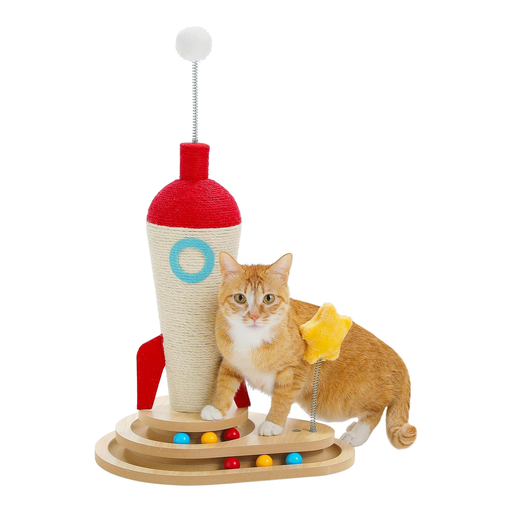
Why this choice suits this profile : At 63 cm tall, with a 40 × 30 cm base, this model is ideal as a first purchase or for a small home where every centimetre counts.
Its solid wood base and vertical post cover the essentials without taking up the space of an XXL cat tree. Supervision is still recommended during the first few uses.
Sisal-covered post, ball track and feather wand. Dimensions : 40 × 30 × 63 cm.
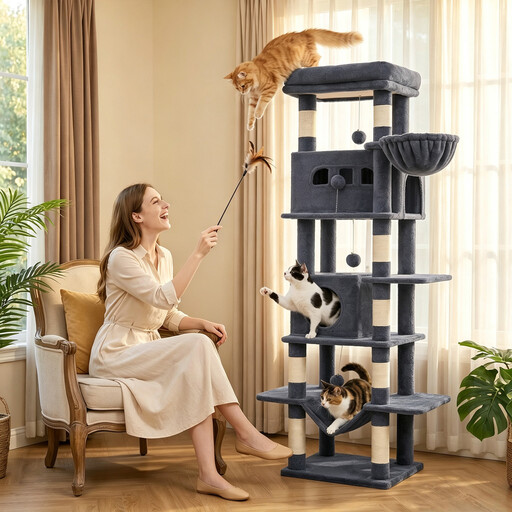
Why this choice suits this profile : Its vertical design is suited to homes with several cats, active pets and anyone who would rather make use of height than floor space.
The reinforced base, thicker panels and anti-tip devices are mentioned on the product page. Securing the unit and regularly checking the fixings remain essential.
Six levels, two hideaways, a hammock, a basket and a 60 × 40 cm platform with a removable cushion.
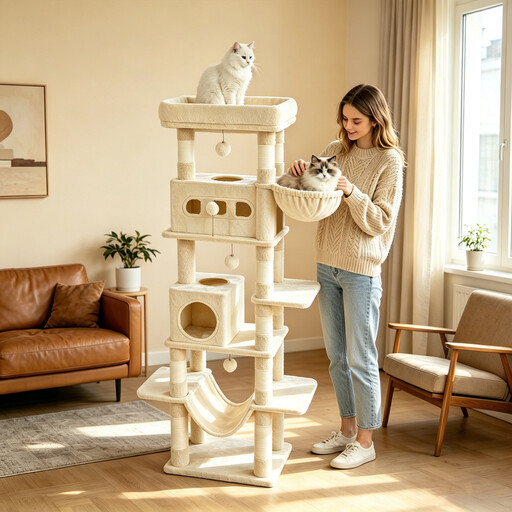
Why this choice suits this profile : This model offers a good balance between height, resting areas and overall footprint, particularly for a home with several cats or a very active large cat.
The eight sisal posts are distributed across the different levels, while the separate spaces prevent all the cats from gathering in the same place.
50 × 30 cm platform, double hideaway, hammock, basket and removable cushions advertised as washable.
We have put together a comprehensive, regularly updated selection of products that meet these exacting criteria, as well as European safety standards.
Before assembly, check that all the parts match the instructions correctly. Tighten the screws gradually, then check the structure after the first few jumps. For a cat tree with hideaways or a cat tree with a hammock, choose a quiet spot that is still close enough to your main living areas to encourage your cat to use it.
A few simple habits can help extend its lifespan:
Lifespan depends on frequency of use, the cats’ weight, humidity and the quality of assembly. Regular inspection is therefore more reliable than a general estimate in years.
Measure the ceiling height and leave a clear area around the structure. A 172.5 cm model will suit many homes, while a 212.5 cm tower requires you to check the available space and the stability of the whole unit carefully.
Yes, provided there are enough platforms and resting areas, and they are sufficiently spacious. For two to six cats, choose several hideaways, a hammock or basket, as well as scratching posts distributed across the different levels. It may also be useful to add a separate scratching post to reduce competition.
Install it on a level floor, tighten each fixing properly and inspect the joints regularly. A wide, reinforced base limits movement, but wall mounting may be worthwhile for taller models if the manufacturer provides for it. Stop using the cat tree if any part is cracked, loose or badly worn.