
Livraison le jour même ou le lendemain

Qualité garantie

Débloquez vos offres de bienvenue: Livraison GRATUITE | Jusqu'à -80 % | 30 jours d'essai gratuits à JoyPlus
Téléchargez l'application
Whether you're a model maker, a 3D printing enthusiast, or a passionate DIYer, the quest for the perfect tool can be a real challenge. A multi-function rotary tool is often the centrepiece of a workshop, capable of sanding, engraving, polishing, cutting, or drilling with pinpoint accuracy. Faced with an overwhelming number of options, it's easy to get lost. Our mission at Joybuy is simple: to give you clear, objective guidance to choose the equipment tailored to your projects, without the unnecessary marketing jargon.
Before diving into our selection, here are the key points to keep in mind to make the right choice.
A rotary tool's performance primarily depends on its rotation speed, measured in revolutions per minute (RPM). A model with variable speed is essential, as it allows you to adapt the speed to the material you're working on?: a low speed for plastic or polishing, and a high speed for metal engraving or cutting.
Also, consider the power source type?:
A multi-function rotary tool is nothing without its accessories. A well-stocked multifunctional tool kit will multiply your possibilities. Check the compatibility and variety of the included bits?: grinding stones, engraving cutters, cutting discs, polishing brushes, etc. For 3D printing enthusiasts, fine sanding accessories are a must for a flawless 3D print finish.
Ergonomics are just as crucial. A lightweight, well-balanced tool reduces fatigue during long sessions. The weight, grip, and ease of changing accessories are factors that will make all the difference in daily use.
We have scrutinised several models based on their technical specifications, versatility, and user feedback. Here are some options that stand out from the crowd, designed for different user profiles.
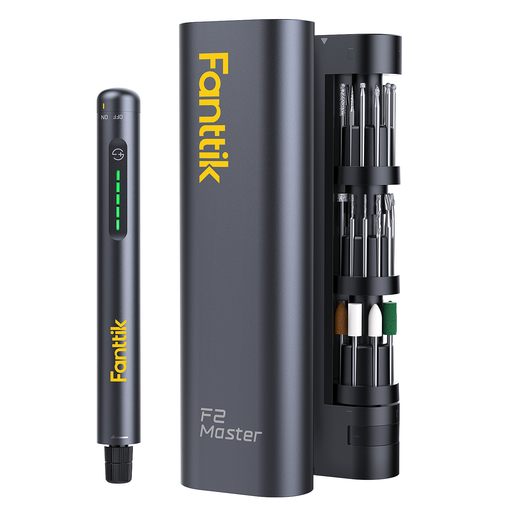
Why it stands out
The Fanttik F2 Master packs a lot of technology into an ultra-compact form factor. Its brushless motor makes it quieter and generates less heat than most traditional models. Its key feature?? The ingenious Revostor storage case, a rotating magnetic stand that organises all 35 accessories and keeps them within easy reach. An excellent example of a modern precision mini drill.
Pros
Who is it for? Ideal for model makers, jewellery creators, and 3D printing enthusiasts looking for a lightweight, precise, and portable tool for detailed finishing work.
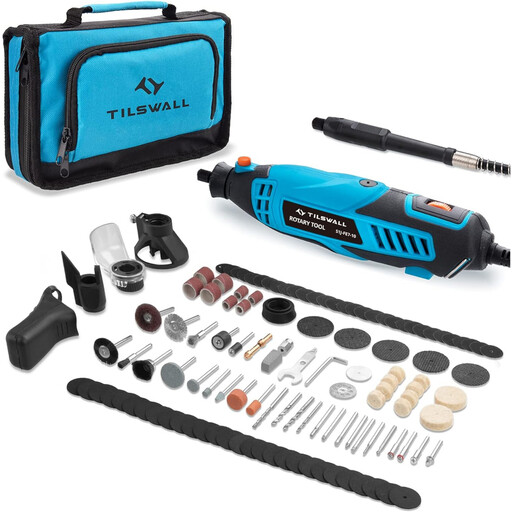
Why it stands out
The Tilswall kit is all about raw power and an ultra-comprehensive set of accessories. With its 160 W motor and a speed range of 8,000 to 33,000 RPM, it isn't afraid to tackle the toughest materials like metal or glass. It stands as a very serious alternative to market leaders like Dremel, including 145 accessories right out of the box for maximum versatility.
Pros
Who is it for? The versatile DIYer who is looking for a robust and powerful corded tool, capable of adapting to a wide variety of projects, from simple polishing to cutting hard materials.
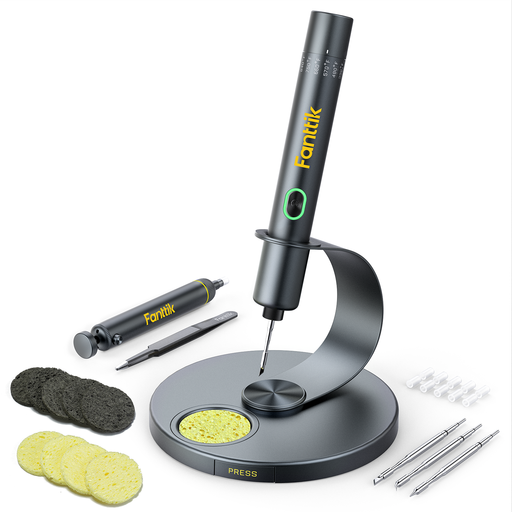
Why it stands out
This isn't a rotary tool, but the Fanttik T1 Max soldering iron is an indispensable companion for many makers and repair technicians. Its ability to operate as a cordless tool or in corded mode gives it formidable flexibility. It stands out for its ultra-fast heating (7 seconds!) and its smart features, like automatic sleep mode.
Pros
Who is it for? Electronics enthusiasts, drone or small appliance repairers, and anyone looking for a precise, fast, and portable soldering iron for their projects.
Our selection highlights tools with distinct profiles, but we know that every project is unique. If you want to explore a wider variety of equipment, more specific kits, or other brands, feel free to browse our catalogue.
Explore our complete collection of DIY kits to find the tool that will be the perfect ally for your next project.
What is the difference between a rotary tool and a standard drill? The fundamental difference lies in their design and use. A standard drill is optimised for torque (rotational force) to drill large-diameter holes. A rotary tool, like an electric engraver, focuses on speed (RPM) and precision, making it ideal for finishing, engraving, polishing, and fine cutting tasks.
Can you use a rotary tool for finishing 3D prints? Absolutely. It's actually one of its key applications. A multi-function rotary tool is perfect for removing print supports, sanding layer lines, smoothing surfaces, and even drilling small holes with high precision. A lightweight, cordless model like the Fanttik F2 Master is ideal for this type of work.
Are accessories universal? Not always. The accessory's shank diameter is the main criterion. Most consumer-grade tools use 3.2 mm (1/8") shanks, but some smaller or precision models may use different diameters, such as 2.3 mm (3/32"). Therefore, be sure to check the compatibility of your tool's collet before buying new accessories. Adapters are available, but it's better to opt for accessories designed specifically for your model.