
Livraison le jour même ou le lendemain

Qualité garantie

Débloquez vos offres de bienvenue: Livraison GRATUITE | Jusqu'à -80 % | 30 jours d'essai gratuits à JoyPlus
Téléchargez l'application
3D printing has revolutionised how creators and professionals bring their ideas to life. The one catch has always been the single-colour constraint, which often required long and tedious painting or assembly sessions. For seasoned makers and professionals alike, time is money. Fortunately, a new generation of 3D printers capable of natively handling multiple colours is changing the game.
In this guide, we'll break down the essential criteria for choosing the multi-colour 3D printer that will truly meet your needs, focusing on the features that will boost your productivity.
Before jumping on a specific model, let's review the technical specifications that separate a gadget from a true production machine for colour 3D printing.
In a professional context, whether for rapid prototyping or small-batch production, speed is king. A fast 3D printer at 600 mm/s can cut your production times in half, or even more. Be aware, however, that such speed is only meaningful if it's supported by a rigid frame and precise motors; otherwise, you risk sacrificing quality for the sake of speed. Additionally, a large-volume 3D printer will give you the freedom to create XXL parts in a single run or launch batch productions, a real asset for optimising your workflow.
The magic of multi-colour printing obviously lies in filament management. The CFS (Color Filament System) particularly stands out. In practice, it's an external unit that houses multiple spools and feeds them, one by one, to a single extruder. This mechanism ensures automatic and rapid colour changes during printing, allowing you to create complex models without any manual intervention. The real bonus? The ability to chain multiple CFS units to manage up to 16 colours, letting you think big for your projects.
A professional FDM 3D printer must, above all, be rock-solid, especially when launching prints that last for dozens of hours. Features like automatic bed levelling are now standard. The smartest systems go even further: instead of probing the entire surface, they focus on the actual print area for faster and more precise calibration. The icing on the cake is the integration of an AI-powered camera to detect failures (the infamous "spaghetti monsters") and monitor the print remotely, offering invaluable peace of mind. No more wasted filament and lost hours!
Keeping these criteria in mind, we've reviewed the new K2 series from Creality, which checks all the boxes for demanding users and professionals.

Why it stands out The Creality K2 Combo is the Swiss Army knife of the range: an excellent balance of performance, volume, and cutting-edge features. Shipped with its CFS unit, it's ready to print in 4 colours right out of the box, with the potential to expand to 16 colours. Its reinforced chassis and servo-assisted stepper motors ensure impeccable print quality, even at full speed.
Benefits
Who is it for? For seasoned makers and small businesses who want a reliable and high-performance colour 3D printing solution without needing a massive build volume.
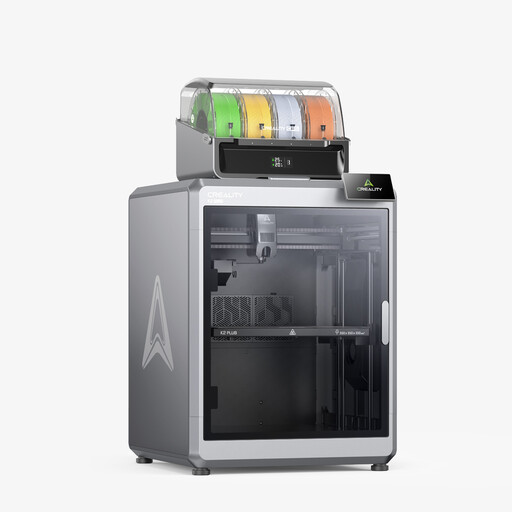
Why it stands out The K2 Plus Combo is the model for those who think big. Its XXL build volume of 350×350×350 mm opens up a world of possibilities: full-scale functional prototypes, wear parts, or batch production of small objects. Its active chamber, which maintains a temperature of 60°C, and its nozzle capable of reaching 350°C make it compatible with the most advanced filaments (PA-CF, ASA, etc.).
Benefits
Who is it for? For professionals, engineers, and designers who need to produce large multi-colour parts or use technical materials for functional prototypes and end-use parts.
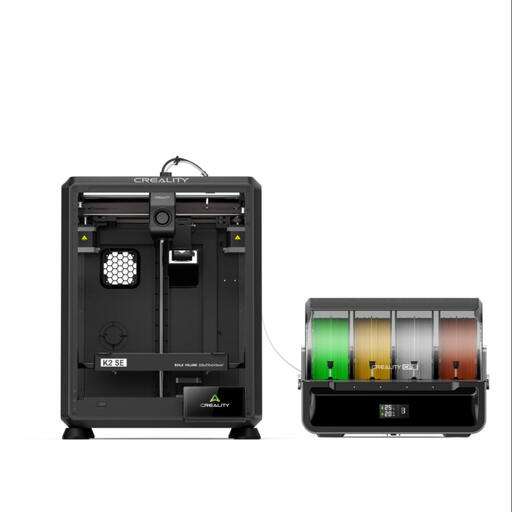
Why it stands out The K2 SE Combo makes high-speed, multi-colour 3D printing accessible. Though more compact, it makes no compromises on the essentials. It features the same CFS ecosystem and benefits from a one-piece die-cast aluminium alloy frame for rock-solid rigidity. Its smart automatic levelling and latest-generation extruder make it a reliable and very easy-to-use machine.
Benefits
Who is it for? For 3D printing enthusiasts who want to take it to the next level and dive into multi-colour printing with a high-performance, robust machine, without needing a very large build volume.
Our selection highlights models that offer an integrated and optimised ecosystem for high-speed multi-colour printing. The 3D printing market is vast and moves very fast. If these machines don't check all your boxes, be aware that many other configurations and technologies exist.
For a broader overview, feel free to browse our complete category of multi-colour 3D printers.
An IDEX (Independent Dual Extruder) printer has two independent print heads. It can therefore print in two colours/materials at the same time, or even print two identical parts simultaneously (mirror or duplication mode). A system like CFS, on the other hand, uses a single extruder fed by multiple filaments. To change colours, it uses a "purge tower" on the side of the build plate. The advantage of CFS? Its scalability (up to 16 colours!) and much simpler calibration. IDEX, for its part, will often be faster for two-colour prints because it doesn't need to purge.
Let's be clear: yes, multi-colour printing takes more time. With each colour change, the printer must stop extruding, retract the filament, load the next one, and purge the nozzle into a dedicated tower to ensure a pure colour. All these steps add to the overall print time. That said, ultra-fast modern machines like the Creality K2 series mitigate the impact thanks to their blazing travel speeds and highly optimised filament-changing systems.
It all depends on the model! The K2 and K2 SE are perfect for standard materials like PLA, PETG, ABS, and even PLA-CF. The K2 Plus, with its heated chamber and high-temperature nozzle, takes it to the next level: it accepts much more technical materials like PA-CF (carbon fibre-reinforced nylon), ASA, or PPA-CF. It's the ideal machine for engineering applications.