
Livraison le jour même ou le lendemain

Qualité garantie

Débloquez vos offres de bienvenue: Livraison GRATUITE | Jusqu'à -80 % | 30 jours d'essai gratuits à JoyPlus
Téléchargez l'application
Navigating the crowded coffee machine market can be overwhelming. Between proprietary pod systems, marketing promises, and a multitude of features, it's easy to end up with buyer's remorse. On paper, the multi-capsule coffee machine seems to have it all?: flexibility, cost savings, and the promise of freedom from a single brand's ecosystem. However, not all machines are created equal. This guide is here to help you see clearly, avoid the marketing traps, and make the right choice.
The market is saturated with models boasting tempting features. Unfortunately, some of these hide flaws that can make daily use frustrating. Here are the red flags you should never ignore.
To avoid falling for marketing hype, focus on a few tangible technical parameters. They are the true indicators of your future machine's performance and durability.
The adapters are the true heart of a multi-capsule coffee machine. Instead of relying on a simple compatibility list, scrutinise their design.
As we've seen, a 20-bar coffee machine label alone guarantees nothing. What matters is the stability of that pressure throughout the entire extraction cycle. A good heating system (thermocoil or thermoblock) ensures a rapid heat-up time and, most importantly, a consistent water temperature. This combination is what guarantees a rich crema and unlocks all the aromas, whether you're using a capsule or your favourite ground coffee.
Beyond a simple espresso, some options can be real game-changers?:
Every user has different needs. Here are a few options that cater to specific profiles, taking into account our performance and reliability criteria.
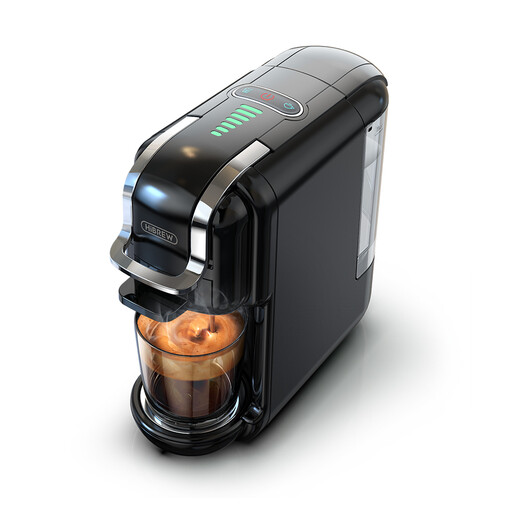
Perfect for families or the undecided who refuse to pick a side between Nespresso, Dolce Gusto, and ground coffee. Compact and versatile, it establishes itself as the kitchen's coffee hub, ready to please everyone.
It uses robust, dedicated drawer-style adapters for each system, avoiding the "false compatibility" trap. Its ease of use prevents excessive complexity.
5-in-1 compatibility (including DG capsules and ground coffee). Hot/cold mode for year-round use.
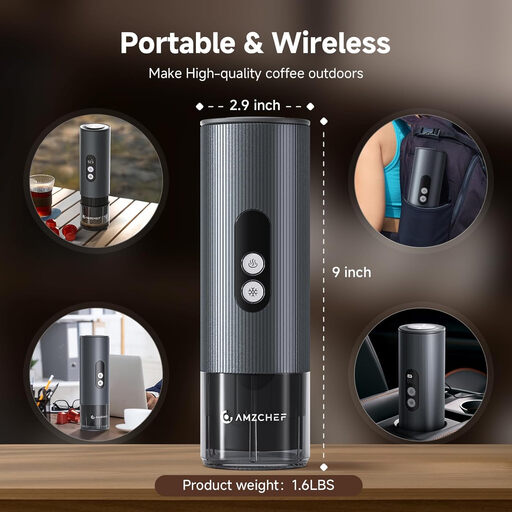
The perfect companion for those on the go (car, camping, office) or living in a studio. Its built-in battery heats the water, and its 20-bar pressure ensures a true espresso anywhere, without needing an outlet.
It doesn't overstate its pressure : the 20 bars are effective thanks to a powerful pump and rapid heating, avoiding the marketing pressure trap. Its design is entirely focused on portability, with no unnecessary complexity.
Full autonomy with a 9000 mAh battery and integrated water heating. Genuine 20-bar pressure for a professional-quality crema. Compatible with NS capsules and ground coffee.

For those who want to level up and delve into the art of espresso. This semi-automatic machine offers full control over ground coffee, with a steam wand for barista-quality cappuccinos and lattes. It's the perfect gateway from the simplicity of capsules to the world of the barista.
It focuses on one thing and does it well : extracting ground coffee. It avoids the trap of flimsy multi-compatibility by offering a robust, semi-professional experience focused on espresso quality.
Dual boiler for optimal temperature stability. Automatic milk frother. Adjustable temperature control. For total control, pair it with a precision electric coffee grinder.
We have curated a complete selection of products that meet our selection criteria and current safety standards.
What is the lifespan of a multi-capsule coffee machine? Its longevity depends on its build quality, but especially on its maintenance. On average, a well-maintained model can last for 5 to 7 years. The crucial point is regular descaling (every 2-3 months, depending on your water hardness) to protect the heating system and pump from limescale.
Are the adapters for different capsules truly reliable? Their reliability varies greatly from one model to another. Systems with interchangeable drawers designed by the machine's manufacturer are generally more robust and effective than universal adapters sold separately. Before buying, it is highly recommended to check user reviews regarding the ease of handling and durability of these parts.
Does a 20-bar machine make better coffee than a 15-bar machine? Not necessarily. For an espresso, a stable pressure of around 9 bars at the coffee puck is considered ideal. Manufacturers advertise the pump's maximum pressure (15, 19, or 20 bars), which is primarily a marketing figure. A 15-bar machine with excellent temperature control will produce better coffee than an unstable 20-bar machine. The stability of the pressure and temperature is more important than the raw number.