Someone who lives alone and measures their breakfast
If you serve muesli from a large pack, weighing the amount you pour lets you stick to a set portion instead of filling your bowl by eye.


For breakfast for one when shopping with diabetes in mind, compare the carbohydrates in the amount of muesli you actually serve. The words “no added sugar” aren’t enough to judge what’s in your bowl. You can weigh muesli from a larger pack or porridge oats at home. If you prefer a single-serve sachet, check its weight and nutritional information before choosing it.
If you serve muesli from a large pack, weighing the amount you pour lets you stick to a set portion instead of filling your bowl by eye.
Looking for a recipe labelled “no added sugar”? Check the carbohydrates and sugars in the nutritional information too, along with any dried fruit in the ingredients list.
Check the ingredients and any “may contain” warnings for every product you buy, particularly if you need to avoid gluten-containing cereals, nuts, milk, soya or sesame.
Start with the amount you plan to serve, then compare the nutritional information and ingredients for the recipe you’ve chosen.
| Criterion | What to check | Who is it for? |
|---|---|---|
| Carbohydrates in your portion | The actual weight you serve and the carbohydrates in that amount. | When making a bowl for myself, I want to be able to measure what I pour so I can keep the portion consistent. Around 44% of consumers would prioritise this control over portion size. |
| Recipe and sugars | The carbohydrates and sugars shown on the label, followed by the cereals and dried fruit in the ingredients. | The words “no added sugar” don’t tell me, by themselves, what’s in my bowl. Nearly 33% of consumers would prioritise comparing recipes and their nutritional information. |
| Allergens and pack size | Any allergens and “may contain” warnings, as well as the pack weight if you’re preparing portions in advance. | If I need to avoid certain ingredients, I need a recipe I can check and packaging that works for everyday use. Around 23% of consumers would put these two needs first. |
This claim doesn’t tell you the total carbohydrates in your bowl. The ingredients lists published by Carrefour France for Bjorg and Carrefour Bio muesli include cereals and dried fruit, among other ingredients.
Compare the carbohydrates in the amount you serve and read the ingredients list, rather than relying on the claim on the front of the pack.
The Carrefour Bio and Bjorg products featured by Carrefour France come in a 375 g pack and a 750 g box respectively. The total pack weight doesn’t tell you how much to serve in a bowl.
If you choose a pack, measure out the portions you’d like to prepare in advance rather than assuming it contains individual servings.
Ingredients and potential traces vary between muesli products. The product information for Carrefour Bio Fruit Muesli published by Carrefour France notes possible traces of nuts, sesame and soya, among other allergens.
Check the ingredients and allergen information on the specific pack you’re buying.
Carrefour France lists a 375 g pack of Carrefour Bio Organic Fruit Muesli with No Added Sugar.
Carrefour France lists a 750 g box of Bjorg Organic Raisin, Date and Fig Muesli with No Added Sugar.
Carrefour France lists a Jordans product made with cereals and 33% dried fruit, nuts and seeds.
These products offer two ways to prepare breakfast for one: serve muesli from a pack or measure out porridge oats yourself. The weight shown is for the whole pack, not an individual portion.
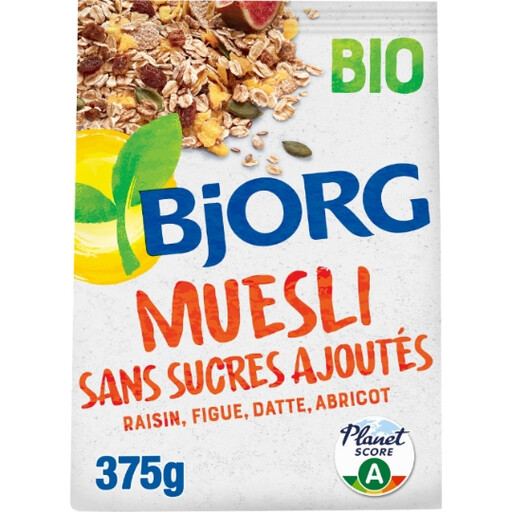 Image unavailable
For a bowl made from a muesli mix in a pack: weigh the amount you serve and check the nutritional information for this product. The pack contains 375 g; its total weight isn’t the same as an individual portion.
 Image unavailable
For a breakfast base where you measure the amount yourself. This 500 g pack contains porridge oats, not muesli or pre-portioned servings. Check its nutritional information for the amount you serve.
No: this claim doesn’t tell you the carbohydrates in the amount you’ll serve. Check the nutritional information and ingredients for the product you’ve chosen, particularly if it contains dried fruit.
There isn’t one set amount that suits everyone. On its page about breakfast with gestational diabetes, the Fédération Française des Diabétiques gives the example of 30 to 40 g of porridge oats with 125 ml of milk or another dairy product. The amount that’s right for you depends on your whole meal and the advice you’ve been given as part of your care.
You can use it to prepare portions at home, but it isn’t the same as sachets that are already portioned out. Check the weight of each portion you prepare and use the nutritional information for that specific product.
Before buying, read the ingredients and any “may contain” warnings for the exact product. Depending on the recipes listed by Carrefour France, things to check may include gluten-containing cereals, nuts, milk, sesame or soya.