For Sunday brunch, choose muesli labelled ‘sugar-free’ if that’s a firm requirement. Under Regulation (EC) No 1924/2006, published on EUR-Lex, this claim means the product contains no more than 0.5 g of sugars per 100 g of solid food. If you’re happy with sugars naturally present in fruit, muesli labelled ‘no added sugar’ may suit you. In that case, compare the ‘of which sugars’ figure per 100 g and check the packet for allergen information.
Who is this choice for?
Anyone looking for a ‘sugar-free’ label
If this label is essential for your brunch, don’t confuse it with ‘no added sugar’. Regulation (EC) No 1924/2006, published on EUR-Lex, sets a maximum of 0.5 g of sugars per 100 g for the ‘sugar-free’ claim on solid foods.
Fans of fruity muesli with no added sugar
You want to avoid added sugar but are happy with sugars naturally present in fruit. The label on the front of the pack doesn’t replace checking the ‘of which sugars’ figure per 100 g: Auchan’s product information for Bjorg Superfruits lists 13 g of sugars per 100 g.
Hosts who keep an eye on allergens
When several people are sharing brunch, check the ingredients and any ‘may contain’ information on every packet. France’s Directorate-General for Competition Policy, Consumer Affairs and Fraud Control reminds consumers that allergenic ingredients must be highlighted on food labels.
What should you look for?
First decide whether you’re looking for ‘sugar-free’ or ‘no added sugar’. Then check the recipe against the needs of everyone at brunch.
| What to check |
Look for |
Who is it for? |
| Sugar claim |
Read the exact claim, then check ‘of which sugars’ per 100 g. Regulation (EC) No 1924/2006, published on EUR-Lex, distinguishes between ‘sugar-free’ and ‘no added sugar’. |
If I’m specifically looking for ‘sugar-free’ muesli, a recipe labelled only ‘no added sugar’ doesn’t meet my requirement; around 36% of consumers put this distinction first. |
| Ingredients and allergens |
Check the ingredients list and any highlighted allergens on the packet you plan to serve. |
If I’m sharing muesli with guests who need to avoid certain ingredients, I need to know what’s in it before serving; around 29% of consumers prioritise this compatibility. |
| Mix and ingredients |
Compare the fruit, wholegrains, fibre and sugars per 100 g. Don’t assume you know what’s in the mix just because it says ‘organic’. |
I want to serve fruity muesli at brunch and know what’s in the mix; around 21% of consumers make this their top priority. |
| Pack size and availability |
Check the pack size and make sure your chosen product is available from your retailer. |
When several people are coming to brunch, I want a suitable pack size and a product I can get from my retailer; this comes first for around 14% of consumers. |
Mistakes to avoid
-
Confusing ‘no added sugar’ with ‘sugar-free’
Dried fruit can contribute naturally occurring sugars to muesli with no added sugar. Auchan’s product information for Bjorg Superfruits lists 13 g of sugars per 100 g.
If you’re looking for a ‘sugar-free’ label, check the packet and read the sugar content per 100 g.
-
Relying on ‘organic’ or ‘wholegrain’ without checking the recipe
These terms don’t tell you whether sugar has been added. Kellogg’s France lists sugar and glucose syrup among the ingredients in Country Store.
Before choosing your muesli, check the ingredients list as well as the nutritional information per 100 g.
-
Forgetting about allergens when sharing muesli
A recipe made with cereals, fruit and seeds may contain ingredients or carry ‘may contain’ warnings that matter to some guests. The label ‘no added sugar’ doesn’t tell you anything about this.
Check the packaging of the product you buy and keep it to hand when you serve brunch.
Muesli brands to know
Bjorg
Auchan’s organic Superfruits option is a fruit muesli with no added sugar.
- It combines wholegrain cereals and fruit.
- Its product information lists 13 g of sugars per 100 g, so it doesn’t meet the ‘sugar-free’ claim.
Carrefour Bio
Carrefour offers Organic Fruit Muesli with No Added Sugar in a 375 g pack.
- The ingredients list includes wholegrain oat and rye flakes, as well as raisins.
- Oats and rye are among the ingredients, so check the label if any guests need to avoid certain cereals.
Happy Bio
Auchan offers Happy Bio organic muesli with no added sugar in a 375 g pack.
- Auchan’s product information lists 8.8 g of fibre per 100 g.
- It also lists 11 g of sugars per 100 g: ‘no added sugar’ doesn’t mean ‘sugar-free’.
Kellogg’s
Country Store is a muesli recipe from Kellogg’s France.
- It’s an option if you’re looking for a classic muesli and added sugar isn’t a concern.
- The ingredients list includes sugar and glucose syrup, so Country Store isn’t suitable if you’re looking for muesli with ‘no added sugar’.
A selection of muesli on Joybuy
This selection is for a brunch where naturally occurring sugars are fine. If you need a ‘sugar-free’ product, check the packaging for this claim before choosing.
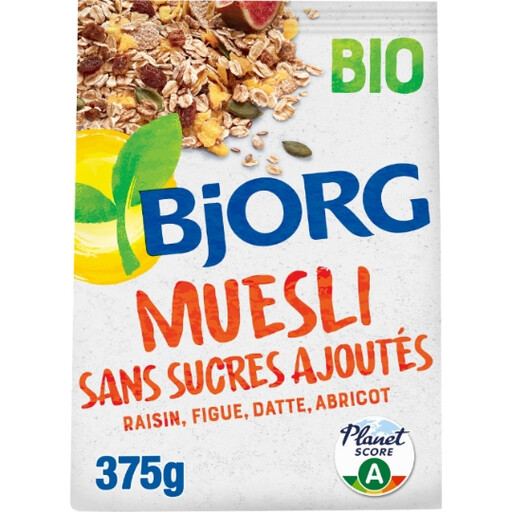 Image unavailable
Bjorg organic muesli 375 g
Worth considering for a muesli-based brunch if you’re happy with naturally occurring sugars. This product comes in a 375 g pack. Before serving, check the packaging for the sugar claim, nutritional information and allergens.
View on Joybuy
Frequently asked questions
Does ‘no added sugar’ mean ‘sugar-free’?
No. Under Regulation (EC) No 1924/2006, published on EUR-Lex, ‘no added sugar’ means that certain sugars, or ingredients used for their sweetening properties, haven’t been added. Sugars naturally present in the product may still remain. To carry the ‘sugar-free’ claim, solid muesli must contain no more than 0.5 g of sugars per 100 g.
How do you compare two types of muesli for brunch?
Compare the nutritional information per 100 g, especially the ‘of which sugars’ figure, then check the ingredients and pack size. France’s Directorate-General for Competition Policy, Consumer Affairs and Fraud Control explains that nutritional information presented per 100 g makes it easier to compare products.
How do you check for allergens before serving guests?
Read the ingredients list and any ‘may contain’ information on the packet you’re going to serve. France’s Directorate-General for Competition Policy, Consumer Affairs and Fraud Control reminds consumers that allergenic ingredients must be highlighted on food labels. Organic or no-added-sugar muesli can still contain allergens.
How should you store muesli after opening?
Reseal the bag and keep it somewhere dry, away from moisture. Follow any specific storage instructions on the packet you’ve bought.


