People who pay attention to labels
You want to be able to spot the blue MSC label on the tin you’ve chosen, rather than relying on a brand’s general commitment.


To choose tinned tuna with verifiable fishing credentials, look for the blue MSC label on the specific tin you’re buying: it doesn’t apply to every product from a brand. For a picnic, choose between tuna in spring water that you can season yourself, a product labelled ‘no draining required’ to cut down on handling, or tuna in oil to suit your recipe. Then check the pack size and storage instructions for after opening.
You want to be able to spot the blue MSC label on the tin you’ve chosen, rather than relying on a brand’s general commitment.
You’re looking for a pack that’s easy to add to food you’re taking out with you. A product that’s already drained can mean less handling at mealtimes.
You want a ready-seasoned filling and are comparing the type of oil, ingredients and nutritional information of the products you’re considering.
First, check the label on the specific product. Then choose a pack to suit your recipe and how you’ll store the tin after opening.
| What to consider | What to check | Who is this for? |
|---|---|---|
| Product certification | Look for the blue MSC label on the specific tin. According to the Marine Stewardship Council, it applies to wild-caught fish from fisheries that have been independently assessed. | If I want to check the fishing practices linked to my purchase, a brand’s general promise isn’t enough. Around 36% of consumers prioritise this verifiable certification. |
| Serving away from home | Compare the pack size, drained net weight and whether the specific product says ‘no draining required’. | When making sandwiches on the go, I’d rather avoid spills and extra handling. Ease of serving comes ahead of other criteria for around 29% of consumers. |
| Recipe and ingredients | Choose between tuna in spring water and tuna in oil by checking the ingredients, type of oil and nutritional information. | If I’m seasoning a salad myself, tuna in spring water meets a different need from tuna already packed in oil. Around 21% of consumers put how well it suits their recipe first. |
| Condition and storage | Inspect the tin and read the storage instructions for after opening, especially if you won’t use the whole contents. | On a long day out, or when I have a large tin, I need to be able to store any leftovers as directed on the packaging. For around 14% of consumers, managing leftovers is the main concern. |
A brand may offer some products bearing the MSC label and others covered by a different initiative.
Check for the blue label on the product you plan to take with you. Don’t assume it’s certified just because of the brand name.
For a recipe, the amount of tuna you can use matters more than the total weight of a tin containing water or oil.
Compare the drained net weight, ingredients and pack size of products that suit your recipe.
The DGCCRF says that dents, rust or bulging may indicate that a tin has deteriorated.
Inspect the tin before you leave and, if you’re unsure about its condition, don’t eat the contents.
Once opened, the storage instructions printed on the product must be followed. Unused tuna can no longer be stored like an unopened tin.
Choose a portion that’s right for your meal, or take a food-safe container and a way to keep it cool so you can follow the instructions on the tin you’ve bought.
The brand offers MSC-certified white tuna in spring water in 160 g or 2 × 80 g packs, as well as whole MSC-certified tuna in olive oil.
Auchan lists a 186 g tin of Saupiquet whole MSC-certified tuna in spring water, labelled ‘no draining required’.
Pêche Océan product listings include 112 g of MSC-certified white tuna in spring water and 160 g of MSC-certified skipjack tuna in sunflower oil.
Lidl lists a 750 g pack of Sol&Mar MSC-certified skipjack tuna in sunflower oil, with a drained net weight of 750 g.
A Carrefour listing features a 120 g tin of Petit Navire whole MSC-certified tuna in spring water, already drained.
Auchan’s tuna range includes MSC-certified products from Petit Navire and Saupiquet.
This tuna in spring water can be used in a salad or sandwich to take with you. Check for the MSC label on the tin you receive.
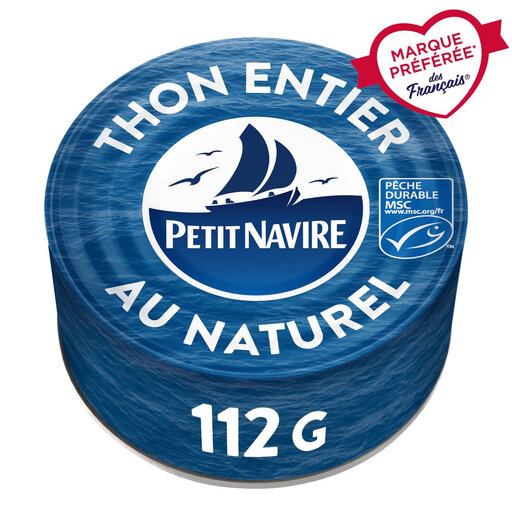 Image unavailable
For a salad or sandwich, this tuna in spring water lets you choose how to season your dish.
Total weight: 160 g; drained net weight: 112 g.
After opening, follow the storage instructions on the tin.
According to the Marine Stewardship Council, it indicates that the wild-caught fish comes from fishing practices independently assessed against its environmental requirements. Check that the label appears on the product you buy: it doesn’t, by itself, tell you about the recipe or storage conditions.
No, certification must be checked product by product. Petit Navire lists products explicitly marked as MSC-certified as well as products described as part of an initiative aiming for certification; these claims aren’t equivalent.
Compare the ingredients and net quantity. If the tuna is packed in a liquid, check its drained net weight too. The DGCCRF says this must be shown on the label in that case. Nutritional information and storage instructions can also help you choose between products.
Follow the instructions for the product you’ve bought, and take something to keep it cool if you need to store a portion while you’re out. For the 186 g tin of Saupiquet whole MSC-certified tuna in spring water listed by Auchan, the instructions are to transfer any leftovers to a suitable food container, keep them between 0 and 4 °C and eat them within 48 hours. Don’t automatically apply these instructions to other tins.
No, the MSC label relates to fishing practices, not exposure to methylmercury. Anses has specific recommendations about eating fish for pregnant or breastfeeding women and children under 3. The label doesn’t replace this advice.