People who have a cold lunch at work
If you’re short on time and don’t want to cook, drained fillets can be added to bread or a salad. For example, Carrefour says its MSC-certified sardine fillets in brine can be eaten cold once drained.


If certified fishing is your priority, look for the blue MSC label on the specific tin of sardines you plan to buy. According to the Marine Stewardship Council, it identifies wild-caught fish from a fishery assessed against its environmental standard, but it says nothing about the recipe or its nutritional values. For a cold lunch at work, choose a convenient option to prepare, then compare the ingredients, nutritional information and drained weight to suit your preferences.
If you’re short on time and don’t want to cook, drained fillets can be added to bread or a salad. For example, Carrefour says its MSC-certified sardine fillets in brine can be eaten cold once drained.
If certification guides your choice, check for the blue MSC label on the product you’re buying. The Marine Stewardship Council associates this label with a fishery assessed against its environmental requirements; a brand name alone doesn’t mean all its sardines are certified.
If the amount of oil, salt or the pack size matters for your lunch, check the ingredients and nutritional values on each tin. Saupiquet’s product information for its sardine fillets in brine and in olive oil shows different recipes and nutritional values, so be sure to check the basis on which they’re given, too.
For a lunch at work, first check the label if certification is important to you. Then choose a convenient preparation and a recipe that suits your preferences.
| Criteria | What to check | Who it matters to |
|---|---|---|
| Certified fishing | Look for the blue MSC label on the specific tin; don’t assume it applies to an entire range. | I want to be able to identify a fishing certification for my sardines, even if I also like the recipe. Around 37% of consumers would make this their priority. |
| Preparation at work | Check whether the sardines can be eaten cold once drained, and choose between fillets and whole sardines depending on how you want to prepare them. | When my lunch break is short and I can’t heat up my meal, I mainly look for a tin that’s easy to serve. Convenience would come first for around 27% of consumers. |
| Recipe and ingredients | Compare the ingredients, fat and salt per 100 g on a like-for-like basis: either the product as sold or the drained product. | If I’m already adding a dressing to my lunch, I want to make an informed choice between a recipe in brine and one in oil. Around 18% of consumers would prioritise the ingredients. |
| Tin size | Check the net weight, drained weight and how many portions you plan to use. | When planning my lunches, I’d rather choose an amount that matches what I’ll eat than go by the tin’s apparent size alone. Pack size would be the priority for around 18% of consumers. |
A brand may offer several recipes, but not all of them will carry the MSC label. According to the Marine Stewardship Council, the blue label identifies fish from a fishery assessed against its standard.
If this matters to you, check the logo on the tin or the product listing for the exact product.
A value per 100 g of product including its oil can’t be compared directly with a value per 100 g of drained sardines.
Check the basis shown on each pack before comparing the fat or salt in recipes in brine and in oil.
A product listing for sardines may still be available to view even when the product is out of stock at your chosen shop.
Check that the specific tin is available before planning several lunches around it.
Storage instructions after opening vary by product. For its sardine fillets in brine and olive oil, Saupiquet says to keep them in the fridge and eat them within two days.
Choose an amount that suits your meal, or follow the instructions on the tin to store any leftovers.
Any portion you can’t store as directed could go to waste.
Check the recipe, pack size and any MSC certification for each product individually, even within the same brand.
Saupiquet offers sardine fillets in brine and in olive oil, among other options. Both recipes are worth considering for a cold lunch.
Connétable offers sardines without oil, in oil and with added flavourings, so you can choose to suit the meal you have in mind.
A Carrefour listing describes MSC-certified sardine fillets in brine, which should be drained and eaten cold.
Auchan lists a Parmentier product of whole sardines in extra virgin olive oil carrying the MSC label.
The range listed by E.Leclerc includes different pack sizes and sardine recipes to compare, depending on the lunch you’re planning.
These Joybuy tinned sardines let you choose between recipes in olive oil and one in water for a quick meal. If MSC-certified fishing is a must, check the label on the specific product before you buy.
 Image unavailable
An olive oil recipe to consider if you want to enjoy sardines at work without cooking.
135 g tin. If the MSC label is essential to your choice, check that it’s shown on this product. Be sure to follow the storage instructions after opening, too.
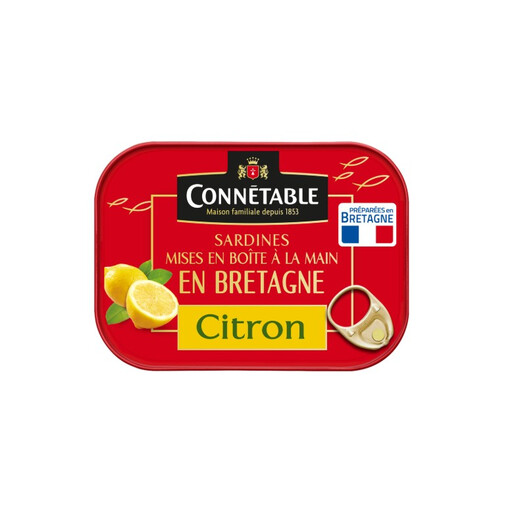 Image unavailable
A lemon-flavoured recipe for a no-cook lunch, ideal if you prefer your sardines already seasoned.
1/6 tin, 115 g. If certification is your top priority, check for the MSC label on this product. If you don’t finish the tin, check the storage instructions, too.
 Image unavailable
Worth considering for a quick lunch if you’re looking for small sardines in olive oil.
The title gives weights of 115 g and 81 g; check the label to understand what each weight refers to before comparing this tin with other sizes. Check separately for the MSC label if needed.
 Image unavailable
A spicy recipe to consider for enjoying sardines at work without cooking.
1/6 tin, 115 g, in olive oil with Espelette pepper. Check for the MSC label if you’re looking for certified fishing, and read the instructions for after opening.
 Image unavailable
Worth considering for a cold lunch if you prefer sardines without the central bone and in water rather than oil.
98 g tin. Compare this product’s ingredients and nutritional values with those of the sardines in oil, and check for the MSC label if certification matters to you.
According to the Marine Stewardship Council, its blue label means that the wild-caught fish comes from a fishery independently assessed against its environmental requirements. It doesn’t tell you about the amount of oil, the salt or the flavour, so check these details on the tin you choose.
Yes, if the instructions for the product say it can be eaten cold. For example, Carrefour says its MSC-certified sardine fillets in brine can be eaten cold once drained; check the instructions on your own tin.
Follow the instructions on the tin you’ve bought. For its sardine fillets in brine and olive oil, Saupiquet says to refrigerate them after opening and eat them within two days; the time may differ for another product.
It depends on the recipe and what you’d like to add to your lunch. Olive oil alone isn’t enough to determine which tin is the better choice nutritionally. Compare the ingredients, fat and salt per 100 g on a like-for-like basis, either before or after draining.
Manger Bouger gives a tin of sardines as an example of a portion of fish and says a portion is around 100 g. To work out how much is in the tin you’re buying, check its net weight and drained weight, too.