
Livraison le jour même ou le lendemain

Qualité garantie

Débloquez vos offres de bienvenue: Livraison GRATUITE | Jusqu'à -80 % | 30 jours d'essai gratuits à JoyPlus
Téléchargez l'application
A bolt that’s overtightened can damage threads, distort a component, or make future maintenance a real headache. On the other hand, insufficient tightening can lead to play, vibration, or even the assembly working loose. Whether you’re working on a car, motorbike, bicycle or machine, a torque wrench lets you apply a precise torque value rather than relying on feel alone.
The Movecrab digital torque wrench features a screen, multiple measurement units, and audible, visual and vibration alerts. These are useful features – provided you choose the right model. Yet several common mistakes crop up time and again at the point of purchase.
A wrench that boasts a very wide range isn’t necessarily suitable for every job. A model rated for 6.8 to 135 N·m, for example, won’t replace a tool designed for the very low torque settings needed on a bicycle. The torque you need should sit comfortably within the middle of the range, not just at one of its extremes.
The stated accuracy also deserves a close look. Movecrab’s digital models claim an accuracy of ±2% in the clockwise direction, according to the product specifications. This figure doesn’t let you off following the manufacturer’s recommendations or using the tool correctly – especially when it comes to tightening in the intended direction.
The 1/2-inch format is generally suited to sockets used on vehicles and assemblies that require higher torque. More compact and easier to handle, the 3/8-inch format often proves more practical on a motorbike – for spark plugs, certain automotive jobs, and everyday tasks.
For a bicycle or small screws, a 1/2-inch wrench can quickly become cumbersome and lack precision. Very low torque settings sometimes call for a dedicated tool, such as a 1/4-inch adjustable wrench covering 2 to 24 N·m.
A backlit screen, LED alarm or measurement memory can all come in handy. But the interface still needs to be readable, and the torque range must actually match the work you have in mind. A triple alert – vibration, sound and light – makes life easier in a noisy or poorly lit workshop. However, it shouldn’t encourage you to keep applying force once the threshold has been reached.
When choosing a torque wrench for a car, make sure it covers the values listed in the vehicle’s technical documentation. For a motorbike torque wrench, a 3/8-inch drive and a mid-range torque span will often be more practical. On a bicycle, prioritise fine adjustment and the ability to measure low torque values.
The digital models featured here support several units, including N·m, lb·ft, lb·in and kgf·cm. In the UK, N·m is the most logical choice, as it’s the unit used in the majority of technical manuals.
‘Track’ mode displays the real-time value as you apply force. ‘Peak’ mode, on the other hand, stores the maximum torque reached. Some models claim a storage capacity of 500 measurements, while digital adapters can store up to 1,000 values.
Presets make it easy to switch between recurring tasks. However, do check how many values can be saved and how they are programmed in the instruction manual.
A digital torque wrench is a measuring instrument, not a breaker bar for multiplying force. Movecrab’s product sheets state that you should not exceed 120% of the maximum value, not use the tool as a hammer, and not pair it with an impact wrench when using a digital adapter.
After use, reset an adjustable wrench to its minimum value if the manual recommends it. Store it in a dry place, away from heat, moisture, dust and salt water. For long-term storage, remove the batteries if the manufacturer advises it.
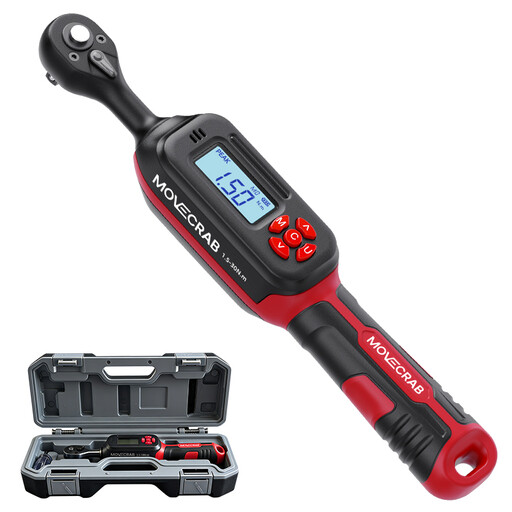
Why this suits this profile: Its mid-range torque and compact design make it ideal for first jobs on a bicycle, motorbike, car or around the house.
The value is displayed in real time, and the tool combines vibration, an audible signal and an LED indicator when the programmed threshold is reached.
Stated accuracy of ±2%, four measurement units, ten presets, and Track and Peak modes.
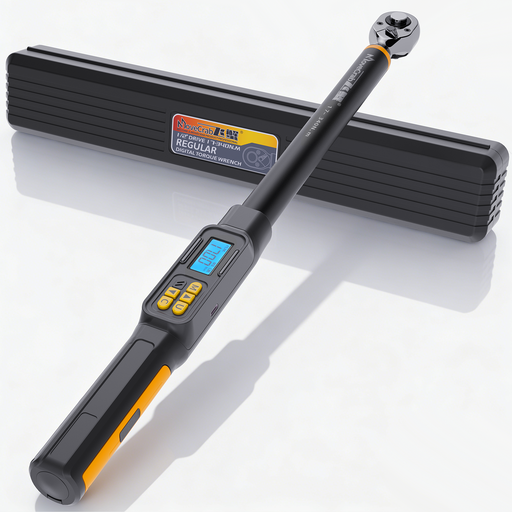
Why this suits this profile: Its wide torque range targets automotive work, motorbike jobs and certain maintenance tasks that require higher torque.
The drive size is clearly stated, and the multiple alerts reduce the risk of accidentally exceeding the selected torque.
LED display, units in N·m, lb·in, lb·ft and kgf·cm, bidirectional ratchet head, and a claimed storage capacity of 500 measurements.
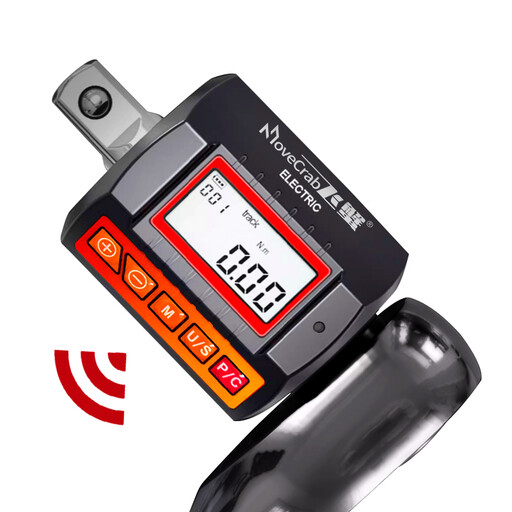
Why this suits this profile: The adapter lets you keep using handles or ratchets you already have in your workshop. 3/8-inch and 1/4-inch adapters are also included.
Torque is controlled by a digital module rather than by simply reading a scale. It should only be used with a manual ratchet, never with an impact wrench.
Three working modes, audible and visual alarm, claimed auto shut-off after ten minutes, and memory for 1,000 values.
We’ve put together a comprehensive, real-time selection of products that meet these demanding criteria and European safety standards.
For professional use, note the purchase date, storage conditions and any calibration checks. A precision torque wrench should be checked or replaced after a drop, a significant torque overload, or prolonged exposure to moisture.
3/8 inch is suitable for motorbike work, spark plugs, many common assemblies, and some bicycle jobs with the right adapter. 1/2 inch is more suited to automotive sockets and higher torque settings. In any case, the torque range in N·m should take priority over the drive size alone.
Battery consumption depends on how often you use it, the battery type, and how long it’s switched on. The MoveCrab adapters described here feature an auto shut-off claimed to activate after ten minutes of inactivity. For long-term storage, removing the batteries can reduce the risk of leakage, as advised in the manual.
There’s no single lifespan that applies to all tools. Impacts, moisture, storage conditions and torque overloads can all affect accuracy. Use the supplied case, avoid extreme temperatures, and consult the manual for recommended check or calibration intervals.