
Livraison le jour même ou le lendemain

Qualité garantie

Débloquez vos offres de bienvenue: Livraison GRATUITE | Jusqu'à -80 % | 30 jours d'essai gratuits à JoyPlus
Téléchargez l'application
Standing in the DIY aisle, choosing a mounting adhesive can quickly become a headache. Between promises of "instant grab," "extreme strength," and confusing technical sheets, it's easy to get lost or walk away with the wrong product. Our mission at Joybuy? To help you decode the labels and avoid the marketing traps to find THE perfect adhesive for your project.
Before you head to the checkout, here are the 3 pitfalls to avoid at all costs:
To never make a mistake again, you just need to master a few technical concepts. Once you understand them, choosing an adhesive becomes much simpler.
The chemistry behind the adhesive determines its properties and its field of application.
This is the most important criterion. Materials are classified into two categories:
To help you visualise the right product, here are a few solutions tailored to different user profiles.
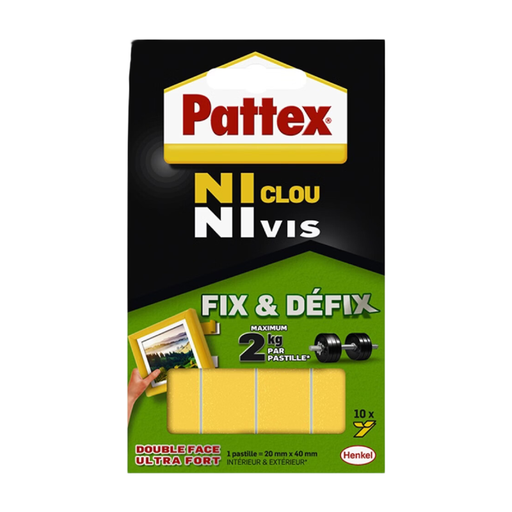
Why this choice? Ideal for tenants or those who love to change their decor. It allows you to hang frames, small objects, or smoke detectors without drilling and, most importantly, without stress when it's time to take everything down.
It directly addresses the problem of removal. Its formula is designed for a clean removal, leaving no traces or damage on smooth, non-porous surfaces.
The ultimate drill-free mounting and removable solution. Each tab supports up to 2 kg on compatible surfaces.
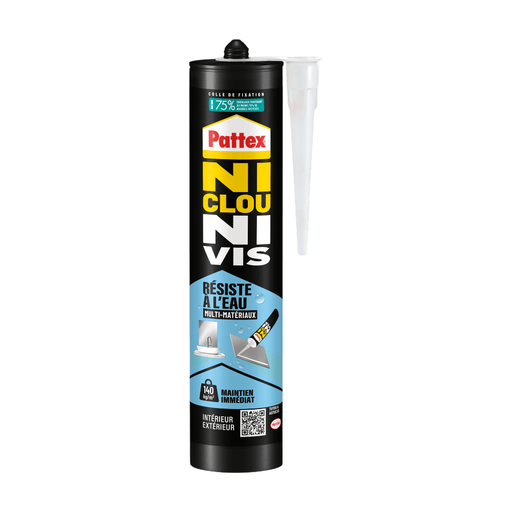
Why this choice? This is the product to always have in your toolbox for a multitude of jobs: fixing a skirting board, a light shelf, a house number, or a decorative element. Its indoor/outdoor versatility makes it a safe bet.
It clarifies the concept of water resistance: effective in humid environments and on temporarily wet surfaces, but not for immersion. It avoids the brute force trap by relying on Flextec polymer technology, which ensures a bond that is both flexible and durable.
Solvent-free polymer technology, repositionable for a few minutes, and compatible with most materials, including outdoors. A transparent adhesive version is available for invisible finishes.
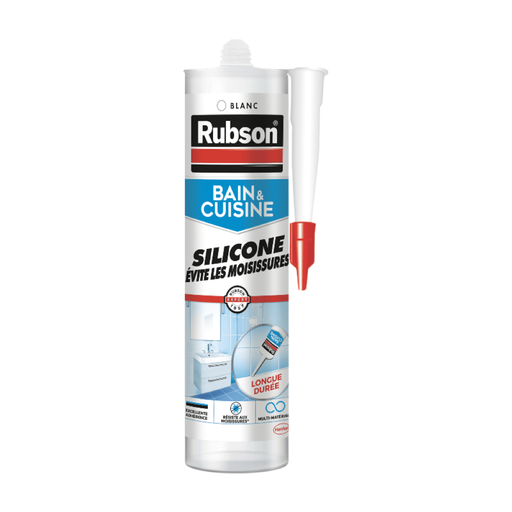
Why this choice? Essential for re-sealing the joints of a sink, shower, or basin. Its mission is not to bond with extreme force, but to create a flexible, waterproof, and sanitary barrier for the long term.
It doesn't just claim to be "water-resistant." It's a sanitary sealant, reinforced with fungicides to actively fight against the appearance of mould, the number one enemy of joints in wet areas.
Anti-mould silicone sealant formula for long-lasting protection. Adheres perfectly to standard sanitary materials (enamel, porcelain, glass, stoneware).
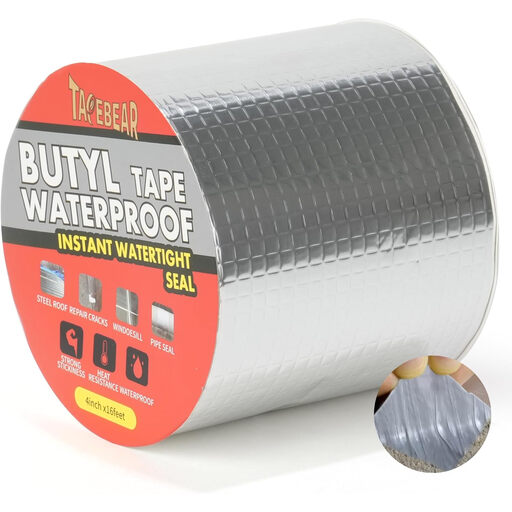
Why this choice? For homeowners or camper van owners facing a leak. Note, this is not an adhesive, but an emergency waterproofing solution to seal a gutter, skylight, or awning.
It doesn't fall for the vague "water-resistant" claim. It's a butyl-based waterproof adhesive tape, designed to create a 100% impermeable and durable barrier, even outdoors.
Simple and immediate application for an emergency roof leak repair. Adheres powerfully to many surfaces (metal, tile, wood, fibreglass) and resists both UV rays and extreme temperatures.
We have put together a complete selection of products that meet our selection criteria and current standards.
A mounting adhesive's main function is to join two items together with high bonding strength. Its purpose is to resist pulling and shearing forces. A sealant, on the other hand, is designed to fill a joint between two elements and prevent the passage of air or water. It must remain flexible to absorb movement. Some hybrid products can perform both functions, but for a specific need (maximum strength or perfect waterproofing), a dedicated product will always perform better.
Yes, it's possible, but under certain conditions. Extra-strong mounting adhesives can support significant loads, but it is imperative to follow the manufacturer's instructions to the letter:
This is the tricky part. For products specifically designed to be removable, like removable double-sided adhesive tabs, you can usually just pull gently or use dental floss to cut the adhesive. For permanent mounting adhesives, the task is more complex. You often have to cut the adhesive with a thin blade (or a cheese wire, a pro tip!), then patiently scrape off the residue. Applying heat (with a hairdryer) can sometimes soften the adhesive and make it easier to remove. On fragile surfaces like a painted wall, it is unfortunately difficult to avoid some damage.