
Livraison le jour même ou le lendemain

Qualité garantie

Débloquez vos offres de bienvenue: Livraison GRATUITE | Jusqu'à -80 % | 30 jours d'essai gratuits à JoyPlus
Téléchargez l'application
Rediscovering the authentic taste of homemade purées, soups, and compotes is one of life's simple pleasures. Yet, choosing the right tool can quickly become a headache. To prevent your new purchase from gathering dust in a cupboard, let's review the essential criteria and the pitfalls to avoid. The goal is to find a kitchen companion that will serve you faithfully for years to come.
The 3 pitfalls to avoid when buying a food mill:
To avoid these traps, a few key points are all you need to sort the good from the bad and choose a model that fits your needs.
The material is the number one criterion. A Moulinex stainless steel food mill is a long-term investment. Stainless steel ticks all the right boxes:
The number and fineness of the discs determine the mill's versatility. A good manual food mill should come with several discs. A model with two discs is an excellent starting point:
Comfort in the kitchen often comes down to the details that make all the difference. Be sure to check for:
To illustrate these criteria in action, here are a few products that meet our standards for durability and practicality, suited for different types of cooks.
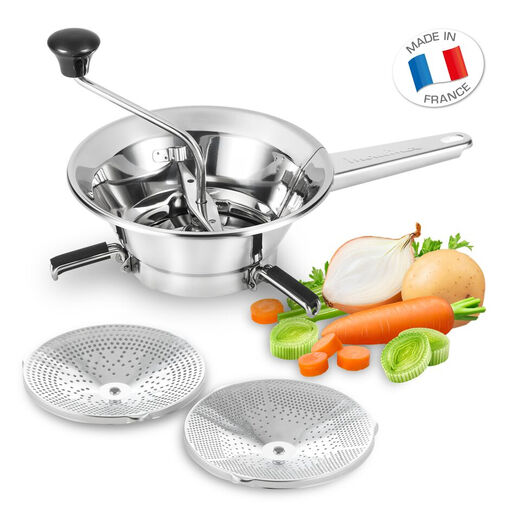
Why it's for them: This tool is the perfect partner for anyone looking to recapture the authentic taste of family recipes. It's ideal for making smooth purées, creamy vegetable soups, and fruit compotes, including baby food.
Its all-stainless steel construction protects it from stains and wear. Fully disassemblable and dishwasher-safe, it makes cleaning a simple formality.
It comes with two stainless steel discs (fine and medium), giving you perfect control over the texture. Its foldable, non-slip feet ensure perfect stability and optimised storage.
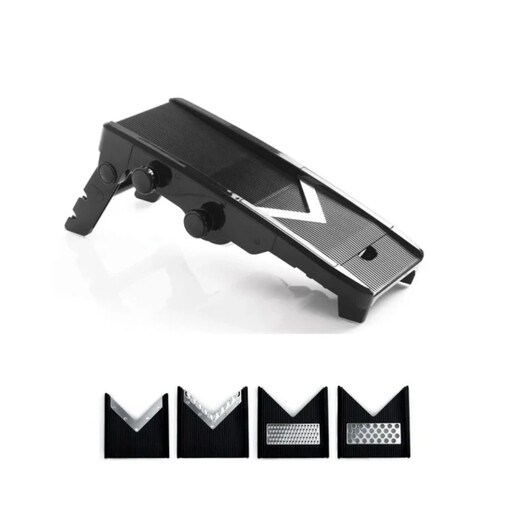
Why it's for them: When cooking in large batches, chopping vegetables can be time-consuming. This mandoline is the ideal complement to a food mill, allowing you to slice ingredients quickly and efficiently before cooking.
No more tedious and often uneven manual chopping. A consistent cut ensures even cooking—the secret to a perfectly textured purée.
Its 6 stainless steel blades allow you to slice, grate, or julienne. The adjustable cutting thickness, from 1 to 9 mm, offers surgical precision.
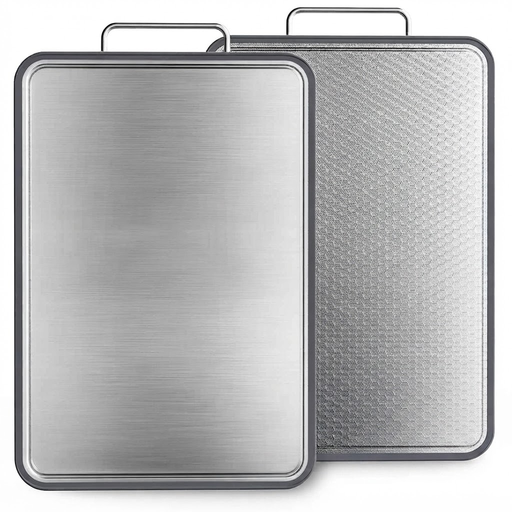
Why it's for them: Anyone who chooses a stainless steel mill for its impeccable hygiene will be won over by a cutting board that shares the same qualities. It's a winning combination for a healthy and hassle-free kitchen.
Unlike wood or plastic boards that get scratched and absorb juices, this one prevents any risk of cross-contamination and retains no odours.
Its double-sided surface is ideal for dedicating one side to meat and the other to vegetables. The clever juice groove catches liquids and keeps your worktop spotless.
We have curated a complete range of utensils that meet our strictest criteria for quality and durability.
Assembly is child's play: choose your disc, place it in the bottom of the bowl, then attach the axle with its blade and the crank. As for cleaning, stainless steel models like the A40102 can be fully disassembled and are dishwasher-safe. Maintenance is no longer a chore!
The Moulinex food mill is primarily designed for cooked, soft foods. Forcing hard, raw vegetables (like carrots or potatoes) through it could damage the mechanism or the disc. However, it's perfectly fine for making a coulis from soft red fruits or berries.
Be aware, the results are nothing alike! An immersion blender pulverises all the ingredients (including skin and seeds), creating a very fine texture that can also become gummy (the nightmare of potato mash!). A food mill, on the other hand, presses the flesh through a disc, separating the pulp from the skin and seeds. This is the secret to achieving that velvety, authentic texture typical of the purées and soups from our childhood.