
Livraison le jour même ou le lendemain

Qualité garantie

Débloquez vos offres de bienvenue: Livraison GRATUITE | Jusqu'à -80 % | 30 jours d'essai gratuits à JoyPlus
Téléchargez l'application
A long journey in a motorhome, with a caravan or trailer, means keeping an eye on several tyres at once. A gradual loss of pressure, a sudden leak or an unusual rise in temperature can go unnoticed from the driving seat. A tyre pressure monitoring system for your motorhome displays this information in real time and alerts you to significant changes.
However, not all systems meet the same needs. Before buying a TPMS for your motorhome, it’s worth knowing the most common pitfalls.
A four-sensor kit may suit some vehicles, but it may not be enough for a motorhome with an extra axle or a car and caravan combination. Start by counting all the wheels you need to monitor, including those on the trailer, then allow a little extra if the manufacturer lets you add sensors.
A 10-sensor TPMS can be a good choice for a long vehicle, a semi-trailer or a fleet with several different configurations.
The distance between the rear wheels, cab and end of the trailer can interfere with transmission. A long range doesn’t guarantee a stable signal if there’s no repeater. For a long vehicle, check the radio frequency, whether a signal repeater is included and the maximum vehicle length recommended by the manufacturer.
Simply displaying the pressure may not be enough. To monitor the tyres on a trailer or motorhome, choose a model that can alert you separately to a rapid leak, low pressure, overinflation, excessive temperature or a low battery. The display should also make it easy to identify the wheel concerned straight away.
Start by listing the wheels you need to monitor. A four-sensor kit suits a straightforward set-up. For a caravan or long vehicle, six, eight or ten sensors may be a better fit.
The pressure range must also match the tyres fitted to your vehicle. Some models designed for passenger cars have a maximum of around 8 bar or 116 PSI. Systems designed for motorhomes, lorries and semi-trailers can go up to 14 bar, or around 203 PSI, depending on the selected unit. Always check the recommended pressure on the tyre sidewall and in your vehicle’s documentation.
Pressure changes with temperature, particularly on motorways and in hot weather. A system that monitors both tyre pressure and temperature can help you spot unusual changes. However, it’s no substitute for a visual inspection or checking and adjusting the pressure when the tyres are cold, using a suitable pressure gauge.
For intensive use, check the temperature measurement range, how easy the display is to read and whether it alerts you to excessive temperatures.
External screw-on sensors are generally easy to install. However, they must be compatible with your vehicle’s valves. Metal valves are recommended in GUTA product listings to improve installation stability. If you have rubber valves, check their condition and compatibility before fitting the sensors.
A pre-paired system means fewer settings to adjust the first time you use it. For long vehicles, a long-range TPMS with repeater helps transmit signals between the rear sensors and the display. Also consider the display’s battery life, replacing the CR2032 or CR1632 batteries, and protecting the sensors from water spray and knocks.
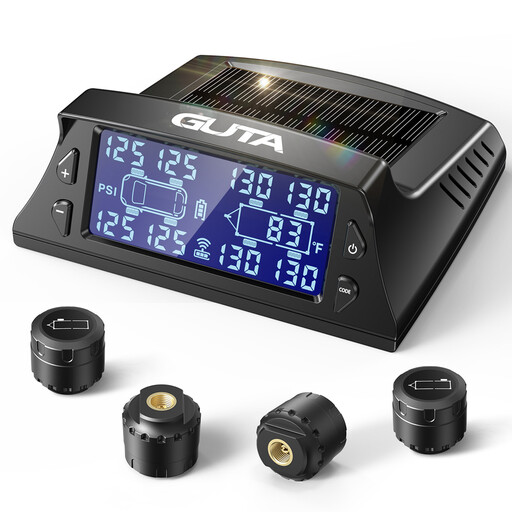
Why it suits this type of user : This set-up is suitable for a motorhome or small trailer that needs four monitoring points, with external screw-on sensors.
The product listing specifies a range of 0 to 13 bar, five types of alert and simple pairing. A repeater may be needed for vehicles over 6 metres long.
Four sensors, an LCD screen, a rechargeable battery and CR2032 batteries stated to last around four years.
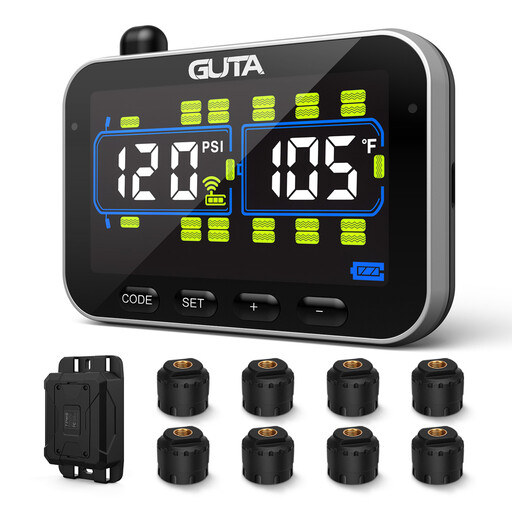
Why it suits this type of user : It’s designed for owners of large motorhomes, caravans or semi-trailers who want to monitor more wheels from a single display.
The kit includes a 433.92 MHz repeater and is specified for vehicles under 15 metres long, helping to meet the transmission needs of longer combinations.
Eight sensors, six alarm modes, pressure and temperature readings, plus a stated two-year warranty.
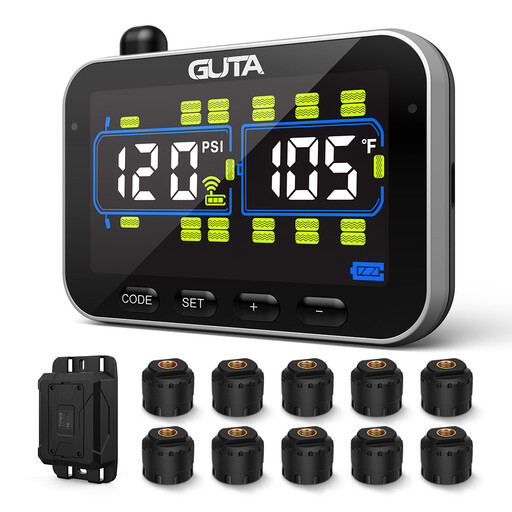
Why it suits this type of user : This kit meets the needs of long vehicles, semi-trailers and anyone who wants to monitor ten wheels or keep their set-up flexible.
The number of sensors helps avoid compromises with multi-axle combinations. The repeater and factory pairing mean fewer adjustments are needed before you set off.
Ten sensors, a stated range of up to 14 bar, six alerts and a colour screen with automatic backlighting.
We’ve put together a comprehensive, regularly updated list of products that meet these demanding selection criteria and European safety requirements.
Remove the valve caps, identify each sensor according to its position, then screw it on without overtightening. Install the display in the vehicle and place the repeater between the more distant wheels and the display if one is included in the kit. Then check that the display shows a pressure and temperature reading for every wheel.
It depends on the battery used and the conditions they’re used in. The product listings for the GUTA kits featured here state a battery life of around four years with a CR2032 battery. This is only an estimate: cold weather, heat, washing and how often the sensors transmit can all reduce battery life.
After buying the system, the main costs are replacing the sensor batteries and recharging the display. You should also regularly check that the sensors are secure, the valves are in good condition and the system is watertight. A TPMS makes it easier to monitor your tyres, but it doesn’t replace a manual check before setting off or the maintenance recommended by the manufacturer.