
Livraison le jour même ou le lendemain

Qualité garantie

Débloquez vos offres de bienvenue: Livraison GRATUITE | Jusqu'à -80 % | 30 jours d'essai gratuits à JoyPlus
Téléchargez l'application
Motorhome and camping equipment should enhance your independence without turning your vehicle into a technical room. Inverter, cooking, heating, refrigeration or road safety: each accessory meets a specific need, but product listings do not always make it easy to compare products on a sound basis.
Before placing your order, three common pitfalls are worth avoiding:
To size your motorhome power supply, start by adding together the power requirements of the appliances likely to run at the same time. A computer, charger and small fridge will not place the same demand on the battery as a 2,000 W hotplate.
A 12 V to 220 V inverter should clearly distinguish between:
The power actually available also depends on the battery. As a general guide, a 1,000 W appliance supplied by 12 V can draw a high current, especially once conversion losses are taken into account. Short, correctly sized cables are therefore essential.
A 200 W folding solar panel can supplement a portable battery, but its output varies considerably depending on its orientation, the season, shading and sunlight levels. The advertised power corresponds to precise testing conditions; it does not represent constant output in real-world use.
In particular, check:
A 200 W panel is mainly suitable for charging devices and portable power stations, rather than permanently powering highly energy-intensive equipment.
With a portable diesel heater, ventilation and the safe extraction of exhaust gases must come first. A combustion appliance must never be used in an enclosed space without suitable installation: the risk of carbon monoxide poisoning means you must follow the instructions and the manufacturer’s guidance carefully.
For cooking appliances, check their stability, the available surface area and power consumption. A 2,000 W hotplate may be practical, but it requires a power supply capable of handling such a load.
Also measure the available spaces before ordering. Weight, cable length, fan noise and easy access to the sockets are all details that make a difference in everyday use.
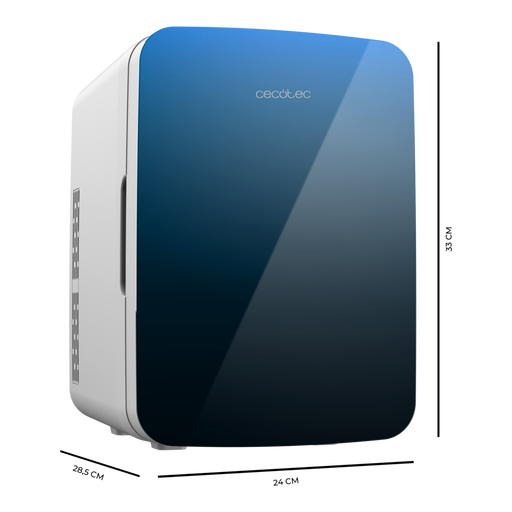
Why this suits this type of traveller : With a 10 L capacity and 12 V/220 V power supply, this mini fridge keeps drinks and a few food items cool in a van, car or small camping space.
The dual power supply means you do not need to buy additional adaptors. Its capacity clearly makes it suitable as a supplementary fridge; it is not intended to be a miniature family refrigerator.
Advertised cooling and heating range from 7 °C to 65 °C, with 12 V and 220 V power supply.
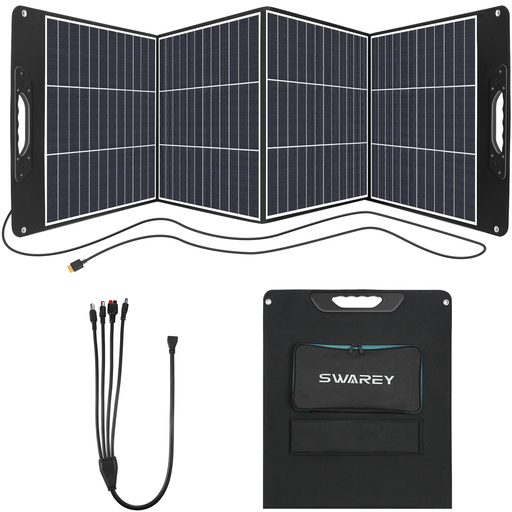
Why this suits this type of traveller : Travellers looking for a portable charging solution get a folding panel advertised at 200 W, supplied with several adaptors for use with a power station.
XT60 and Anderson connectors, along with various DC outputs, are specified. However, it is still essential to check that they are compatible with your battery before buying.
Monocrystalline cells advertised with 23 % efficiency, USB-A, USB-C and QC3.0 outputs, plus an adjustable stand.
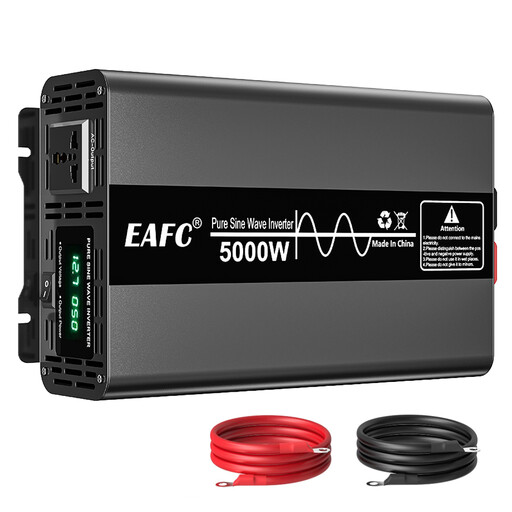
Why this suits this type of traveller : It is intended for 12 V systems capable of powering demanding appliances, provided the battery, cables and protective devices are correctly sized.
The product listing distinguishes between 2,500 W continuous power and 5,000 W peak power. This is essential information, so you do not size the entire system based solely on the maximum figure.
Pure sine wave output, LCD monitoring screen and advertised protection against overload, overheating and voltage fluctuations.
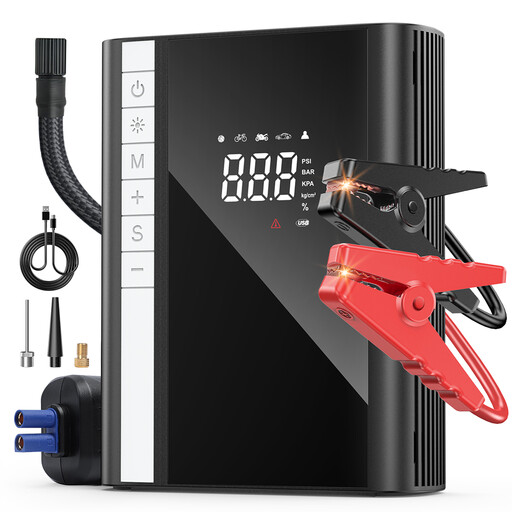
Why this suits this type of traveller : Drivers of SUVs, motorhomes and caravans can combine two useful accessories to deal with common roadside incidents.
It does not replace regular tyre maintenance or a battery in good condition, but it combines jump-starting, inflation and emergency lighting functions.
Designed for SUVs, pick-up trucks and motorhomes, with an integrated air pump and light.
We have put together a complete, real-time updated selection of products that meet these demanding criteria and European safety requirements.
Depending on your vehicle and how you travel, you can complete this list with:
For every electrical product, read the instructions in French and check the input voltage, plug type and safety guidance. Where required, the CE marking must be present and accompanied by information from the manufacturer or importer; on its own, it does not guarantee compatibility with your system.
Choose one based on the continuous power required by your appliances, rather than peak power alone. Pure sine wave output may be preferable for powering a computer, television or other sensitive electronic device. Also remember to check the battery capacity, cable cross-section, ventilation and built-in protection.
It can charge phones, computers and small power stations when there is sufficient sunlight. Output drops as soon as the panel is shaded, poorly positioned or exposed to cloudy skies. To improve your autonomy, pair it with a battery of suitable capacity and a compatible controller.
Prioritise appliances whose consumption genuinely matches your needs. Run the heater with suitable ventilation, avoid connecting a very powerful hotplate to a small battery and charge your equipment when the sun is shining. Monitoring consumption quickly helps identify the most power-hungry appliances.