
Livraison le jour même ou le lendemain

Qualité garantie

Débloquez vos offres de bienvenue: Livraison GRATUITE | Jusqu'à -80 % | 30 jours d'essai gratuits à JoyPlus
Téléchargez l'application
Our editorial team tests dozens of pieces of safety gear every year. The motorcycle protective vest is undoubtedly one of the most crucial, but also one of the most complex to choose. Between marketing promises and unreadable spec sheets, it's easy to make a mistake.
Our mission with this guide is to help you avoid the pitfalls and focus on the criteria that truly matter for your safety and comfort, whether you ride on the road, in enduro, or on an MTB.
Before you even start comparing models, let's review the common mistakes that can render a protective vest completely ineffective, or even dangerous.
To get it right, focus on these three technical points. They are the real deciding factors when evaluating the quality of a motorcycle armour jacket.
This is fundamental. A certified motorcycle protective vest has mandatorily passed a series of impact resistance tests governed by European standards. Look for these certifications?:
Each standard is available in Level 1 or Level 2. Always aim for Level 2?: it offers far superior shock absorption capacity. It's a must-have, especially for the motorcycle back protector.
A good vest is a complete system. Its materials must work in synergy?:
Your vest should be like a second skin. Check for multiple straps and adjustment points?:
Modularity is a real bonus. Removable protectors (chest, back) not only make cleaning easier but also allow you to adapt the level of protection to your ride, for example, by switching to a lighter setup like full-body MTB protection.
Based on these criteria, here are a few models that have caught our eye and meet specific needs.
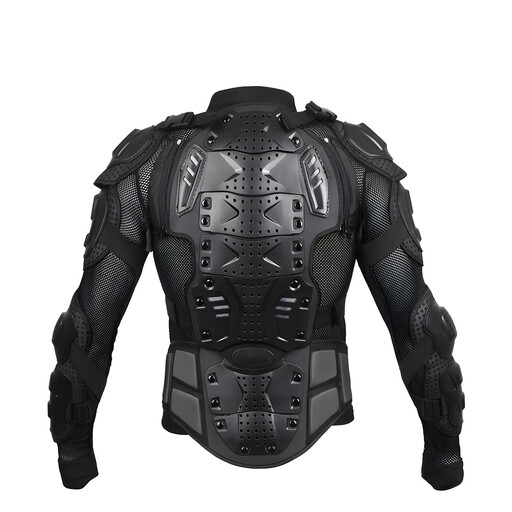
Why we chose it : Engineered for the demands of off-road riding, this model shines with its flexible design that offers maximum freedom of movement, which is essential in enduro or motocross. The protection is comprehensive, leaving no key area undefended.
It combines a robust PE outer shell with EVA foam inserts, avoiding the "empty shell" trap. Its ultra-breathable mesh structure directly tackles the problem of overheating.
Comprehensive and modular protection (removable protectors) ; excellent freedom of movement thanks to its articulated design.
Why we chose it : Because safety depends above all on a precision fit, this model focuses entirely on customisation. Available in a wide range of sizes, it's perfect for riders with a larger build who often struggle to find gear that stays in place.
It tackles the poor-fit pitfall head-on. The thumb loops and wide Velcro belt hold the vest snugly against the body, ensuring the protectors remain fixed and effective, even in the heat of the action.
Multiple adjustment points for a custom fit ; optimal stability thanks to the thumb loops and wide waist belt.
We have selected other gear that meets our demanding selection criteria and current safety standards.
Most quality vests have removable protectors. Once the shells and foam pads are removed, hand wash the textile portion in cold water with a mild detergent. Rinse thoroughly and let it air dry, away from direct sunlight or a heat source. Most importantly, never put it in a tumble dryer?!
No. In many regions, for example, only a helmet and CE-certified gloves are mandatory for the rider and passenger. However, a motorcycle back protector is often required for the handling portion of the riding test and is always mandatory on a racetrack. Although optional for road use, wearing a protective vest is still highly recommended to reduce the risk of serious injury to the chest and spine.
Yes, absolutely. Most vests are designed specifically for this purpose?: they are worn under a jacket and are an excellent replacement for the stock protectors, which are often of poor quality. Just make sure your jacket is loose enough to accommodate the vest without constricting you or hindering your movement.