
Livraison le jour même ou le lendemain

Qualité garantie

Débloquez vos offres de bienvenue: Livraison GRATUITE | Jusqu'à -80 % | 30 jours d'essai gratuits à JoyPlus
Téléchargez l'application
For many riders, getting their hands dirty is a genuine pleasure. But working on your knees or in awkward positions quickly turns this passion into a chore. A good motorcycle lift is a life-changing accessory, but the market is flooded with models whose promises are sometimes... optimistic.
Choosing the wrong equipment isn't just throwing money down the drain; it's a direct risk to your safety and that of your prized machine. Before you commit, beware of these common pitfalls:
Investing in the right equipment means buying peace of mind to work on your bike in complete safety.
To make an informed choice, you need to understand a few technical parameters. These details determine not only compatibility with your motorcycle but also your safety and ease of use.
The first and most obvious criterion is the load capacity. Don't just look at your bike's dry weight as listed by the manufacturer. Remember to add the weight of all fluids (oil, fuel, coolant) and any accessories (top case, luggage, crash bars).
Golden Rule: Choose a motorcycle lift with a load capacity at least 20% greater than your vehicle's total curb weight. This safety margin is essential to ensure perfect stability and avoid overstressing the lifting mechanism.
The type of mechanism directly dictates how you'll use the lift.
The safety of your setup depends on details that are too often overlooked at the time of purchase. Always check the following:
Every rider has specific needs. Here is our selection, tailored to different uses and types of machines.
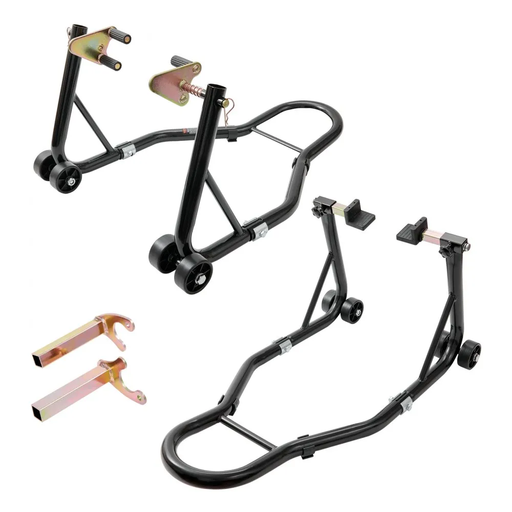
Who is it for? For riders who do their own basic maintenance (chain lubing, wheel cleaning) or who are looking for a stable solution for winter storage. It's the simplest and most effective approach for the majority of sportbikes, roadsters, and tourers.
This kit sidesteps the trap of instability. Its robust steel structure and wide support points ensure a reliable hold, whereas entry-level models can flex or lack grip.
Delivered with both L-shaped adapters (for swingarms) and U-shaped adapters (for spools), it provides a complete and versatile solution for the front and rear in a single purchase.
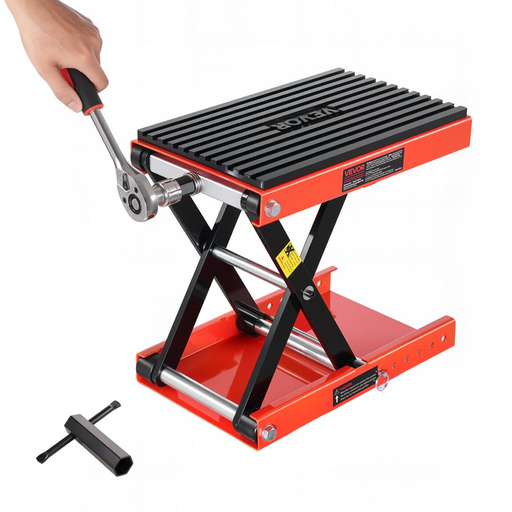
Who is it for? Perfect for owners of customs, cruisers, or ATVs with a frame that allows for a central lift. Its wide platform and high capacity make it a highly versatile tool for those who work on different types of vehicles.
It solves the headache of compatibility with frames that lack spools or have double cradles. Its wide platform ensures optimal weight distribution and stability, eliminating any risk of tipping.
Its lifting range (105–380 mm) and operation with a simple socket wrench allow for a controlled and precise lift, without the bulk of a hydraulic system.
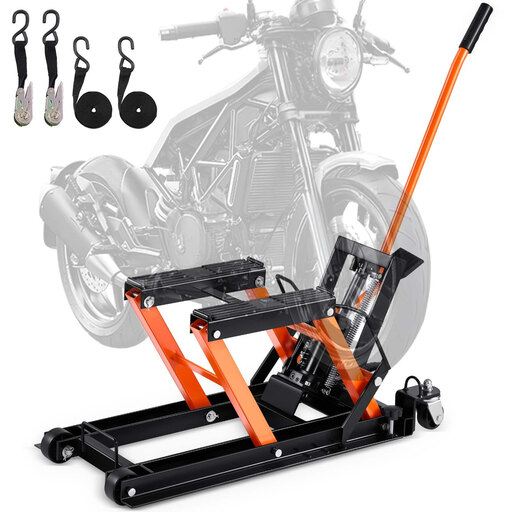
Who is it for? Aimed at expert home mechanics or small workshops. Its 700 kg capacity and foot-pedal hydraulic ram allow for the effortless lifting of the most imposing machines (large tourers, fully-loaded customs) for major jobs (engine, transmission).
It eliminates the risk of unreliable mechanisms. Its quality hydraulic pump and reinforced structure are built for repeated, safe use. The mechanical lock ensures the load remains stable, even during long hours of work.
Its casters, including two 360° swivels, allow you to slide and position it effortlessly under the bike, and then move the entire assembly around the workshop as needed.
Discover our full selection of products that meet our strict selection criteria and current safety standards.
The fundamental difference lies in the lifting method. A paddock stand (or workshop stand) lifts a single wheel at a time, using the swingarm (rear) or fork bottoms (front) as a contact point. In contrast, a scissor lift is placed under the engine to lift the entire frame, freeing up both wheels. This is ideal for working on the suspension or frame.
There are three points to check:
Generally, very little. The maintenance is minimal but crucial for safety. It comes down to periodically checking for leaks at the ram and monitoring the hydraulic oil level. Storing it away from moisture and cleaning it regularly will be enough to ensure its longevity and reliability.