
Livraison le jour même ou le lendemain

Qualité garantie

Débloquez vos offres de bienvenue: Livraison GRATUITE | Jusqu'à -80 % | 30 jours d'essai gratuits à JoyPlus
Téléchargez l'application
Choosing motor skills toys for children isn’t just about comparing colours or the number of activities listed. At home, with a childminder or in a nursery, poorly sized equipment can end up in the cupboard, wear out prematurely or make supervision more difficult.
Three common pitfalls keep cropping up:
To choose a durable product, you need to weigh up the child’s age, the available space and the technical specifications that are actually provided.
The recommended age is a useful guide, but it needs to be considered alongside the intended use. For a baby of a few months, a wooden baby gym or a sensory toy that supports motor development mainly encourages grasping, observation and hand-eye coordination. The child should be able to play on the floor, on a flat surface, with an adult nearby.
For children who are starting to walk, foam climbing blocks let you create a small course: crawling, climbing up, climbing down, going around or building. From 3 years old, a children’s climbing frame can offer more challenges, provided you respect the dimensions and maximum weight stated.
Always check:
For toys sold in the European Union, the EN71 standard covers several aspects of safety, including mechanical and physical properties, flammability and the migration of certain substances. However, the declaration of conformity should be checked on the product page: it doesn’t replace following the assembly instructions or usage guidelines.
High-density foam with a removable cover can be suitable for indoor use, particularly in an indoor children’s play area, a nursery room or a spacious bedroom. Check for a non-slip base, secure fastenings and washable covers.
Outdoors, a children’s slide must be installed on a flat, sufficiently soft surface. UV treatment can help preserve the material, but it’s still best to cover or store the product when not in use.
Measure the play area before placing your order. Allow enough clearance around a slide, ladder or climbing frame, keeping it well away from walls, fences or furniture.
Maintenance also matters a great deal for motor skills toys intended for a nursery and equipment used frequently:
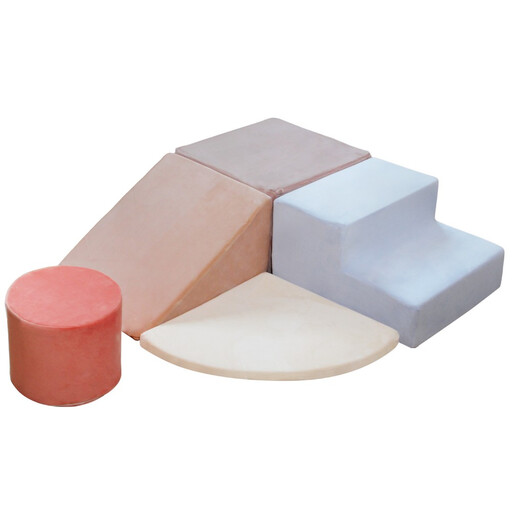
Why this choice suits this profile: This set of five blocks is ideal for families who want to build up their equipment gradually with a modular indoor set that requires no permanent assembly.
The shapes can be rearranged depending on the child’s age and the space available, while the hook-and-loop fasteners and some non-slip bases help keep the modules in place.
High-density foam, removable machine-washable covers and EN71 compliance stated on the product page. Allow 24 to 48 hours after unpacking for the blocks to fully regain their shape.
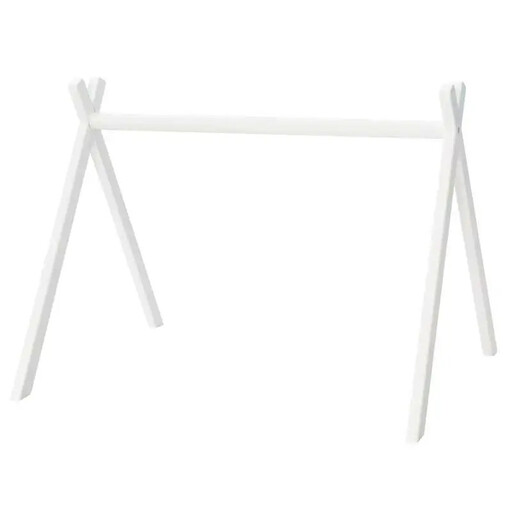
Why this choice suits this profile: This wooden baby gym is aimed at parents looking for a simple solution for the first few months, one that fits easily into a living space.
Its use is clearly designed for discovery, grasping and coordination, rather than for climbing, which would be unsuitable for babies.
Lacquered wood, dimensions of 52 × 70 × 50.5 cm and easy-to-wipe surfaces. Use on a flat surface, under adult supervision.
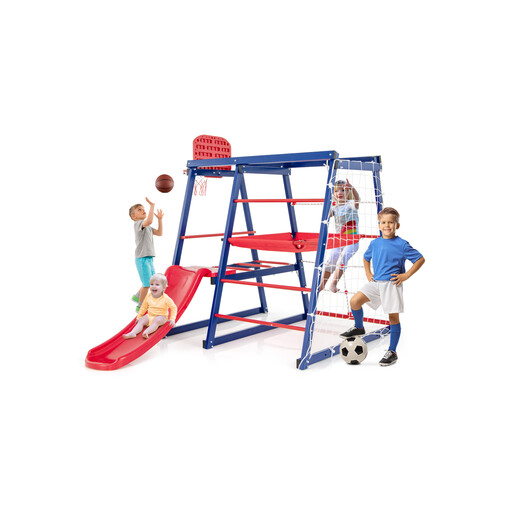
Why this choice suits this profile: This climbing frame is designed for spaces with a dedicated play area, whether at home or in a group setting, to offer a variety of physical activities.
The product page details several pieces of equipment rather than making a vague promise: slide, ladder, net, rope and basketball hoop. Assembly and checking all connections are still essential.
Metal frame stated as rust-resistant, dimensions of 150 × 142 × 146 cm and a stated maximum weight capacity of 100 kg. Check the available space before buying.
We’ve put together a comprehensive list, updated in real time, of products that fully meet these demanding selection criteria and European safety regulations.
Place the modules on a clear, stable, non-slip floor. Start with a short layout, then gradually add elements as the child masters their first movements. Do not place any module near stairs, furniture with sharp corners or a door.
Its lifespan depends on how often it’s used, the weight it supports, the quality of the assembly and how well it’s maintained. To extend its use, clean the surfaces according to the manufacturer’s instructions, store outdoor equipment under cover and regularly inspect seams, fastenings, screws and handles.
The price varies depending on the material, the number of modules, the dimensions and whether it’s for indoor or outdoor use. Foam blocks are a good starting point, while a metal frame or a 2-metre slide requires more space and installation. Compare the features that are actually included rather than relying solely on the number of activities listed.