
Livraison le jour même ou le lendemain

Qualité garantie

Débloquez vos offres de bienvenue: Livraison GRATUITE | Jusqu'à -80 % | 30 jours d'essai gratuits à JoyPlus
Téléchargez l'application
Getting up at night shouldn't be an obstacle course in the dark. Whether it's to reassure a child, make nighttime navigation safer for a senior, or simply find your way to the bathroom without waking up the entire house, the rechargeable motion-sensor night light stands out as a solution that's as simple as it is effective. The only catch: the market is flooded with models making tempting promises, but their performance often leaves much to be desired. To help you sort through the options, our editorial team has broken down the common pitfalls to avoid and the essential criteria to check before you buy.
Making a choice can quickly become a headache. Many products look alike, but a few design flaws are all it takes to turn a good idea into a frustrating gadget. Here are the three red flags you should never overlook.
To make the right choice, a few technical specifications make all the difference. These objective criteria are your guarantee of a reliable product that's truly suited to your daily life.
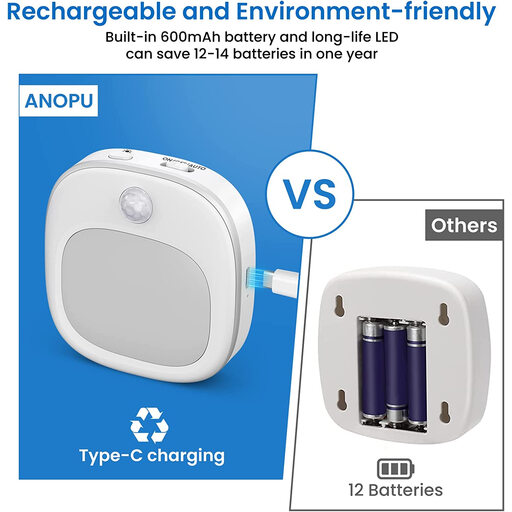
The main advantage of a rechargeable model is that it frees you from the hassle of replacing batteries. Check the battery capacity, expressed in milliampere-hours (mAh). A capacity of at least 500 mAh typically provides a comfortable battery life of several weeks in detection mode, depending on usage frequency. Opt for a USB rechargeable night light, ideally with a modern USB-C port, for simple, universal charging with the same cables as your other devices.
A good passive infrared (PIR) sensor must strike the right balance between range and precision.
For a good wireless accent light, flexibility is key.
Why we chose it: This two-pack of night lights ticks all the boxes for versatile home use. It's perfect for those looking for a reliable and cost-effective solution to equip multiple areas, such as a hallway and a bedroom.
Its 500 mAh battery ensures solid battery life. Its 5 brightness levels and 3 colour temperatures allow you to fine-tune the lighting to prevent any harsh glare.
Versatility: Adjustable brightness and colour. Cost-effective: Sold as a 2-pack and is USB rechargeable.
Why we chose it: For places where recharging is impractical (cellar, attic, shed) or for those who prefer the simplicity of batteries, this model is a smart alternative. It offers the same detection and adjustment features as rechargeable models.
By running on batteries, it eliminates the need for recharging. Its brightness and colour temperature settings provide a soft, non-aggressive light.
Maximum runtime: No recharging needed—just a simple battery swap. Flexibility: Comprehensive lighting adjustments.

Why we chose it: For a child's room, safety and a playful design are paramount. This soft silicone model is safe to touch and withstands handling by little hands. Although it doesn't have motion detection, its touch activation is intuitive for a child, and its adjustable brightness is perfect for bedtime.
Its 1200 mAh battery offers excellent runtime. The LED light is soft, and its touch-dimming feature prevents any glare, creating a perfectly reassuring atmosphere.
Safety First: Soft, child-safe silicone. Child-Friendly Simplicity: Activate and adjust with a simple touch.
Explore our full selection of products that meet our strict selection criteria and current safety standards.
Battery life depends heavily on the battery's capacity and the frequency of detections. For a model with a 500 mAh battery used in detection mode in a moderately trafficked area (about 10 activations per night), you can expect between 4 and 8 weeks of use before needing to recharge it.
Ideally, place it between 50 cm and 1.5 m off the ground. In a hallway, position it in the centre to cover both directions. On a staircase, install one at the top and one at the bottom, aimed towards the steps. Avoid placing it opposite a heat source (radiator, HVAC vent) or a window, as temperature fluctuations can cause false triggers.
Absolutely not. An LED night light is extremely energy-efficient. Most models consume less than 1 watt. Since it only turns on for a few minutes in total each day, its impact on your electricity bill is virtually zero—we're talking a few cents per year.