Hosts who prioritise low fat content
If this matters more than the flavour, compare the stated amount per 100 g with the applicable threshold for solid foods. A fruity name alone doesn’t tell you the fat content.


To keep fat content down in a Mother’s Day dessert, choose a tub that lists its fat content and don’t rely on the word ‘sorbet’ alone. Regulation (EC) No 1924/2006, published on EUR-Lex, reserves the claim ‘low fat’ for solid foods containing no more than 3 g of fat per 100 g. By comparison, Carrefour lists 8.7 g of fat per 100 g for its Extra vanilla ice cream. Check sugars, allergens and pack size separately if the dessert is to be shared.
If this matters more than the flavour, compare the stated amount per 100 g with the applicable threshold for solid foods. A fruity name alone doesn’t tell you the fat content.
For a fruity dessert to round off your Mother’s Day meal, also check the size, sugars and ingredients of the tub you choose.
Check the ingredients and any ‘may contain’ warnings on the packaging of the product you buy. The word ‘sorbet’ alone doesn’t rule out allergens.
Start with the fat content, using a comparable unit, then check what matters for your meal: sugars, pack size and information for your guests.
| Criterion | What to check | Who is it for? |
|---|---|---|
| Fat content | Check the amount per 100 g. For solid foods, Regulation (EC) No 1924/2006 sets the maximum for the ‘low fat’ claim at 3 g per 100 g. | If my main aim is to keep fat content down, I need a figure rather than a flavour that sounds light; around 42% of consumers put this check first. |
| Dessert to share | Compare the pack size and the ‘sugars’ line in the nutritional information; low fat content doesn’t tell you how much sugar a product contains. | When serving a fruity dessert at the table, I want a size that suits my guests without confusing fat with sugar. Sharing is the top priority for around 33% of consumers. |
| Allergens and storage | Check the ingredients, any ‘may contain’ warnings and the storage instructions for the exact tub. | When several people are having dessert, I need to take their allergies into account and get the frozen product home to the freezer; around 25% of consumers prioritise these precautions. |
The flavour doesn’t replace the nutritional information. A figure given per 100 ml can’t be compared directly with a threshold expressed per 100 g unless you have the information needed to convert it.
Before relying on a low-fat claim, check the ‘fat’ line and its unit for the exact product.
These figures describe different aspects of a dessert. The ‘0% fat’ claim on Carrefour Extra lemon sorbet isn’t enough to tell you how much sugar it contains.
If sugar also matters to you, compare its figure separately in the nutritional information.
Depending on the product, a sorbet may carry ‘may contain’ warnings for ingredients including milk, eggs or nuts. These warnings matter when you’re serving dessert to a group.
Ask your guests about any dietary requirements, then check the information on the packaging of the product you buy.
Getting it home is part of choosing a frozen dessert. The Ministry of Agriculture gives −18 °C as the reference temperature for frozen storage.
Buy the tub at the end of your shop, carry it in an insulated bag and follow the storage instructions on its packaging. Don’t refreeze a thawed product.
These names can help you find products to compare; the specific flavour and pack size still matter.
Two Carrefour Extra listings show the difference between lemon sorbet and vanilla ice cream in a tub.
The E.Leclerc catalogue features ESKISS sorbets in tubs, including mango.
Auchan’s category lists sorbets and ice creams in tubs separately.
The French Vanilla product page describes a recipe containing cream, milk and eggs, among other ingredients.
If you’re considering a Ben & Jerry's tub, first choose the flavour and size you want to compare.
Lidl’s tips for homemade ice cream are about recipes, not the contents of a tub bought in store.
This clementine sorbet is worth considering if you’re looking for a fruity frozen dessert. If you’d like to share it for Mother’s Day, check the pack size and the information on the packaging before choosing it.
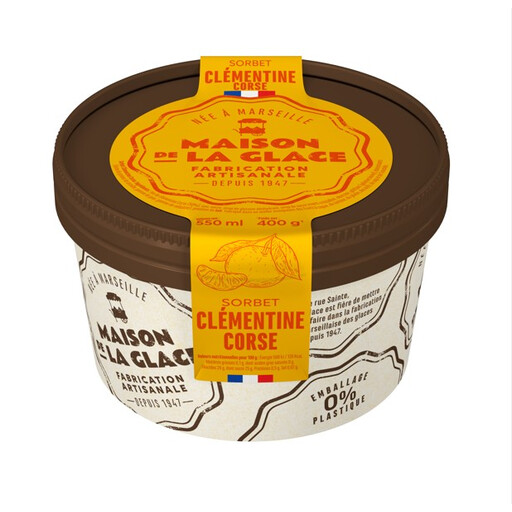 Image unavailable
A clementine sorbet to consider if you’re looking for a fruity frozen dessert.
Check that the pack size is suitable for sharing. To compare fat and sugar content or take allergies into account, check the information on the packaging of the product you buy.
For solid foods, this claim is reserved for products containing no more than 3 g of fat per 100 g, in accordance with Regulation (EC) No 1924/2006, published on EUR-Lex. Check the figure and unit given for the product you’re buying.
No. Check the stated fat content of the exact sorbet. Carrefour labels its Extra lemon sorbet ‘0% fat’, while a figure given per 100 ml for another product can’t be compared directly with the 3 g per 100 g threshold for solid foods without a reliable conversion.
Yes, if sugar is also part of your decision: a figure for fat content doesn’t tell you how much sugar the product contains. Read both lines separately in the nutritional information rather than treating them as the same thing.
Check the ingredients and allergen warnings on the packaging of the sorbet you buy. Depending on the product, it may state that it could contain traces of milk, eggs, gluten, soya, peanuts or nuts; the word ‘sorbet’ doesn’t mean you can skip this check.
Don’t refreeze a thawed product; this instruction appears, for example, on Carrefour’s lemon sorbet product page. For the journey home, use an insulated bag and put the tub in the freezer promptly, following the instructions on its packaging.