
Livraison le jour même ou le lendemain

Qualité garantie

Débloquez vos offres de bienvenue: Livraison GRATUITE | Jusqu'à -80 % | 30 jours d'essai gratuits à JoyPlus
Téléchargez l'application
A mop and bucket with wringer can make cleaning the kitchen, bathroom, hallways and living areas considerably easier. However, some models quickly show their limitations: an unstable bucket, ineffective wringing or a mop head that is too wide to fit under furniture.
It is therefore best to look beyond the marketing promises before placing your order. Here are the criteria to check, the common mistakes to avoid and some options suited to different needs.
A large bucket does not necessarily mean greater convenience. Once full, it can become awkward to move, particularly in a home made up of several rooms. You also need to leave some space below the maximum level to prevent splashes.
For typical household use, a volume of around 8 litres often offers a good balance between capacity and manoeuvrability. The final weight nevertheless depends on the amount of water added and the material used for the bucket.
The term ‘hands-free’ can refer to very different mechanisms: a rotating basket, an integrated press or a rinsing system combined with a squeegee. Above all, check that the wringer allows you to control the mop’s moisture level effectively.
This is a key consideration when cleaning parquet, tiles and laminate flooring. An overly wet mop can leave marks on certain surfaces and increase drying time. Conversely, a poorly rinsed mop may simply spread the dirt around.
Even a self-cleaning mop must be rinsed after every use. Traces of detergent and damp fibres can quickly develop unpleasant odours if the head is left inside the bucket.
Preferably choose a removable microfibre mop, which is easy to rinse and dry. Before putting it in the washing machine, check the manufacturer’s washing instructions.
The base should remain firmly in place when you press down on the handle. A carrying handle and pouring spout make emptying easier. Also remember to measure the available space: a double-compartment bucket is often bulkier than a standard model.
Separating clean and dirty water can be useful for large areas or to avoid rinsing the mop too frequently in the sink. However, it does not remove the need to change the water when it becomes cloudy.
A telescopic handle allows you to adjust the height to suit you and makes it easier to store the floor-cleaning kit. Pay particular attention to the locking system: it must remain firmly secured during back-and-forth movements.
A handle that is too flexible reduces precision and can tire your wrist. For cleaning under furniture, a flat, articulated head will generally be more effective than a bulky mop.
Microfibre is suitable for the routine care of most hard floors, but the moisture level should be adapted to the surface. On varnished parquet or laminate flooring, use a thoroughly wrung-out head and avoid leaving water standing. On tiled floors, a slightly wetter mop can help lift greasy marks.
Check the recommendations from the flooring manufacturer and avoid corrosive products or boiling water, which could damage certain bucket components.
The products shown below correspond to the information available in their product listings. Check the features and dimensions on each product page before buying.
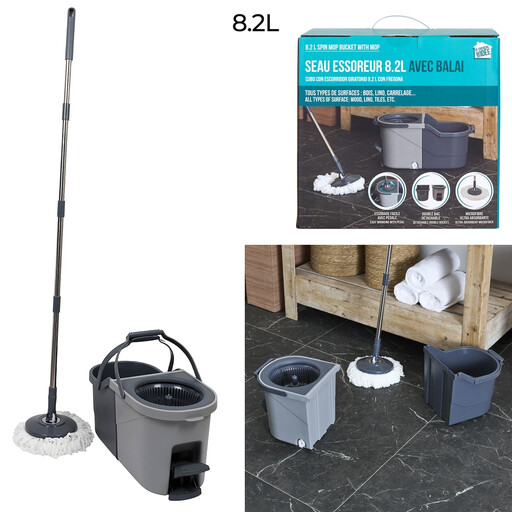
Why this choice suits this profile : with its 8.2 L bucket, telescopic handle and integrated wringer, this system is suitable for everyday cleaning in both flats and houses.
The listing mentions moisture-level control and a splash-resistant design. However, the bucket should be placed on a flat surface and not filled above the indicated line.
Reinforced polypropylene, telescopic handle, integrated wringer and stated compatibility with tiles, laminate, polished stone and treated wood.
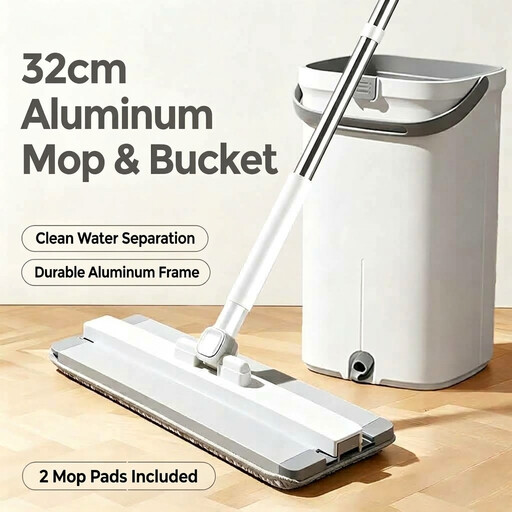
Why this choice suits this profile : its 32 cm flat head and two-function system are designed for households that regularly clean large areas or hard-to-reach spaces.
The listing states that it has two separate compartments, an integrated rinsing system and wringing without direct contact with dirty water. Rinse and dry the head after every use.
Clean and dirty water separation, one-handed operation, microfibre head suitable for dry or wet use, and easier access beneath sofas and beds.
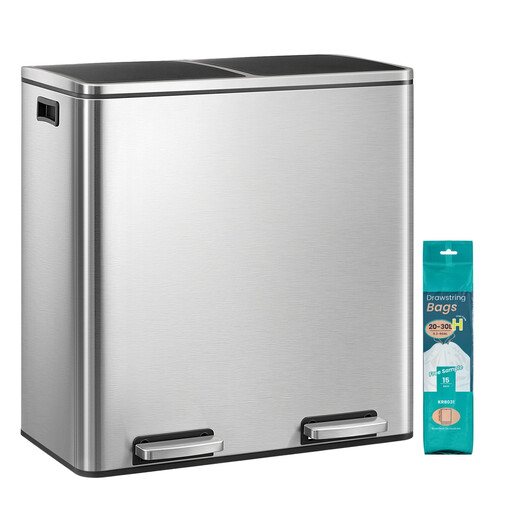
Why this choice suits this profile : this product is not a mop and bucket set. However, it can complement a busy utility room or kitchen thanks to its two 30 L compartments.
Do not confuse it with a hands-free mop bucket with wringer: it is intended for waste sorting and does not replace a floor-cleaning system.
Two removable 30 L bins, pedal-operated opening and soft-close lid. Consider it only as an additional organisational accessory.
To protect the mechanism, avoid abrasive products, harsh solvents and repeated knocks. On a wet floor, proceed carefully: the surface may remain slippery for several minutes.
It can be useful when cleaning several rooms without putting the mop back into water that is already very dirty. On the other hand, it requires regular maintenance and generally takes up more space than a standard bucket.
It depends on how often it is used, how it is washed and which products are used. A microfibre mop rinsed after every use, dried properly and washed according to the manufacturer’s recommendations can remain effective for longer. Replace it when it becomes less absorbent or continues to leave marks.
Choose a flat mop paired with a bucket offering precise wringing. The head must be thoroughly wrung out before use on these surfaces, and any standing water should be avoided. Always check the flooring manufacturer’s recommendations.