
Livraison le jour même ou le lendemain

Qualité garantie

Débloquez vos offres de bienvenue: Livraison GRATUITE | Jusqu'à -80 % | 30 jours d'essai gratuits à JoyPlus
Téléchargez l'application
A Montessori climbing frame for children can transform a living room, bedroom or nursery into a proper motor-skills space. But an attractive photo and a few promises about development aren’t enough to make the right choice. Your child’s age, the stability of the structure, its dimensions and how easy it is to maintain all have a direct impact on safety and how long you’ll be able to use it.
Before you place your order, here are the main pitfalls to avoid.
A product advertised as “from 12 months” isn’t necessarily suitable for a child who already climbs confidently. Conversely, a structure designed for ages 3 to 7 may prove too large or too demanding for a toddler.
Always check:
The manufacturer’s guidelines never replace the presence of an adult. A baby motor-skills course in particular must be set up on a flat, clear surface that’s appropriate for your child’s size.
A motor-skills structure can be great fun to use, but it can become tricky to store in a French flat where every square metre counts. A foldable climbing triangle is an interesting solution, provided the folding mechanism is properly locked during use.
Measure the available space, allowing for:
The term Montessori is often used to describe a toy that encourages independent exploration. However, on its own, it’s no guarantee of material quality, stability or suitability for your child’s age.
Instead, look at the concrete details: rounded edges, firm handles, a non-slip base, sturdy joints, protected fastenings and clear assembly instructions. For toys sold in the European Union, check for applicable conformity information, particularly the CE marking and references to the European Toy Safety Directive. Mentions like EN71 should be verified in the product listing and the manufacturer’s documents, rather than taken as a blanket guarantee.
Solid wood, plywood, metal and foam all serve different needs. A wooden structure is generally suited to a fixed space and requires regular checks on screws and joints. Metal can better withstand dynamic use, while foam motor-skills blocks minimise hard surfaces indoors.
Choose:
The stated maximum weight capacity needs careful attention. Some manufacturers give a capacity per element, others for the whole structure. In any case, this figure alone won’t tell you how the toy will behave when your child swings or jumps on it.
After assembly, check:
A well-chosen Montessori sensory toy can support several stages of development, but its accessories shouldn’t make it unnecessarily complicated to use. A wooden baby play arch is suitable for early manual discovery, while a structure with a ramp, tunnel or bridge is aimed at children who can move around actively.
Maintenance also deserves your attention. Washable covers are particularly practical for everyday use, especially in nurseries or preschools. For a product delivered vacuum-packed, follow the expansion time stated by the manufacturer before using it.
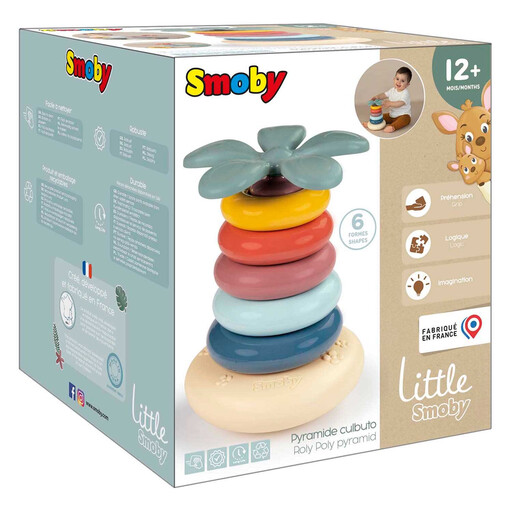
Why this choice suits this profile: This compact toy, usable from 12 months, lets you start with stacking and handling without installing a large structure in your home.
Its progressive use and compact size mean you don’t have to invest in a bulky structure straight away.
Mobile rounded base, five coloured rings and a rotating top element. No batteries required.
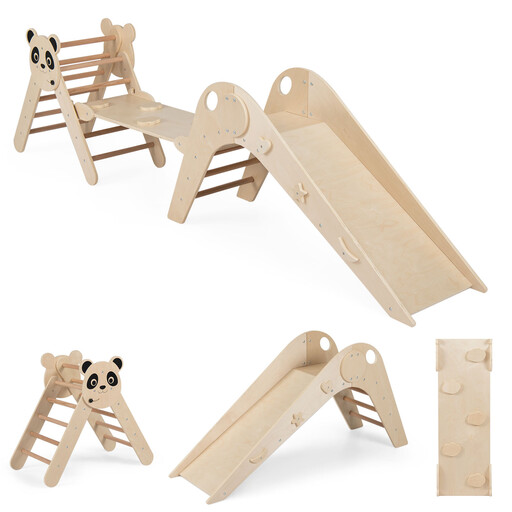
Why this choice suits this profile: This wooden set offers several configurations for families who want to create a proper indoor play area for children from 3 years old.
The triangle folds for easy storage, and the set isn’t limited to a single activity: ramp, tunnel and bridge are all included.
Beech wood and plywood, smooth handles and edges, stated capacity of 50 kg per element.
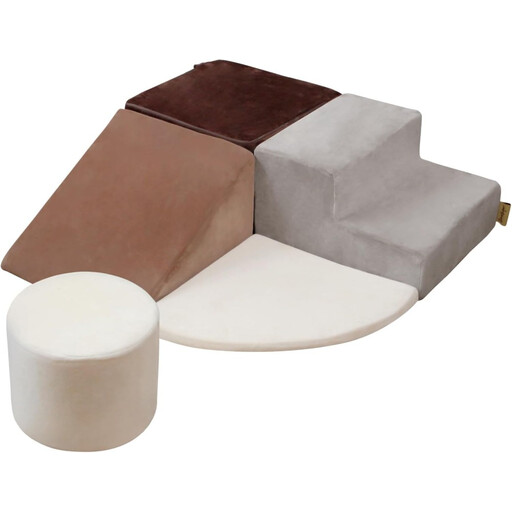
Why this choice suits this profile: Early years professionals and families looking for a modular space can create courses, tunnels and climbing zones indoors.
The removable, washable covers make hygiene simple, while the hook-and-loop fasteners and non-slip bases keep the blocks in place.
High-density foam, five shapes, machine-washable covers and EN71 compliance stated by the manufacturer.
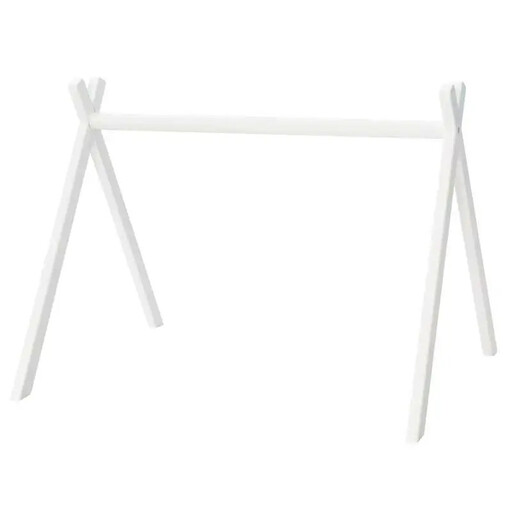
Why this choice suits this profile: This arch is suitable for babies from 3 months for grasping and observation activities, without offering climbing intended for older children.
Its use is completely different from a children’s climbing frame: it’s a sensory support to place on a flat surface, under supervision.
Lacquered white wood, dimensions 52 × 70 × 50.5 cm and surfaces that can be cleaned with a damp cloth.
We’ve put together a complete, real-time updated selection of products that meet these demanding criteria and European safety regulations.
At 12 months, it’s best to start with a compact motor toy that encourages handling, stacking and simple movement. A structure with height, a ramp or a bridge must match your child’s motor skills and should always be used under direct supervision.
Place it on a flat, clear, non-slip floor. Follow the assembly instructions carefully and check the fixings before each session. Move furniture with sharp corners or hard surfaces out of the way. A mat can complement the setup, but it doesn’t replace the precautions recommended by the manufacturer.
It all depends on the materials, how often it’s used, the weight it supports and how well it’s maintained. Regularly inspect the screws, seams, foam, ropes and fastenings. Immediately remove any element that shows cracks, deformation or loosening.