
Livraison le jour même ou le lendemain

Qualité garantie

Débloquez vos offres de bienvenue: Livraison GRATUITE | Jusqu'à -80 % | 30 jours d'essai gratuits à JoyPlus
Téléchargez l'application
A Montessori climbing frame for children can create a stimulating play area at home, in a nursery or in a playroom. Climbing triangles, Montessori activity arches, soft blocks and combined obstacle courses: there is no shortage of formats. However, marketing claims alone do not always make it easy to choose wisely.
Before you buy, three common pitfalls are worth keeping in mind:
Here are the criteria to consider when comparing a folding climbing triangle, a wooden climbing toy or a baby motor-skills course.
The age given by the manufacturer is a guide, not permission to let your child play unsupervised. For a 3-month-old baby, a Montessori activity arch designed for reaching out and observing suspended elements meets a different need from a climbing toy designed for a child aged 3 to 7.
In particular, check:
For very young children, a motor-skills toy should be placed on a flat, clear and suitable surface. Older children can enjoy a course with a ramp, net or ladder, provided that every accessory is securely fixed in place.
A climbing frame should minimise unexpected movement. Look for a sufficiently wide base, sturdy handrails, well-fitted joints and completely smooth surfaces.
A wooden climbing toy is appealing because of its natural look, but the material alone does not guarantee safe, practical use. Solid beech wood, plywood, painted finishes or treated metal: whatever the material, the product details should specify the dimensions, maximum weight and care instructions.
For foam motor-skills blocks, check the density, whether the underside is non-slip, how the modules are attached to one another and whether the cover can be removed. The EN71-1, EN71-2 and EN71-3 markings refer to European requirements covering, among other things, mechanical properties, flammability and the migration of certain substances. They should be verifiable in the product documentation: do not simply infer them from the toy’s appearance.
Measure the available space before ordering. An indoor play area for children should leave clear space around the structure so that your child can climb up, climb down and move around without bumping into furniture.
A folding model can be particularly practical in a flat or shared bedroom. By contrast, a 150 × 142 × 146 cm metal structure requires a more spacious room or a suitable outdoor location. Versatility is valuable when transformations are simple: a triangle that can accommodate a ramp, tunnel or motor-skills bridge offers several possibilities without requiring multiple purchases.
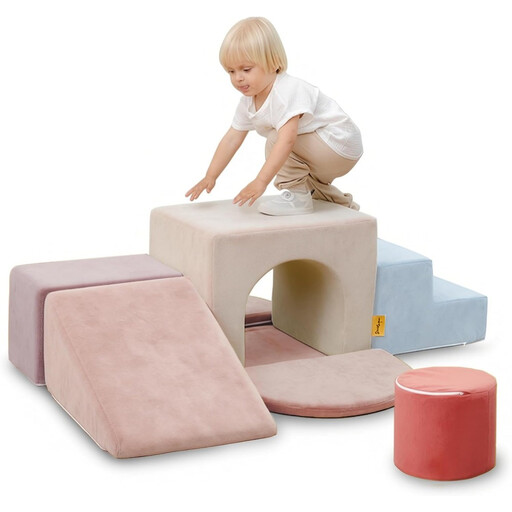
Why this choice suits this profile : This set of seven blocks is ideal for families who want to start gradually with a modular course, without permanent installation. The modules can be used for climbing, crawling, building a tunnel or creating a course in a bedroom.
The removable, washable covers make cleaning easier. The non-slip underside and hook-and-loop fasteners are presented as ways of keeping the modules together.
High-density polyurethane foam, seven pieces, machine-washable covers and no assembly required. The product details state compliance with the EN71 standards mentioned.
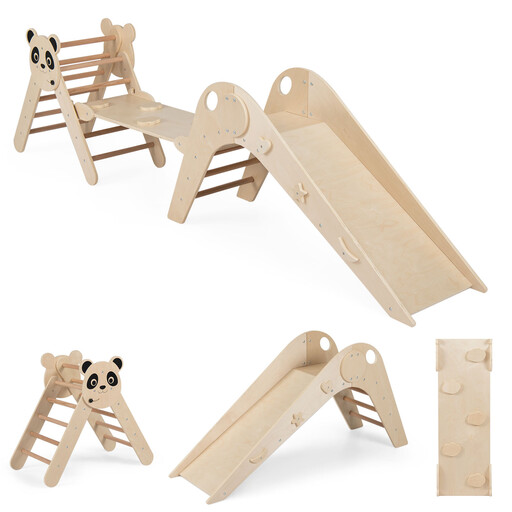
Why this choice suits this profile : This wooden set is designed for families looking for an adaptable structure that can be reconfigured and remain in place for years in a playroom.
The triangle folds away for easier storage. The product details mention smooth edges, handrails and handles: all important points to check before assembly.
Solid beech wood and plywood, triangle, slide that can also be used as a tunnel, and balance bridge that converts into a ramp. The stated load capacity reaches 50 kg per element.
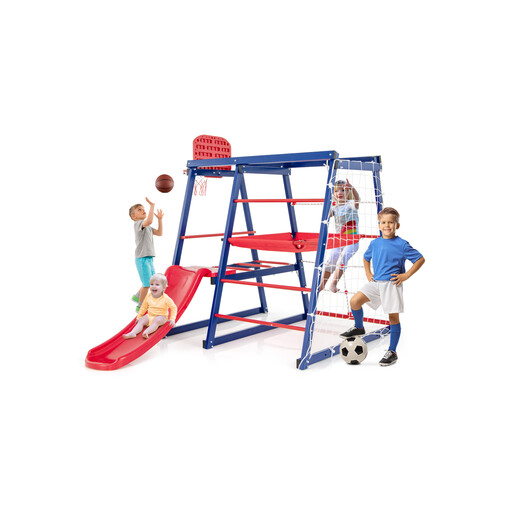
Why this choice suits this profile : Its seven activities in a single structure make it suitable for a large playroom, frequent family use or a properly arranged indoor and outdoor space.
The product details specify the dimensions, the metal frame’s rust resistance, the joints and the thickness of the cotton ropes. This information is more useful than a simple promise of versatility.
Slide, net, ladder, rope ladder, basketball hoop and two platforms. The stated age range is 3 to 7 years and the stated load capacity reaches 100 kg.
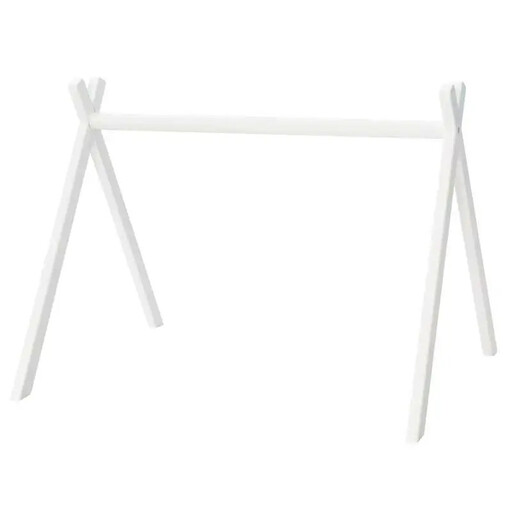
Why this choice suits this profile : This arch is designed for families looking for a compact first activity space for a baby, rather than a climbing frame intended for a child who is already independent.
The recommended age of 3 months and up helps prevent choosing a climbing triangle too soon. The product details recommend a flat surface, adult supervision and checking the components before every use.
Dimensions of 52 × 70 × 50,5 cm, white lacquered wood, easy-to-wipe surfaces and assembly described as simple. Compatible accessories are sold separately.
We have put together a complete, real-time updated list of products that meet these exacting selection criteria, as well as European safety regulations.
Not necessarily. An activity arch may be suitable from 3 months, depending on its product details, while a climbing triangle or a structure with a slide may be designed for children aged 3 and over. Always read the minimum age, warnings and conditions of use. Adult supervision is still recommended during play.
It depends on your child’s age and weight, how often it is used and how well it is maintained. An adaptable model, such as a triangle fitted with a ramp and bridge, can support several stages of motor development. Regularly inspect the screws, handles, stitching, ropes and surfaces. Stop using the structure as soon as any component becomes loose or damaged.
The budget does not always end with the price of the toy. It may include a protective mat, compatible accessories, storage solutions or replacement parts. Folding models reduce the amount of space required, while blocks with washable covers make everyday care easier. Before ordering, also check the assembly required and the dimensions of the parcel.