
Livraison le jour même ou le lendemain

Qualité garantie

Débloquez vos offres de bienvenue: Livraison GRATUITE | Jusqu'à -80 % | 30 jours d'essai gratuits à JoyPlus
Téléchargez l'application
For any parent or grandparent, nothing is more rewarding than watching a child explore the world with confidence and curiosity. Inspired by the Montessori method, an activity gym is a valuable tool for supporting their development at home. But with an overwhelming number of options available, it's easy to make the wrong choice and regret your purchase. Here is our guide to help you navigate the options and select the perfect one for your child.
Before you commit, watch out for these three pitfalls that can turn a promising purchase into a bulky piece of furniture that's quickly abandoned.
To ensure you're making a sound investment, focus on these three essential criteria.
This is the number one criterion: safety. Look for products that explicitly mention their compliance with the European standard EN71. This standard is divided into several parts, the most important of which for this type of toy are:
A quality Montessori wooden toy is recognisable by its sturdy wood (beech, birch), rounded edges, and perfectly smooth finish. For foam activity blocks, check that the foam is high-density and that the covers are durable and washable.
A good Montessori activity gym should be able to grow with your child. Modular systems are the ones that will last the longest. Consider elements that can be used alone and then combined:
This versatility renews the child's interest and adapts to their motor skill development.
Before buying, take out your tape measure and measure the available space. Opt for foldable or easy-to-disassemble models if you're short on space. Weight is also a factor to consider: wooden structures are very stable but heavier, while foam modules are lightweight and easy for a child to move themselves, which promotes their autonomy.
To move from theory to practice, here's how these criteria translate into a few products suited for different ages and needs.
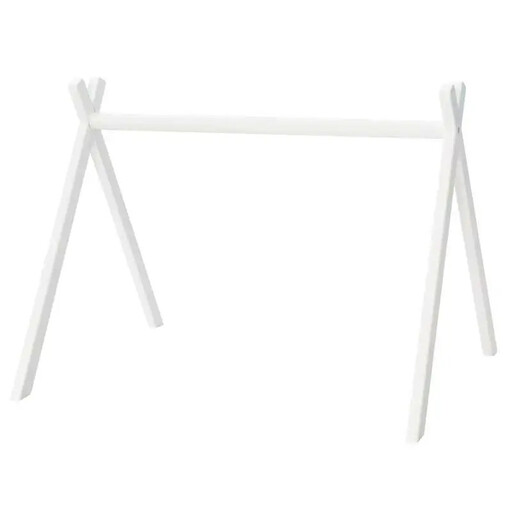
Why we chose it: Perfect for the first few months, this activity arch stimulates hand-eye coordination and encourages the baby to touch and grasp hanging toys (sold separately), all while lying down.
Specifically designed for infants, it avoids the "one-size-fits-all" trap. Its function is targeted and perfectly suited to the first phase of motor development.
Simple, lacquered wood structure that is easy to assemble and maintain. It provides a neutral frame for hanging various sensory toys, which can be changed as the baby grows.
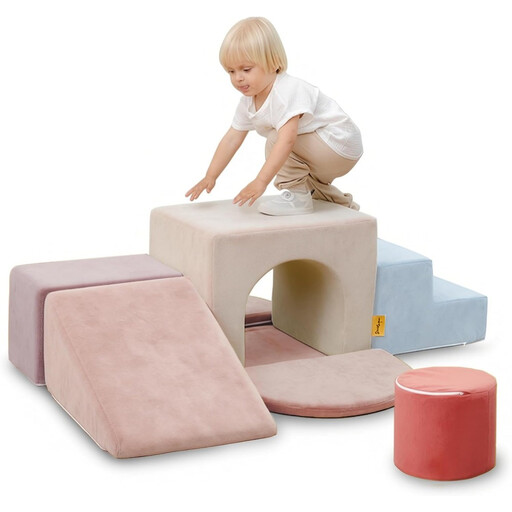
Why we chose it: Perfect for families who prioritise safety and creative freedom. This 7-piece foam block set allows for building endless courses, forts, or slides, all without the risk of bumps.
It checks two essential boxes: safety (EN71 certification) and modularity. The lightweight blocks can be reconfigured endlessly, ensuring a very long playful lifespan.
Removable, machine-washable covers for impeccable hygiene. The non-slip base and hook-and-loop fasteners ensure the stability of the constructions.
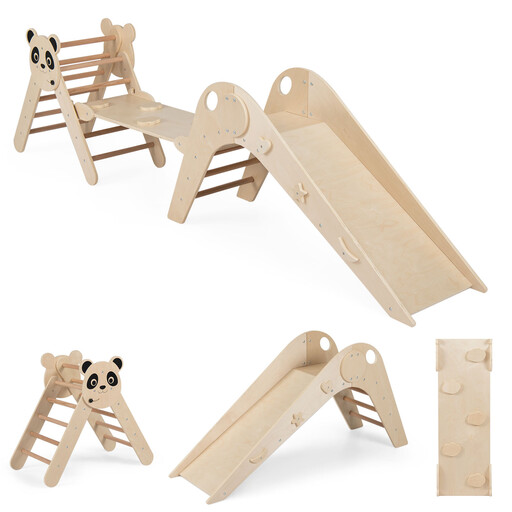
Why we chose it: A true mini indoor playground. This complete set with a climbing triangle, slide, and balance bridge is aimed at older children (from 3 years) who need to channel their energy.
It solves the space problem: the triangle is foldable and stores easily against a wall. Its solid beech wood design with smooth edges checks all the safety boxes.
A highly versatile 3-in-1 set that promotes balance, coordination, and strength. The playful panda-themed design is an excellent invitation to create stories.
We have curated a complete selection of products that meet these criteria for safety and quality.
It all depends on the type of equipment. An activity arch can be used from the very first months. A Pikler Triangle is often recommended around 6-8 months, when a baby starts trying to pull themselves up. More complex structures are generally intended for children aged 2 or 3 and older. Always follow the manufacturer's recommended age.
Always install the equipment on a flat, stable surface, away from furniture with sharp corners. Placing a soft play mat underneath is highly recommended to cushion any potential falls. Adult supervision remains essential, especially with younger children.
There is no single best choice, as they meet different needs. A Montessori wooden toy like a climbing triangle is perfect for developing strength and agility. Foam activity blocks, which are lighter and softer, are ideal for creative building and quiet play. The final choice depends on your child's age, temperament, and the space you have available.